How Teams Read ERS Harvesting Mid-Race
How race engineers balance ERS recovery, deployment, limits and lap-time cost to make mid-race telemetry calls.
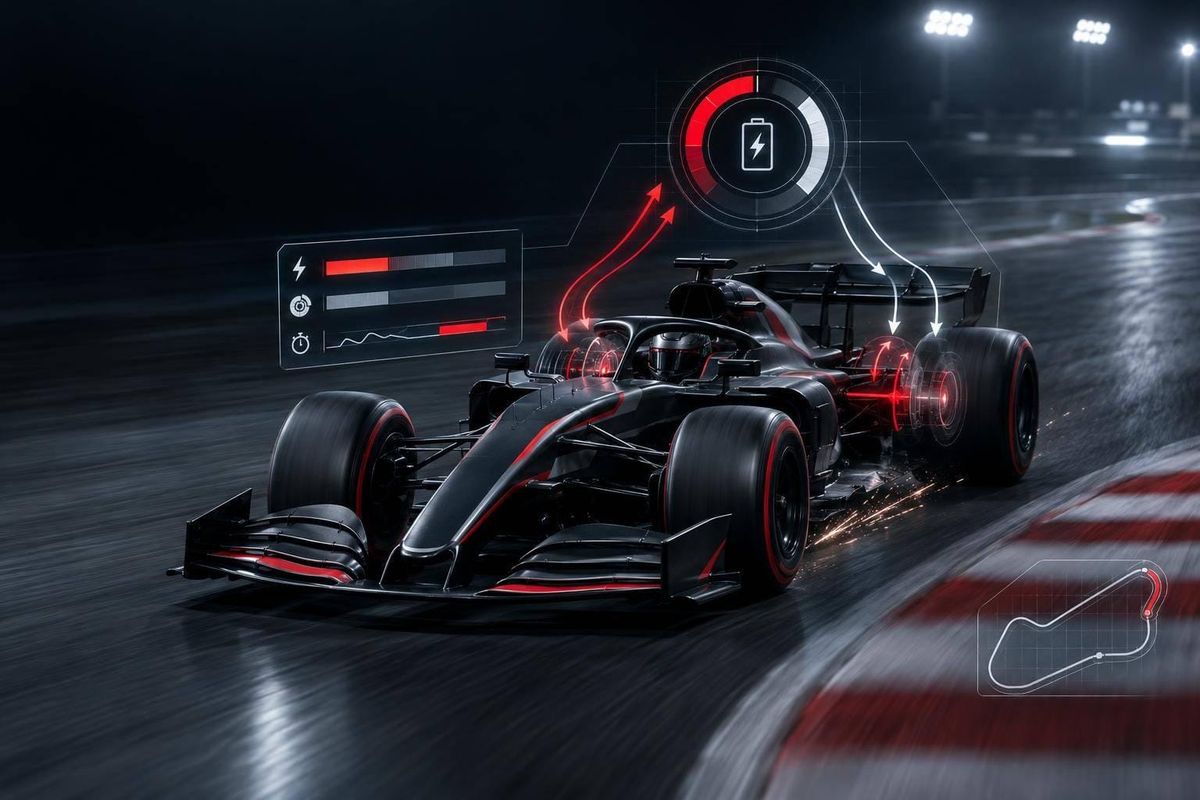
More harvested energy doesn’t always mean better race pace. When I review ERS data, I compare recovery, deployment, and stored charge with lap times - and check whether the car can support the next 1–3 laps.
Here’s what I look for before turning those traces into a radio call:
- Energy balance: Is charge rising because recovery increased, or because deployment fell?
- Limits: Do the current FIA rules, temperatures, and electrical limits allow the change?
- Pace cost: Will extra energy later repay the time lost now?
- Results: Do driver feedback and the next lap confirm that the adjustment worked?
My rule: <u>judge the call by usable energy and lap time</u>, not charge alone.
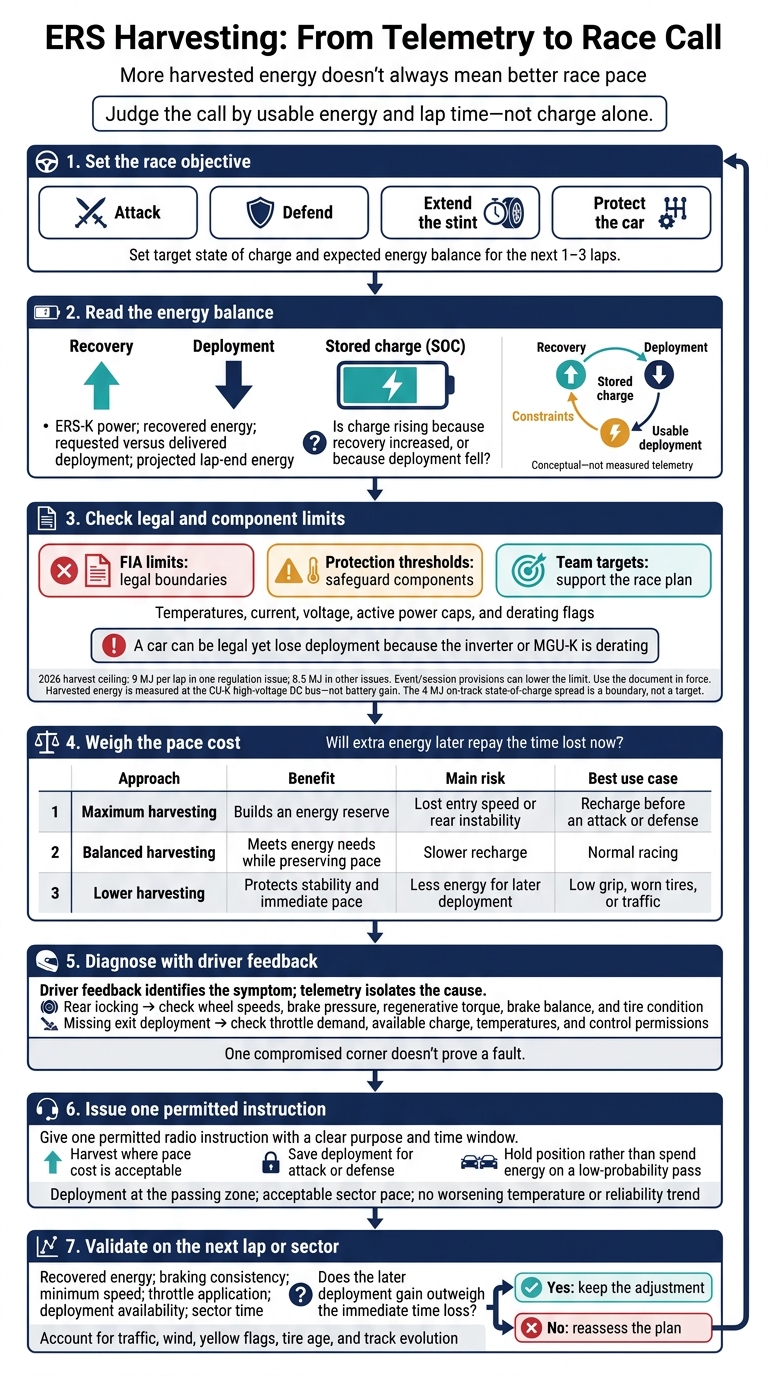
ERS Harvesting: From Telemetry to Race Call
Tools for Tracking ERS Harvesting
Once engineers know what to watch, the live screen needs to put ERS data in race context. Dashboards combine electrical data, timing data, and lap simulations. The FIA Standard ECU and data logger support live monitoring and post-session review; the logger must retain at least 2 hours 15 minutes of race or Sprint data. Lap delta, gaps, tire age, and projected next-lap position should sit beside the energy traces.
Key Signals and Trace Overlays
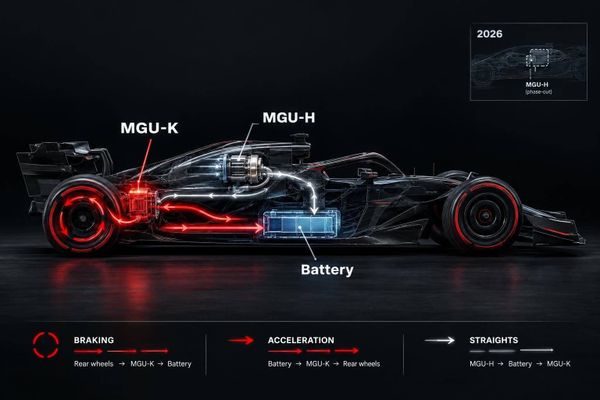
The main overlay compares ERS-K power, recovered energy, SOC, and requested versus delivered deployment against speed, brake pressure, and temperatures. Current and voltage help pinpoint a shortfall. But before treating a deployment gap as a system fault, engineers should also check wheel slip, thermal protection, and the overall energy-management plan.
An annotated energy-and-speed graphic should mark braking zones, deployment starts, and overtaking opportunities. Use mph alongside km/h so speeds are clear to US readers. Mark coasting and partial-throttle recovery, too: the 2026 recovery framework includes coasting and throttle operation. Adding projected lap-end energy shows where the current plan could leave a shortfall. That view then helps shape the radio call.
From Data Review to Driver Instructions
Engineers then separate energy management from pure pace trade-offs. Performance and power-unit engineers assess recovery, temperatures, and delivery limits. Strategy engineers weigh traffic, pit windows, and chances to overtake or defend. They compare the stint with simulations updated for fuel load, tire condition, and track state.
A recovery deficit doesn't automatically mean “harvest more.” Timing data must show whether extra recovery would cost an immediate overtaking opportunity. Engineers can call for harvesting where the pace cost is acceptable, save deployment for an imminent attack or defense, or hold position instead of spending energy on a low-probability pass.
A rival’s energy state is inferred, not read directly. Speed traces, sector times, acceleration onto straights, repeated deployment patterns, braking behavior, and lap-time changes help engineers decide whether to attack or defend.
sbb-itb-7c68254
ERS Limits During a Stint
Once the traces are aligned, engineers check whether the stint stays within legal and thermal limits.
Measuring the 2026 Harvesting Ceiling
The applicable FIA regulation issue, event provisions, and session type determine the ceiling. One issue of the 2026 Power Unit Technical Regulations sets ERS-K harvested energy at 9 MJ per lap, measured at the CU-K high-voltage DC bus. Other issues set 8.5 MJ, while event-specific provisions can lower the limit for selected competitions or sessions. Engineers must use the document in force - not assume one number applies everywhere.
That figure measures harvested energy at the bus, not battery gain. A short recovery spike can still yield a modest lap total. Engineers therefore compare integrated bus energy with the net change in Energy Store charge.
Rules, Hardware Thresholds, and Energy Targets
The live review has three layers: FIA limits set the legal boundaries, protection thresholds safeguard components, and team targets support the race plan.
| Limit type | Setting authority | Relevant telemetry | Response when approached |
|---|---|---|---|
| FIA lap harvest limit | FIA regulations and event/session provisions | CU-K bus harvested energy; cumulative MJ per lap | Reshape recovery to stay within the applicable allowance. |
| FIA power/energy limits | FIA technical regulations | MGU-K power; Energy Store state of charge and boundaries | Cap power or adjust recovery and deployment to stay compliant. |
| Thermal/electrical protection thresholds | Power-unit and battery-control systems | Battery, inverter, and MGU-K temperatures; current; voltage; derating flags | Reduce recovery or deployment; adjust cooling or control settings. |
| Team targets | Race-engineering strategy group | State of charge against target; deployment reserve; projected energy demand | Change energy spending or delay an attack. |
These limits tell engineers when to ease recovery, hold deployment, or protect the battery.
Upper headroom is the recovery margin left before reaching a usable-energy ceiling, acceptance limit, or thermal limit. Lower reserve is energy saved for the next attack, defense, or restart. Neither is the same as SOC. Exact protection thresholds and SOC windows vary by team.
Engineers track temperature trends and active power caps alongside remaining charge. A car can be legal yet lose deployment because the inverter or MGU-K is derating. Temperature, current, and voltage help engineers decide whether to harvest more or preserve deployment. Unused harvesting allowance cannot create braking opportunities or make a hot battery accept more energy.
That check informs the next call: whether extra harvesting is worth the lap-time cost.
Weighing Harvesting Gains Against Race Pace
When Extra Harvesting Is Worth the Cost
Recovering more energy pays off only when using it later makes up for the pace lost now. Lifting earlier or changing regenerative braking can reduce entry speed, unsettle the rear tires, or limit traction. Those trade-offs shape the three harvesting modes below.
| Approach | Benefit | Main risk | Best use case |
|---|---|---|---|
| Maximum harvesting | Builds an energy reserve | Lost entry speed or rear instability | Recharge before an attack or defense |
| Balanced harvesting | Meets energy needs while preserving pace | Slower recharge | Normal racing |
| Lower harvesting | Protects stability and immediate pace | Less energy for later deployment | Low grip, worn tires, or traffic |
Engineers check engine-map settings and compare requested recovery with measured recovery. Repeated mismatches under the same conditions suggest a problem; one compromised corner doesn’t prove a fault. When the pattern repeats, driver feedback helps narrow down the cause.
Using Driver Reports to Check the Diagnosis
Once engineers confirm a pace loss, they need to separate what the driver feels from what the system is doing. Driver feedback identifies the symptom; telemetry isolates the cause.
Rear locking prompts checks of wheel speeds, brake pressure, regenerative torque, brake balance, and tire condition. Entry instability also requires a look at steering and yaw traces, plus wind, grip, and traffic. If deployment is missing on exit, engineers check throttle demand, available charge, temperatures, and control permissions at that location. The report alone doesn’t prove an ERS failure.
Checking Whether an Adjustment Worked
Engineers locate the deviation and compare it with simulation and recent laps that reflect the conditions. They then use the driver’s report to choose a permitted adjustment or a lift-and-coast instruction. Formula 1’s official explanation says preloaded engine maps usually control harvesting, with driver override where permitted.
That check guides the next radio call, and the next lap or sector tests the change. Engineers compare recovered energy with braking consistency, minimum speed, throttle application, wheel slip, deployment availability, and sector time. They also account for traffic, wind, yellow flags, tire age, and track evolution. Keep the adjustment only if the later deployment gain outweighs the immediate time loss.
Turning an ERS Review Into a Race Call
The Review Sequence
Once the traces and limits are clear, turn the data into a race call. Start with the objective: attack, defend, extend the stint, or protect the car. Set the target state of charge and expected energy balance for the next 1–3 laps. Compare recovery and deployment with that plan, then check regulatory, thermal, electrical, and reliability limits.
Next, weigh the lap-time and tire cost. Turn the trace review into one permitted radio instruction with a clear purpose and time window. Before making the call, define success: deployment at the passing zone, acceptable sector pace, and no worsening temperature or reliability trend.
The data behind the call also sets its limits.
What the Evidence Can Show
Recovered energy isn’t the same as usable energy for the next move. The FIA’s 2026 on-track state-of-charge spread of 4 MJ is a boundary, not a target.
Issue the instruction only if the energy balance supports the planned move within the limits in force.
FAQs
How do engineers distinguish ERS faults from planned energy saving?
Engineers compare real-time Energy Recovery System (ERS) telemetry with expected performance models. They check battery charge, energy flow, and deployment efficiency, alongside driver feedback and race strategy instructions.
Planned energy saving shows up as data that matches the selected energy mode or requested coasting. Unexpected changes in power output or thermal performance prompt an immediate diagnostic review for possible mechanical or electrical faults.
How do ERS limits affect mid-race strategy changes?
ERS limits mean teams must balance energy used for overtaking or protecting a position against caps on storage and output. Engineers track battery charge and how efficiently energy is deployed in real time to stay within those caps.
If a driver uses energy too fast, the team may switch to a conservation mode or adjust the harvesting profile. If a rival struggles to balance energy use, the team may deploy more energy to try to overtake.
What happens when driver feedback conflicts with ERS telemetry?
Race engineers use telemetry and driver feedback together. Telemetry tracks battery charge, temperatures, and energy deployment. Driver feedback adds context about how the car handles and delivers energy.
Engineers check live data against radio reports. If a driver reports a problem but the readings look normal, they investigate possible mechanical damage or sensor faults. Both inputs help engineers choose ERS modes, plan energy use, or, in severe cases, bring the car into the pits.