Lenovo and F1: E-Waste Program Review
Analyzes Lenovo’s Formula 1 asset-recovery claims, highlighting missing device outcomes, chain-of-custody, and emissions reporting.
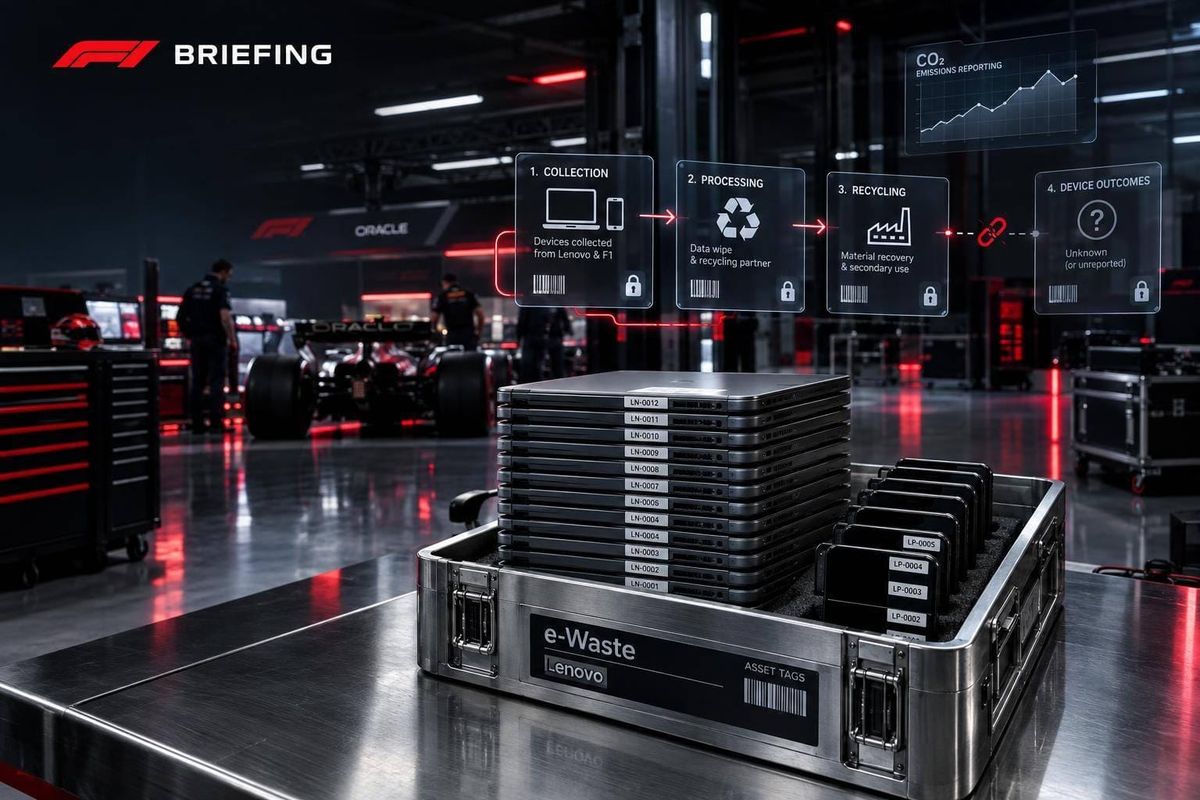
My take: Lenovo’s F1 recovery services are documented, but the results need more proof. I would not treat the cited 95% asset disposition rate or 800-plus recovered devices as verified results without a reporting period, equipment scope, and records showing where each device went.
I focus on what you can check:
- Scope: Central Formula One systems - not individual teams unless their participation is confirmed.
- Race readiness: How returns, repairs, and replacements fit between races.
- Recovery routes: Reuse, repair, parts recovery, and recycling, compared by timing, security, retained value, and resource use.
- Accountability: Asset tracking, data removal, costs, and measured energy or emissions results.
My bottom line: <u>counting collected devices is not enough</u>. I want to know what returned to service, how long it stayed in use, and what happened to the rest. Lenovo’s repair and refurbishment options show what could be done, not what F1 has confirmed doing.
Hardware Use and Race-Weekend Returns
Devices, Locations, and Failure Response
Hundreds of terabytes move between trackside operations and the UK-based Media & Technology Centre during a single race weekend. That data supports real-time telemetry, race operations, and global broadcasting.
At that scale, reliability and the ability to recover from failures guide hardware deployment and replacement decisions. Teams need to assess failed or aging devices fast, so return speed and asset recovery matter alongside uptime.
Device Collection Between Races
Public reporting does not explain how failed or retired devices are returned, or how Lenovo fits those returns into freight and customs schedules. Timing matters: it affects whether hardware can be repaired, put back into use, or retired before the next race.
Hardware Lifecycle Diagram
The diagram below separates documented steps from return and recovery details that remain unverified.
[D] Lenovo provisioning → Trackside and UK M&TC use
                                      ↓
[U] Return → Triage → Repair/redeployment,
                     parts recovery, or recycling

[D] Documented  [U] F1-specific implementation unverified
The program’s reported disposal results can help assess this unverified recovery path - specifically, how much hardware is recovered, repaired, or discarded.
sbb-itb-7c68254
Asset Recovery Services: Results and Reporting Gaps
Reported Results: 95% Asset Disposition and Over 800 Devices
What happened after those assets left service remains unclear. The source does not verify the reported 95% asset disposition rate or the claim of more than 800 recovered devices. It also leaves out the reporting period, equipment scope, and denominator.
“Asset disposition” does not explain where the equipment ended up. Without supporting reports, these figures cannot establish repair, reuse, or recycling rates. The recovery record should show which assets went to reuse, repair, parts recovery, or recycling.
Chain of Custody and Data Security
The issue goes beyond how many devices were recovered. Each asset needs a traceable record. The supplied evidence does not document Formula One-specific chain-of-custody records. A verifiable record would link each asset ID to every handoff, repair step, and final destination.
Missing Device, Cost, and Impact Data
The source leaves out retirement counts by device type, weights, destination mix, refurbishment totals, repair yields, parts-recovery yields, recycler details, and verified environmental outcomes. It also provides no verified resale value, credits, or cost savings for Formula One.
How Lenovo Asset Recovery Services Turn Old Laptops into New Budget | Outcomes in Action
Repair, Parts Recovery, and Race Readiness
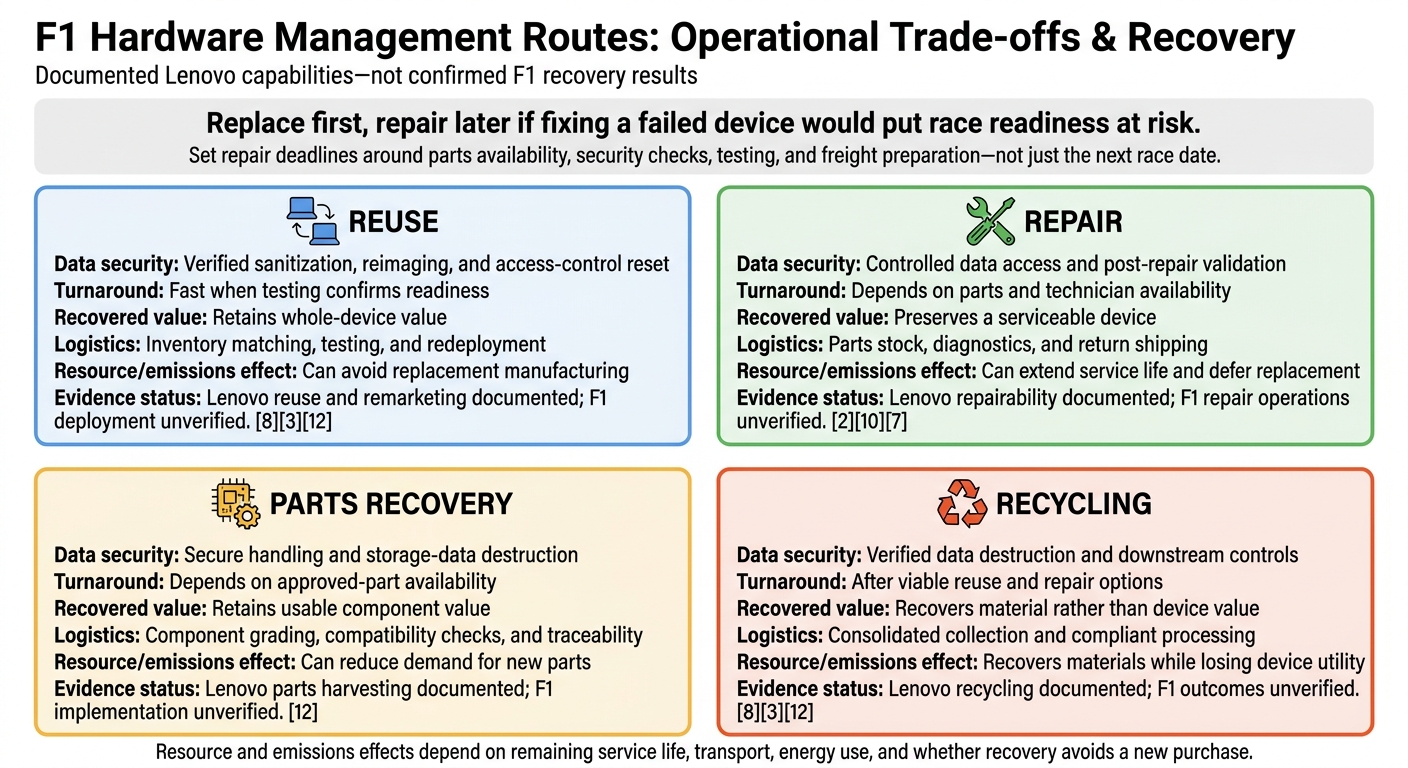
F1 Hardware Recovery: Four Routes Compared
When hardware leaves service, the goal is to keep F1 race-ready without discarding equipment that still has use.
Repairability and Second-Life Equipment
Replace first, repair later if fixing a failed device would put race readiness at risk. Back-office devices can usually wait longer than trackside or media systems.
In 2024, iFixit gave the Lenovo ThinkPad T14 Gen 5 a provisional repairability score of 9/10. Lenovo lists 9.3/10 for some configurations, but the ratings aren't directly comparable.
Lenovo identifies the battery, memory, SSD, keyboard, and WWAN module as user-replaceable parts. Its Certified Refurbished offering covers both PCs and servers. These are Lenovo capabilities - not documented Formula One use.
For F1, those options only work if equipment returns in time for paddock deadlines. Set repair deadlines around parts availability, security checks, testing, and freight preparation - not just the next race date.
Comparing Reuse, Repair, Parts Recovery, and Recycling
The table compares four recovery routes by how well they fit F1 needs: speed, retained value, and security requirements. Each route's resource and emissions effects depend on remaining service life, transport, energy use, and whether it avoids a new purchase.
| Route | Data security | Turnaround | Recovered value | Logistics | Resource/emissions effect | Source status |
|---|---|---|---|---|---|---|
| Reuse | Verified sanitization, reimaging, and access-control reset | Fast when testing confirms readiness | Retains whole-device value | Inventory matching, testing, and redeployment | Can avoid replacement manufacturing | Lenovo reuse and remarketing documented; F1 deployment unverified. |
| Repair | Controlled data access and post-repair validation | Depends on parts and technician availability | Preserves a serviceable device | Parts stock, diagnostics, and return shipping | Can extend service life and defer replacement | Lenovo repairability documented; F1 repair operations unverified. |
| Parts recovery | Secure handling and storage-data destruction | Depends on approved-part availability | Retains usable component value | Component grading, compatibility checks, and traceability | Can reduce demand for new parts | Lenovo parts harvesting documented; F1 implementation unverified. |
| Recycling | Verified data destruction and downstream controls | After viable reuse and repair options | Recovers material rather than device value | Consolidated collection and compliant processing | Recovers materials while losing device utility | Lenovo recycling documented; F1 outcomes unverified. |
Computing Efficiency and Hardware Replacement
The cited workstation-replacement example lacks enough detail to verify the workload, configuration, or efficiency gain, so it should not be presented as a measured result.
Consolidation and EPEAT status do not establish measured emissions savings. To assess a replacement, compare device counts, measured power draw, performance, redundancy, spare requirements, service incidents, and useful service life before and after the change.
Conclusion: Recovery Results and Reporting Limits
Public disclosures confirm Lenovo’s lifecycle services for Formula 1’s central operations, but not for individual racing teams. A disposal rate or device count alone doesn’t show repair, reuse, or emissions results - or explain how recovery supports race-week reliability. How the results are reported matters as much as the totals.
What Future Reports Should Measure
Future reports should give recovery totals more context. Report collection, reuse, repair, parts recovery, and recycling separately. Use individual asset records to avoid counting a device twice when it’s repaired and later redeployed. Clearly distinguish devices collected, devices repaired, and devices returned to service. Every figure should state its reporting period, denominator, and scope of operations.
Reports should also include device categories and verified data sanitization. Energy or emissions claims need a stated baseline, calculation method, and evidence that can be independently supported - not just a disposal percentage.
Key Lessons for F1 Hardware Management
For race-week operations, speed matters only when custody and traceability remain intact. Secure returns, fast redeployment, reliable replacements, and an auditable chain of custody must work together. Custody records should follow each asset to its final destination. Redeployment dates and additional months in use should show whether recovery extends device life.
These controls improve hardware management even when team-level participation remains unverified. Electronics recovery addresses only one part of Formula One’s overall resource use and emissions.
FAQs
How could F1 verify Lenovo’s e-waste results independently?
F1 could use established industry benchmarks to track hardware from deployment through disposal or recovery. It could require Lenovo to submit audited reports that link retired equipment to recycled materials and account for recovered components through verified secondary markets.
F1 could then check those reports against its internal inventory records and third-party environmental certifications to verify accuracy and measure progress toward sustainability targets.
When is replacing F1 hardware greener than repairing it?
In Formula 1, replacement can be the greener - or required - choice when repairs can’t resolve the risk of failure in mission-critical hardware. Reliability and safety come first.
Teams like McLaren are working toward a fully circular car by 2030, using recycled carbon fiber and material tracking. For now, recycled materials are used only in non-structural components. Critical parts, such as the monocoque, still need virgin carbon fiber to meet performance and safety standards.
How could customs delays affect F1 device recovery?
Customs delays can leave F1 computing equipment, servers, and employee devices stuck in transit when they’re due for refurbishment, parts recovery, or decommissioning. They can also slow the return of refurbished equipment to team use.
To maintain performance across race weekends, teams may have to rely on older, less efficient systems or buy more hardware. Both options can work against goals to reduce resource use and keep equipment and parts in use.