Driver Autonomy vs Team Control: F1 Pit Wall Guide
Breaks down pit wall strategy vs driver responsibility, FIA radio limits, team orders, and when drivers can override calls.
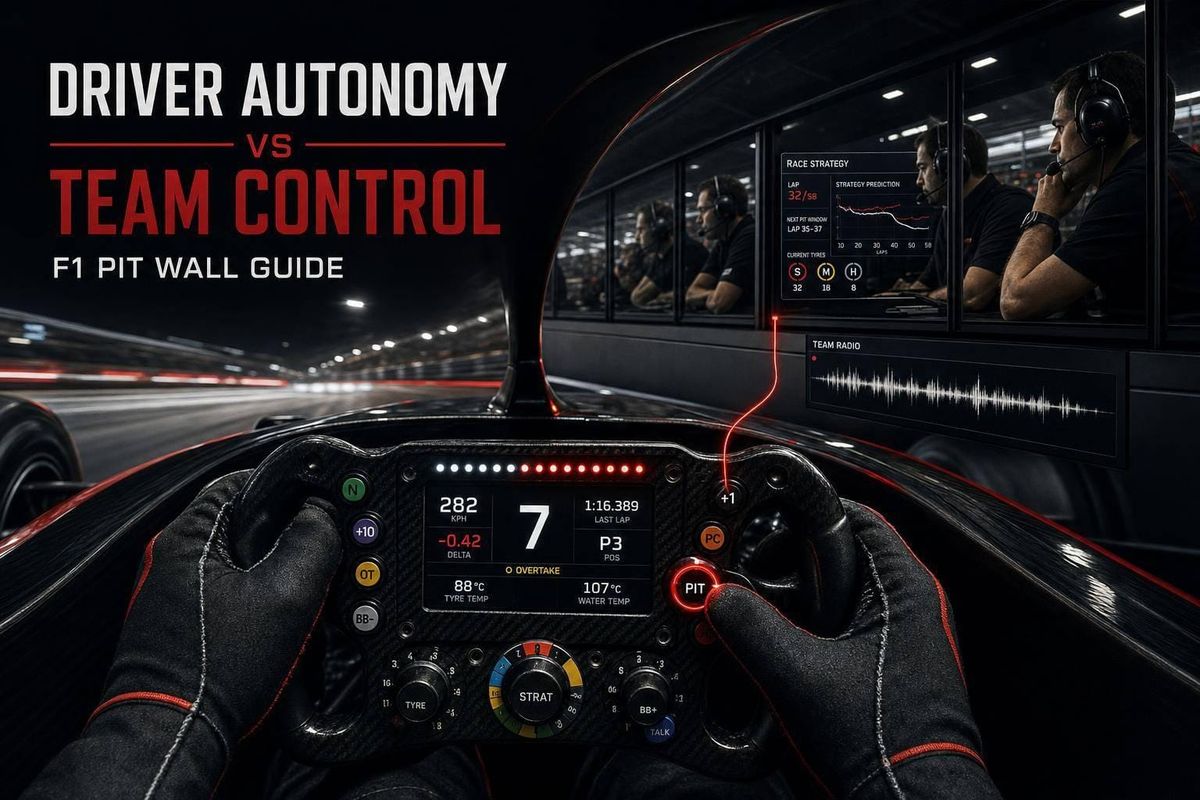
In F1, the team calls the race plan, but the driver still has to drive the car alone. That is the short answer.
If you want to read race radio the right way, here’s the split:
- The pit wall handles pit stops, tire use, fuel, engine risk, and team orders
- The driver handles grip, braking, visibility, wheel-to-wheel moves, and live safety calls
- The race engineer is the one voice between both sides
- FIA Article 27.1 says the driver must drive the car "alone and unaided"
- Teams can say "box this lap" or share gap and weather info
- Teams cannot give driving coaching like gear-by-gear or corner-by-corner instructions
- In July 2016, Nico Rosberg got a 10-second penalty after Mercedes radio advice crossed that line
- Since 2014, FIA radio limits have tried to stop teams from driving the car from the pit wall
If I boil the full guide down to one point, it’s this: the pit wall owns the big-picture call, and the driver owns the moment.
That is why driver pushback matters. Sometimes the model sees more. Sometimes the driver feels more. And when those two clash, race radio tells you who is trying to take control.
25 Years Of Legendary F1 Team Radio
sbb-itb-7c68254
Quick comparison
| Area | Team control | Driver control |
|---|---|---|
| Race plan | Pit window, tire plan, fuel use, engine care | Carrying out the plan |
| Live car feel | Limited to data and radio | Full feel through the wheel, pedals, and seat |
| FIA limit | Can inform | Must not coach the driving |
| Team orders | Can issue them | Can question them, but may still need to obey |
| Final role | Guide the race | Own the driving |
So when you hear a short radio call, I’d read it in one of three ways: strategy, fault management, or team order. If it starts sounding like the engineer is driving the lap, that is where the rule steps in.
Pit Wall Hierarchy: Who Makes the Call
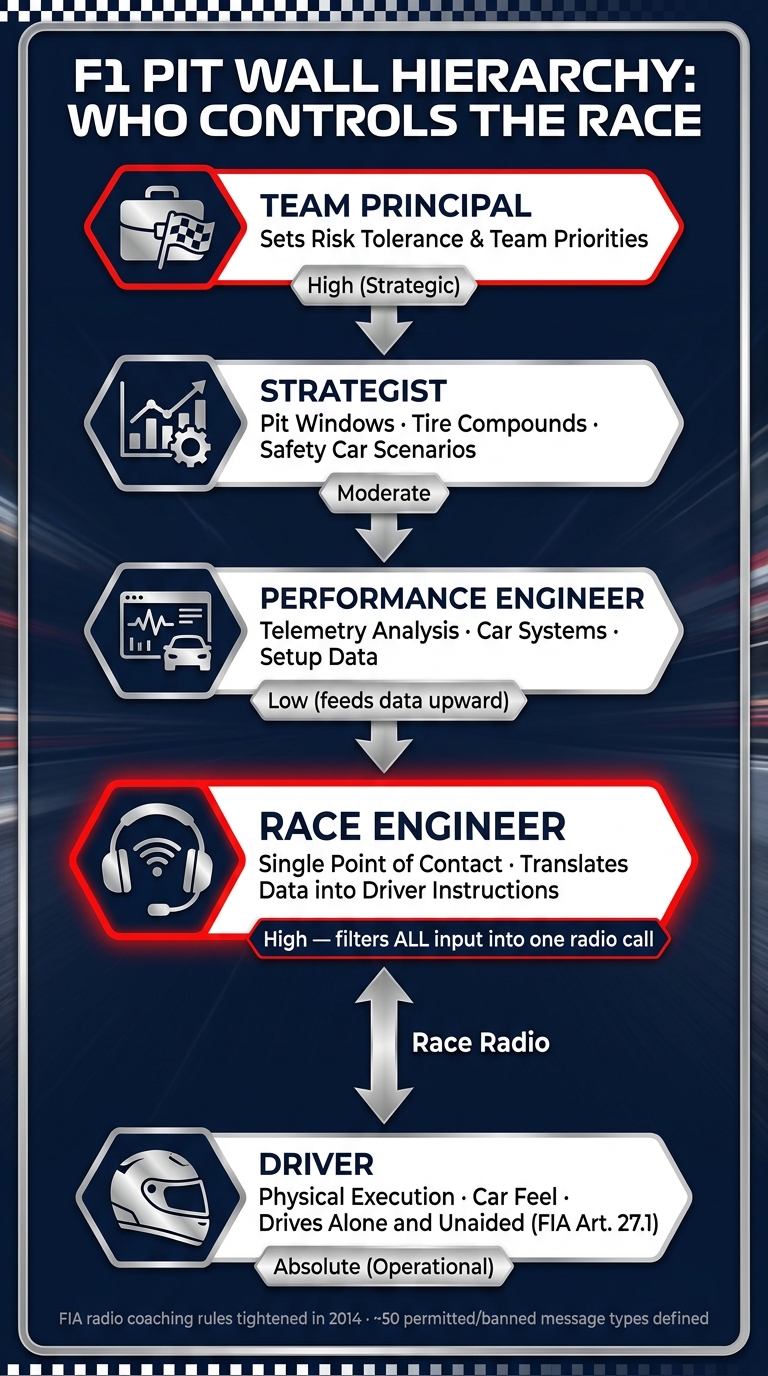
F1 Pit Wall Hierarchy: Who Controls the Race
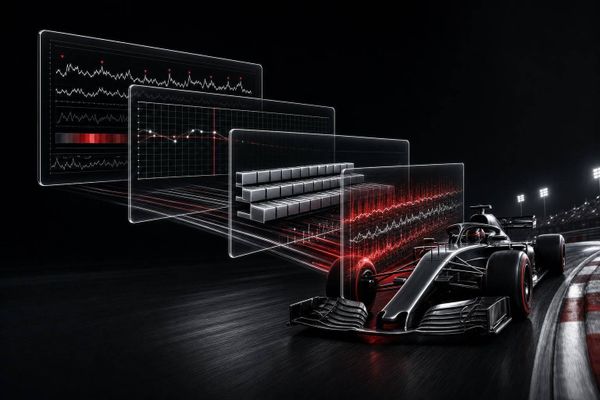
The pit wall runs on a clear chain of command. Each person owns a specific part of race management, and that setup explains why drivers get certain calls at certain moments. It’s the system that turns a flood of telemetry into one short radio message.
Race engineer, performance engineer, strategist, and team principal: what each role does
The race engineer is the driver’s main connection to the team. As TheF1DB puts it:
"The race engineer is the single point of contact between driver and team during a session. They translate telemetry into language the driver can act on."
That’s the voice the driver hears most. The race engineer gives pit calls, explains the plan, and helps keep the driver locked in. Behind the scenes, the performance engineer watches car systems and studies telemetry. They usually pass that information up to the race engineer instead of speaking straight to the driver.
The strategist builds the race plan before the lights go out. That includes pit windows, tire compound choices, and Safety Car odds. Then, as the race shifts, the strategist re-ranks the best options in real time. Above them all, the team principal sets the team’s appetite for risk and decides team priorities when strategy, points, or title aims pull in different directions.
| Role | Primary Responsibility | Influence on Driver Autonomy |
|---|---|---|
| Race Engineer | Single point of contact; translates data into driver instructions; keeps the driver focused | High - filters all incoming data into direct commands |
| Strategist | Scenario planning; pit windows; tire compound choices; Safety Car probabilities | Moderate - sets the plan, relies on the engineer to execute |
| Performance Engineer | Telemetry analysis; car system monitoring; setup changes | Low - feeds data to the race engineer, not the driver |
| Team Principal | Sets risk tolerance; sets final team priorities when strategy, points, or championship goals conflict | High (strategic) - decides overall team orders |
| Driver | Physical operation; car feel; final execution | Absolute (operational) - must drive "alone and unaided" |
Once that hierarchy is in view, the next step is seeing how a decision actually gets to the driver.
How decisions move from the strategy team to the cockpit
A call usually begins with strategy and reaches the cockpit through the race engineer. Before the race, the strategy group maps out scenarios like Plan A, Plan B, and Plan C, each tied to different pit windows and tire compound choices. During the race, the performance engineer watches live telemetry while the strategist tracks rival gaps and updates the option ranking.
When the team is ready to act, the race engineer strips the message down and sends it at the right moment - during a calmer part of the lap, not in the middle of a corner or deep in a braking zone.
Teams also rely on pre-agreed shorthand so they can move fast without flooding the driver with extra words. At the December 2021 Abu Dhabi Grand Prix, Red Bull race engineer Guillaume Rocquelin used the code "Plan F" on the final lap to Max Verstappen. That short call let Verstappen carry out a pre-agreed tactical move without needing a long explanation at high speed. In other words, shorthand turns radio into a trigger, not a speech.
Good radio is short on purpose: one instruction, one action. That matters even more once FIA radio limits come into play.
Rules and Limits: What Teams Can Tell Drivers
What radio guidance is allowed and what crosses the line
The FIA lets the pit wall share race data, but it does not let the team drive the car by radio. And because every instruction goes through the race engineer, the rule covers every message in that chain. So yes, telling a driver to push is allowed. But corner-by-corner coaching, or telling the driver exactly how to take a corner, crosses into illegal coaching.
The same idea applies to technical advice. Engineers can tell a driver to pick a default mode to recover from a sensor, actuator, or control fault, but only when that step brings the car back without giving it more pace than it had before the problem started. If the advice helps the driver get speed back, that is where the line gets crossed.
The 2016 British Grand Prix showed that line in plain terms. Nico Rosberg's 10-second penalty came from the coaching message, not the fault-fixing one. Fault recovery is allowed. Performance coaching is not.
How FIA communication rules changed and what they mean today
The FIA tightened its radio coaching rules in 2014, after hybrid power units made car management much more complicated. To spell out the boundary, it issued about 50 types of messages that were allowed or banned.
Today, engineers can still pass along data the driver can't sense on their own, like tire carcass temperatures and battery state-of-charge. Short coded messages are also allowed, but only when they stay inside those permitted limits.
That line starts to matter most when legal radio traffic starts sounding like a team order. At that point, the harder issue isn't just what the FIA permits. It's when the team can still overrule the driver.
Team Orders vs Driver Judgment: Where the Real Contest Happens
When team orders take priority over individual racing
Once radio coaching ends, the next issue is simple: who gets the last word on the race result?
Under FIA rules, team orders are allowed. A team can tell a driver to hold position, swap with a teammate, or follow a plan that helps the constructor's championship more than the driver's own finishing place.
That makes sense. The pit wall sees the whole board. It has the full race picture in front of it: fuel load, engine condition, time gaps, and championship points. The driver, by contrast, feels the car and reacts to the moment. So the real tension isn't whether the team can give the order. It's how far the driver can push back when that order clashes with what they feel on track.
Team orders can lock in points and protect the final result. But if a driver is asked to hold back too often, trust can start to fray between driver and engineer.
McLaren's "papaya rules" made that tradeoff easy to spot. Team control can protect points, but it can also dull a driver's natural race instinct. The same split shows up the other way around too, especially when the driver knows something right now that the pit wall hasn't picked up yet.
| Action | Obeying Team Orders | Asserting Driver Autonomy |
|---|---|---|
| Primary Goal | Maximize the team's championship points | Maximize the individual race result |
| Typical Scenario | Position swaps, holding station, yielding track position | Overriding a pit call because of tire feel or changing weather |
| Communication Style | Pre-agreed codes like "Plan F" or "papaya rules" | Questioning strategy calls or resisting pace instructions |
When drivers can push for their own call
Driver judgment matters most when conditions shift faster than the model can react. Grip changes. Brake feel changes. Traffic builds. Weather moves in. Sometimes all of that happens before telemetry shows the full story.
| Feature | Team (Pit Wall) Advantage | Driver (Cockpit) Advantage |
|---|---|---|
| Data Source | Real-time telemetry, GPS, and strategy software | Physical sensory input like steering weight, vibration, and G-forces |
| Scope | Global view of the entire field and pit windows | Immediate grip levels, brake pedal feel, and visibility |
| Resource Focus | Fuel flow, battery state, and engine health | Car balance and mechanical grip at the limit |
| Decision Basis | Mathematical models and historical probability | Instinctive racing and real-time track assessment |
This is the narrow space where driver input has real authority. If a driver says the rear feels nervous on corner entry, that message often reaches the team before the numbers fully back it up. If a driver says the tires still have life left when the model says otherwise, that's new information from the cockpit, not noise.
The best teams don't dismiss that kind of feedback. They treat it as a live signal. In those moments, driver judgment should beat the model.
Real cases of driver resistance and override pressure
The strongest driver pushback usually comes from one thing: a live read of the car and track that the pit wall does not have yet. The best driver-engineer pairings work because cockpit feel and pit wall data support each other instead of pulling in opposite directions.
That's the real test. The team sets the plan, but the driver still has to decide whether that plan matches the track at that exact moment. Race radio shows that tension better than anything else. It tells you when the pit wall should lead, and when the driver's feel for the car should overrule the plan.
Conclusion: Where Team Control Should Lead and Where Driver Autonomy Must Win
The pit wall owns strategy. The driver owns execution.
That split is simple, and it works. The team handles pit windows, tires, fuel, and reliability. The driver handles grip, braking, visibility, and wheel-to-wheel calls. In practice, that means one side sees the big picture, while the other feels what the car is doing in the moment. To make that work, one voice has to turn all of the team's input into a single call the driver can use.
Key points for reading race radio more accurately
The race engineer is the driver's only live channel during a session. So when a driver pushes back on a call, it's usually one of three things:
- The model hasn't caught up to what the driver feels
- The team is carrying out a pre-briefed contingency
- A team order is running into the driver's race instinct
Tone matters too. A calm engineer during a strategy debate usually points to a structured back-and-forth. An urgent voice in the middle of a corner usually points to safety or a technical issue that needs action NOW.
When a driver questions a pit call, that often means cockpit feel is ahead of the telemetry. And when you hear pre-agreed shorthand, that's usually a sign of a pre-briefed contingency, not a sudden call made on the fly.
The FIA's radio limits protect that balance. The idea is straightforward: the pit wall guides the race, but the driver still has to own the drive.
FAQs
Who has the final say in F1?
In Formula One, final authority is split between strategy and execution.
On the pit wall, the race engineer and chief strategist call the race plan. That covers pit stops, tire calls, and resource limits. They set the direction from the outside, with the full picture in front of them.
But once the car is out on track, the driver has the last word in the cockpit. Under FIA Sporting Regulation Article 27.1, the driver must drive the car alone and unaided. So if track conditions shift, grip drops off, or something feels off in the moment, the driver can overrule the plan and act on what they’re seeing firsthand.
What radio advice is banned in F1?
Under FIA Sporting Regulation Article 27.1, drivers have to operate the car alone and without outside help. That means teams can't give technical coaching over the radio.
So what counts as coaching? Things like advice on braking points, racing lines, or corner-by-corner changes such as brake balance or engine modes. And teams can't dodge the rule with coded messages, either. If a message is meant to hide that kind of guidance, it's banned too.
When can a driver ignore the pit wall?
A driver can’t be talked through every move. Under FIA Sporting Regulation Article 27.1, the driver must operate the car alone and is responsible for how the car is handled on track, including any adjustments.
So while the pit wall calls the broader strategy, the driver still has the final say in the moment. They can change course or tweak the plan on the fly based on grip, tire wear, track conditions, and whatever else the race throws at them.