8 F1 Eras That Share Rule Cycle Patterns
Major F1 rule resets repeat a clear cycle: one team decodes new regs, exploits loopholes, rivals copy, and the field tightens.
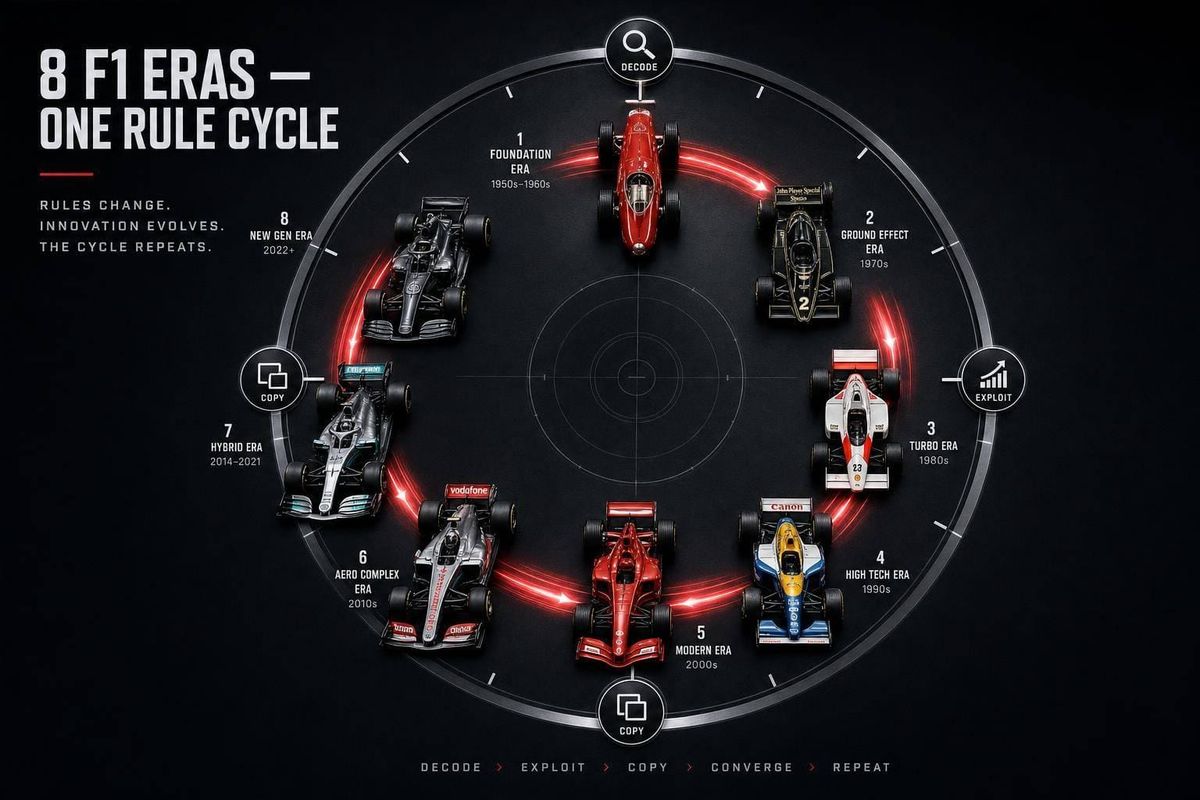
Big F1 rule resets usually follow the same path: one team gets the rules right first, builds a gap, rivals copy the idea or chase loopholes, and the field closes up.
I can sum up the article in one line: the cars change, but the pattern stays the same. That shows up from late-1970s ground effect to the 2026 aero-and-engine reset.
Here’s the short version:
- A reset changes the order
- One team gets an early edge
- Other teams copy it or test gray areas
- The FIA steps in
- The gap shrinks over time
The latest case is easy to spot. From 2022 to 2025, the Q1 gap at Yas Marina fell from 1.274 seconds to 0.591 seconds, and the top three teams’ points share dropped from 78% to 66%. That is the cycle in numbers.
The eight eras covered are:
- Late 1970s to 1982 - ground effect boom and ban
- Mid-1980s - turbo limits and the move to naturally aspirated engines
- 1994 - safety reset and the return of refueling
- 1998 - narrow-track cars and grooved tires
- 2009 - aero reset and the double diffuser fight
- Early 2000s to 2013 - long stable-rules runs led by Ferrari and Red Bull
- 2014 to 2021 - V6 hybrid reset and Mercedes control
- 2022 to 2026 - ground effect return, cost cap, and the next closing-up phase
Ranking Every F1 Regulation Period Ever
Quick Comparison
| Era | What Changed | Early Winner | What Rivals Did | End Result |
|---|---|---|---|---|
| Late 1970s–1982 | Ground effect | Lotus | Brabham fan car | FIA banned it |
| Mid-1980s | Turbo-to-NA shift | McLaren-Honda | New aero ideas spread | Field got closer |
| 1994 | Driver aids banned | Benetton | Teams chased diffuser gaps | Order settled by 1997 |
| 1998 | Narrow track, grooved tires | McLaren | Brake-steer copied, then banned | McLaren-Ferrari fight |
| 2009 | Major aero rewrite | Brawn GP | Teams rushed to copy diffuser | Brawn held on |
| 2000s–2013 | Stable engine rules | Ferrari, then Red Bull | Grid moved toward same design path | Long runs at the front |
| 2014–2021 | Hybrid V6 power units | Mercedes | Rivals chased engine and setup gains | Mercedes led most of the era |
| 2022–2026 | Ground effect, cost cap | Red Bull, then McLaren closed in | Teams copied floor and sidepod ideas | Grid tightened again |
My main takeaway: if you want to know who may control a rules era, look at who reads the new rulebook best in year one. That first step often shapes the next three to eight seasons.
So if you’re watching 2026, you’re not just watching a new season. You’re watching the first chapter of the next F1 pecking order.
Why These 8 Eras Belong in the Same Conversation
These eight eras stretch across almost 50 years. On the surface, they look nothing alike. The cars used different engines, different tires, and very different aero ideas. But the same storyline keeps showing up.
A big rule change lands and flips the pecking order. One team reads the new rules better than everyone else and opens a gap. The rest of the grid then spends the next year or two copying that idea and hunting for gray areas. After that, gains get smaller, the FIA starts making mid-cycle changes, and the field tightens up again. You can see that rhythm across all eight eras in this article. Each one changed who had the upper hand.
The numbers line up with that pattern. Swings of three or more places in the Constructors' standings happen much more often after major resets. In stable seasons, teams tend to finish in about the same spot roughly half the time. In plain English: the reset creates the opening, and the teams that nail the basics early often stay in front for several seasons.
"Getting the fundamentals right at the start of a regulations cycle can have a significant and long-lasting impact." - McLaren Racing
Here’s the pattern in one quick snapshot. The table below shows what happened to reigning champions after each reset.
| Era Reset | Primary Shift | Outcome for Reigning Champion |
|---|---|---|
| 1998 | Narrow track / grooved tires | Williams fell from 1st to 3rd |
| 2005 | Single-race tire rule | Ferrari fell from 1st to 3rd |
| 2009 | Aero reset / double diffuser | Ferrari fell from 1st to 4th |
| 2014 | V6 hybrid power units | Red Bull fell from 1st to 2nd |
| 2022 | Ground effect / cost cap | Mercedes fell from 1st to 3rd |
First up: the ground-effect boom of the late 1970s.
1. Late-1970s to 1982: Ground Effect Boom and Ban
Rule Change
Colin Chapman's Team Lotus showed that an inverted underfloor could produce huge downforce.
Early Advantage Source
The Lotus 78 and then the Lotus 79 turned that idea into a clear cornering edge in 1978.
Loophole Response
Gordon Murray at Brabham went even further. In June 1978, he brought out the BT46B, better known as the "Fan Car", at the Swedish Grand Prix. A rear-mounted fan pulled air from under the chassis, so suction climbed as engine speed climbed. Niki Lauda qualified second and won the race with ease.
Brabham pulled the BT46B after just one race as pressure from rival teams built.
How the Order Settled
By 1983, safety concerns pushed the FIA to ban ground effect, which ended Lotus's edge. After that, the battle shifted from aerodynamics to engine rules.
2. Mid-1980s: Turbo Restrictions and the Shift to Naturally Aspirated Engines
Rule Change Trigger
The FIA's move to 3.5-liter naturally aspirated engines for 1989 turned 1988 into the last turbo season and, at the same time, a handoff year between two eras.
Early Advantage Source
McLaren-Honda owned that 1988 handoff year. The MP4/4 won 15 of 16 races, good for a 93.75% win rate. Ferrari got the only other win at Monza, after the collision involving Ayrton Senna and Jean-Louis Schlesser.
"The MP4/4 was the car that defined dominance in F1; a full house of 16 wins in 1988 was infamously denied by Williams stand-in Jean-Louis Schlesser." - Jake Boxall-Legge, Author
The lesson here wasn't just raw speed. It was timing. McLaren understood the handoff year better than anyone else, and that made all the difference. You see the pattern pretty clearly: one team gets on top of the new direction first, then everyone else starts chipping away at the gap.
Rival Response
The other teams weren't standing still. Some had already started leaning toward naturally aspirated ideas. Adrian Newey's 1988 Leyton House March 881 used a nose-and-wing package that helped airflow reach the underbody more cleanly. That layout later became the blueprint for Newey's title-winning Williams cars in the early 1990s.
How the Order Settled
By the time the naturally aspirated formula arrived in 1989, the field had already tightened. McLaren won nine races, Ferrari took three with the Barnard-designed 640, and Williams-Renault added two. Ferrari's 640 also brought in the sequential-shift semi-automatic gearbox.
So the reset did narrow the gap. It just didn't flip the order overnight.
The next reset would come from safety rather than engines, and the same pattern would show up again.
3. 1994: Safety Rules Reset and the Refueling Strategy Era
Rule Change Trigger
In 1994, F1 stripped out a long list of driver aids: active suspension, traction control, launch control, ABS, and four-wheel steering. The aim was simple. The sport wanted to move away from cars doing too much of the work and put more back in the driver's hands. At the same time, refueling came back, which made fuel load and pit-stop timing central parts of race strategy.
That rule reset changed the feel of F1. Teams could no longer lean on complex electronic systems in the same way, and races started to hinge more on setup, tire use, fuel windows, and driver input.
"Recognising spiralling costs and a concern that F1 was becoming more about machine than man, F1 sought to eliminate both in one swipe of the pen by banning a series of costly driver aids..." - Ollie Barstow, F1 Editor, Crash.net
Early Advantage Source
Williams had the most to lose. Its edge in the early 1990s came from mastering exactly the systems that had now been banned. That run was no fluke either: the team won five of the six constructors' titles from 1992 to 1997.
Benetton reacted faster to the new mechanical formula. With Ross Brawn on the pit wall and Michael Schumacher in the car, the team adjusted better than anyone else and took the 1994 drivers' title. That's often how these resets work. One team loses the tools that made it hard to beat, and another spots the new path first.
Copying or Loophole Response
Then came another shift in 1995. The FIA brought in a 50 mm stepped undertray and smaller wings to reduce downforce. On paper, that looked tight. In practice, Adrian Newey found room to work.
The rules said the reference plane had to run to the rear axle. They didn't say the same thing about the step plane. Williams used that silence in the wording to stop the step plane at the outer edge of the rear wheel, which opened up a larger diffuser exit.
"There was this grey area where you had freedom to cut in above the reference plane to give a much bigger diffuser exit. The diffusers were exit-limited and by undercutting it we got a huge advantage." - Adrian Newey, Technical Director
That idea helped shape the FW18 and FW19, both of which were dominant cars. And once Williams showed what was possible, the rest of the grid went after the same diffuser concept. That's the usual pattern in F1: one team finds the crack in the door, then everyone else tries to squeeze through it.
How the Order Settled
By 1997, things had leveled out. The top seven teams finished in the same order as they had in 1996, a clear sign that the field had largely converged around the same answers. The big scramble after the 1994 and 1995 resets had settled, and the stage was set for the tighter, aero-led change that arrived in 1998.
4. 1998: Narrow-Track Rules and the Grooved-Tire Aero Recovery
After the diffuser disputes of the mid-1990s, the same technical fight showed up in a new place in 1998: body shape and tire grip.
Rule Change Trigger
The 1998 rules cut car width from 2,000 mm to 1,800 mm and replaced slicks with grooved tires to cut cornering speed and mechanical grip. The result was blunt and immediate: almost every team saw its championship position change.
Early Advantage Source
McLaren grabbed the clearest early edge. Adrian Newey spotted a gap in chassis packaging. By shaping the car in a smart way, McLaren could meet the written depth rule while opening up more airflow under the floor.
"The regulation stated a simple width and depth measurement, implying a rectangular section. By putting a fin on the top edges of the chassis, the regulation depth could be achieved much further from the ground, allowing a V-shaped bottom which cleared a lot more airflow space beneath." - Mark Hughes, Grand Prix Editor, Motor Sport Magazine
That extra space under the car helped the MP4-13 keep high downforce levels even with the narrower track. And this wasn't a one-off trick, either. The V-shaped chassis became the basic layout for McLaren's cars through 2001.
Copying or Loophole Response
McLaren also used a second loophole: brake-steer. An extra brake pedal allowed the driver to adjust rear braking distribution on its own, which helped the car rotate earlier with less steering input and less tire scrub. In plain English, it made the car turn more cleanly. Once other teams saw what it could do, the FIA stepped in and banned the system.
How the Order Settled
Williams took the hardest hit in 1998. After leading the sport from 1992 to 1997, the team never bounced back from the mix of rule change, the loss of its engine deal, and Newey's departure. From there, the grid settled into a McLaren-Ferrari fight that shaped the rest of that rules cycle.
That change also set up the longer stretch of rule stability that came next in the 2000s.
sbb-itb-7c68254
5. 2009: Aero Reset and the Double Diffuser Loophole Race
Rule Change Trigger
After the 1998 aero squeeze, F1 took another big swing at reshaping the grid in 2009. The goal was to cut dirty air, so the rules stripped back aero complexity: simpler bodywork, wider front wings, narrower rear wings, and the return of slick tires.
Early Advantage Source
Three teams - Brawn GP, Toyota, and Williams - caught an ambiguity in the new diffuser rules. The gap in the wording was straightforward: the rules allowed a second airflow channel under the car, which delivered a big downforce gain. It was the same pattern seen in earlier rule resets - one group reads the new book a little better, finds the best interpretation first, and gets a head start.
Brawn GP turned that edge into results fast, winning 6 of the first 7 Grands Prix in 2009.
Copying or Loophole Response
Rivals protested right away, but the FIA upheld the design. That left the rest of the field with one option: scramble to copy it during the season.
How the Order Settled
Brawn’s early lead stuck, and the team turned the loophole into both championships. That jump at the start gave them enough margin to lock up the outcome before the rest of the grid fully caught up. In that sense, 2009 wasn’t just a shock result. It was the opening phase of another convergence race.
6. Early 2000s to 2013: Stable Engine Rules and Long Dominance Runs
Rule Change Trigger
The 2006 move from V10 engines to 2.4-liter V8s helped set up one of Formula 1’s longest periods of rule stability.
Early Advantage Source
Ferrari’s edge in the early 2000s came from its close Bridgestone tie-up, with the tires shaped around the F2002. In 2002, Ferrari scored 221 points - the same as the rest of the grid put together. That streak rolled on into 2004, when Michael Schumacher won 12 of the first 13 races.
"It was like a bespoke suit from Savile Row, while the rest of the grid wore off-the-rack." - Joshua Robinson and Jonathan Clegg, Authors, The Formula
Once Ferrari got that far ahead, the rest of the field had little choice. Teams started copying what they could and hunting for rule angles that might slow Ferrari down.
Copying or Loophole Response
Rivals moved fast to copy Ferrari’s packaging ideas, so this next phase was less about surprise and more about the field bunching around the same design path. By the 2003 season, cars across the grid had similar nose shapes and engine covers. Ferrari’s grip finally broke in 2005, when the no-race-refueling tire rule played into Michelin’s stronger durability.
How the Order Settled
After Ferrari, Red Bull followed a similar pattern, but with a different technical base. The team turned the 2009 aero reset into four straight double-title seasons through diffuser work and steady year-to-year development. In 2013, Sebastian Vettel won 10 of the final 11 races, including a record nine straight wins to end the V8 era.
That stretch of stability carried the grid straight into the 2014 engine reset.
7. 2014 to 2021: V6 Hybrid Power Unit Reset
Rule Change Trigger
In 2014, Formula 1 made a huge engine switch. The sport moved from 2.4-liter V8s to 1.6-liter turbo V6 hybrids, along with the MGU-K and MGU-H systems.
That change closed the V8 chapter at a time when Renault-powered cars had won five of the previous eight titles.
Early Advantage Source
Mercedes got on top of the new rules faster than anyone else. In 2014, the team won all but three races and built the best version of the new power unit package.
The reset hit some big names hard. Sebastian Vettel, who had won 10 of the final 11 races of the V8 era in 2013, didn't win a single race after the switch in 2014.
There was also an early sign of how tight the new rules would be. At the 2014 Australian Grand Prix, Daniel Ricciardo was disqualified for going over the new 100 kg/h fuel-flow limit.
Copying or Loophole Response
Mercedes didn't just start strong. It also found a loophole while other teams were still trying to get their heads around the new power-unit package. Rivals had to figure out the new architecture, packaging, and operating window from the ground up.
Red Bull took the biggest hit because Renault's hybrid design lacked power and dependability. Ferrari got closer from 2017, but that push slipped away under reliability trouble and race-operation errors.
Then came another Mercedes idea: Dual Axis Steering, or DAS. The team brought it in for 2020, and it allowed drivers to pull the steering wheel to change the front wheel toe setting while driving. That helped tire warm-up and made performance more steady over a stint. It was legal for that season, then the FIA banned it for 2021.
How the Order Settled
Once the field sorted itself out, the shape of the era was pretty clear. Mercedes won every Constructors' title from 2014 through 2021, giving it eight in a row. It also took seven straight Drivers' titles from 2014 to 2020.
For most of that stretch, the top fight never fully came alive. The one full title battle arrived at the end of the cycle, in 2021. Floor rule changes meant to cut downforce hurt Mercedes' low-rake aero concept more than Red Bull's high-rake setup, and that opened the door to a season-long fight between Lewis Hamilton and Max Verstappen.
That closing-year convergence led straight into the 2022 ground-effect reset, with F1 starting the same kind of cycle again under a new aero philosophy.
8. 2022 to 2026: Ground-Effect Return, Cost Cap, and Convergence Cycle
Rule Change Trigger
The 2022 regulations reset the field. Ground effect came back, and the cost cap made it much harder for teams to spend their way out of a weak first concept. In plain English: if a team got the rules wrong at the start, fixing it became a lot harder than in a normal cycle.
That made the first interpretation of the rules matter more than usual.
"New technical regulations reset the competitive order, erasing embedded advantages and disadvantages, compelling each team to start afresh." - McLaren Racing
Early Advantage Source
Red Bull got that first read right. Adrian Newey shaped the RB18 around a close link between the suspension and the floor, with a focus on steady downforce through speed and ride-height changes instead of chasing the biggest peak figure. That sounds subtle, but it mattered. A car that works across more conditions is often faster over a full weekend than one that looks great in one narrow window.
It also helped Red Bull deal with porpoising far better than its rivals. While other teams were fighting the car, Red Bull had a platform it could use. The payoff was huge: 17 wins from 22 races in 2022.
"What I've tried to do is when there's a big regulation change try to read the regs and come up with a car with a philosophy to suit those regs and as long as the car is half-decent, evolve it." - Adrian Newey, Chief Technical Officer
Copying or Loophole Response
Once Red Bull became the benchmark, the next stage was less about new ideas and more about copying what worked. By 2024, rivals were following Red Bull’s sidepod and floor concept. That’s pretty normal in Formula 1. When one team finds the shape of a fast answer, the rest of the grid starts tracing the outline.
At the same time, teams looked for gains in flexible bodywork. The goal was simple: pass FIA static tests, then let the parts bend at speed to trim drag or add downforce. The FIA stepped in during 2025 with tighter rear wing flexibility checks.
How the Order Settled
The move from one-team edge to a tighter field shows up clearly in the numbers. By 2025, McLaren had become Red Bull’s main rival, and the next battleground was lower ride height. Teams were trying to run the car as close to the ground as possible while staying just on the safe side of the bouncing limit.
| Metric | 2022 (Start of Cycle) | 2025 (End of Cycle) |
|---|---|---|
| Q1 Qualifying Gap (Fastest to Slowest) | 1.274s | 0.591s |
| Points Share of Top 3 Teams | 78% | 66% |
| Primary Technical Challenge | Porpoising/Bouncing | Ride Height Optimization |
| Leading Team | Red Bull | McLaren |
Cross-Era Pattern Snapshot
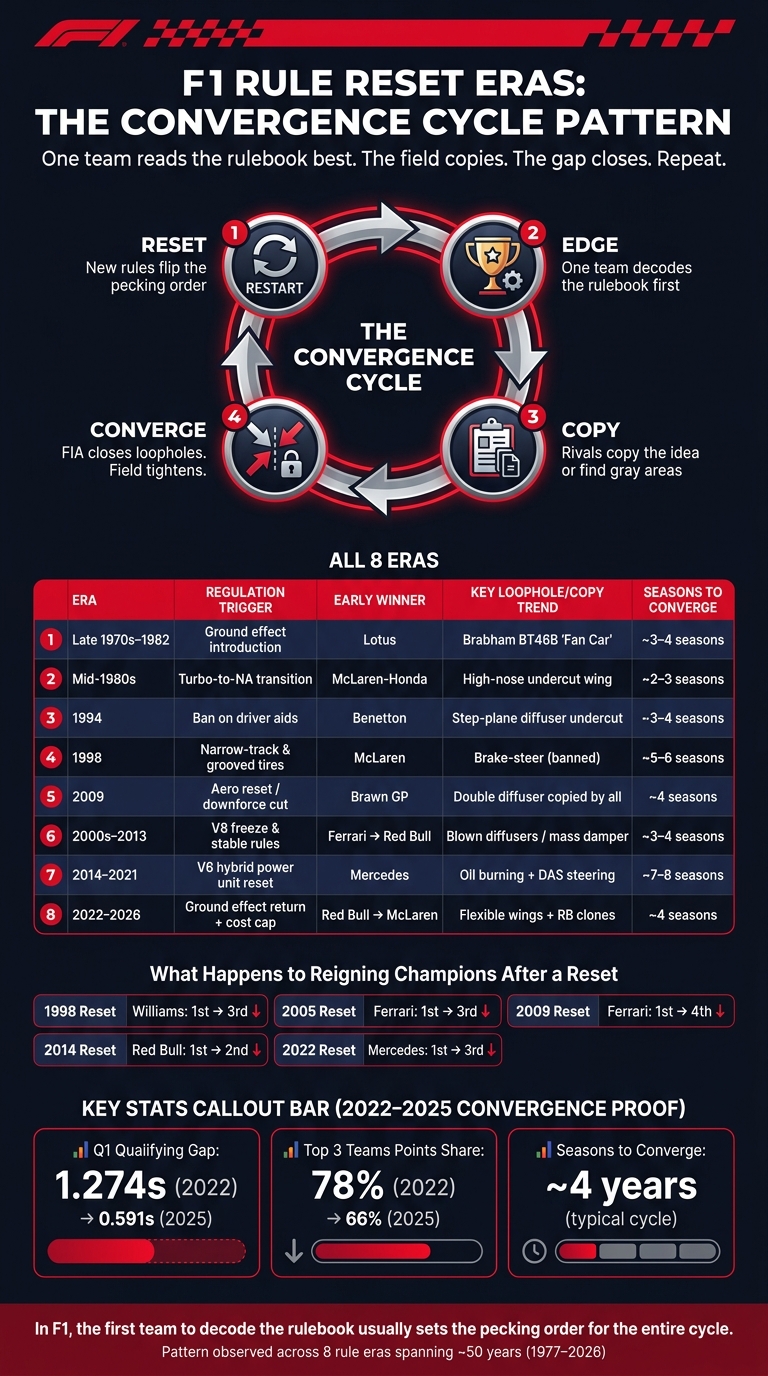
F1 Rule Reset Eras: The Convergence Cycle Pattern (1977–2026)
Across eight rule resets, the same story keeps showing up: one team reads the new rulebook better than everyone else, the rest of the grid either copies the idea or hunts for gray areas, and then performance starts to bunch up again.
The table below puts that cycle in one place.
| Era | Regulation Trigger | Leading Innovation | Key Loophole or Copy Trend | Seasons to Converge |
|---|---|---|---|---|
| 1. Late 1970s–1982 | Ground effect introduction | Venturi tunnels and sliding skirts | Brabham BT46B "Fan Car" | ~3–4 |
| 2. Mid-1980s | Turbo-to-NA transition | Semi-automatic gearbox | High-nose undercut wing | ~2–3 |
| 3. 1994 | Ban on driver aids | Refueling strategy | Step-plane diffuser undercut | ~3–4 |
| 4. 1998 | Narrow-track and grooved tires | V-shaped chassis | McLaren's "extra" brake pedal | ~5–6 |
| 5. 2009 | Aero reset (downforce cut) | Double diffuser | Double diffuser | ~4 |
| 6. 2000s–2013 | V8 engine freeze and stable rules | Blown diffusers | Renault mass damper | ~3–4 |
| 7. 2014–2021 | V6 hybrid power unit reset | Split-turbo architecture | Oil burning and DAS (Dual Axis Steering) | ~7–8 |
| 8. 2022–2026 | Ground-effect return and cost cap | Platform control and suspension-aero integration | Flexible wings and Red Bull clones | ~4 |
That same convergence pattern is now showing up again in the 2026 cycle.
What 2026 Tells Us About the Next Settling Phase
The 2026 season brings a double reset. The aero rules change at the same time as the power-unit rules, with new fuels and tires added to the mix. When that much shifts at once, the biggest gains usually come from reading the rules better than everyone else in the first part of the cycle, before the FIA starts closing loopholes. In plain English: early interpretation may matter more than sheer development output.
We already saw a version of this in the last ground-effect cycle. One team lands on the right idea, the rest study it, copy parts of it, and the grid starts to bunch up. Formula 1 can move fast when the path becomes clear.
That’s part of what makes this era a little tougher. Cost caps and simulator limits leave less room to recover from a weak starting point. If a team opens the season with a strong baseline, it has a much better shot at turning that head start into gains across the year.
"We're better off understanding our platform before we get too keen to redesign it." - Rob Marshall, Chief Designer, McLaren
So the first gaps we see in 2026 won’t just show who built the fastest car. They’ll show who decoded the new rules first. And that matters, because 2026 may tell us whether an early edge is just a one-season hit or the start of another convergence cycle.
Conclusion
The 2022-to-2025 convergence wasn't a fluke. It lines up with what F1 has done after every big rule reset covered in this article. Across eight eras, the same pattern keeps showing up: one team reads the new rules better than everyone else, rivals copy the idea or find weak spots, the FIA shuts the loophole, and the field tightens up.
The latest cycle makes that pattern plain in the numbers. In the 2022–2025 ground-effect cycle, the Q1 qualifying gap fell from 1.274 seconds in 2022 to 0.591 seconds by 2025, and the top three teams' share of available points slid from 78% to 66% in that same period. That's convergence happening in plain sight.
The cars change. The development pattern doesn't.
That's why loopholes matter so much at the start of each cycle. As one editor put it, loopholes reward the team that understands the gap between the written rule and the physics.
In F1, the first team to decode the rulebook usually sets the pecking order for the whole cycle. That's the real lesson of these eight eras.
FAQs
Why do F1 rule resets usually create one early dominant team?
A clean-sheet era puts every team in the same spot at the start: they all have to read a new rulebook and turn it into a car that works on track.
That’s why the first phase matters so much. The team that nails the basics early can grab points fast and build momentum while other teams are still figuring out the new package.
That edge can get even bigger if one team finds ambiguities or loopholes before its rivals do, or before the FIA steps in. While the rest of the grid is still learning the new car platform, that head start can be hard to claw back.
How long does it usually take the field to close up after a major rules change?
Usually, the field tightens over a few seasons as teams fine-tune their cars and design ideas start to look more alike.
At the start of a new rules era, teams often hunt for loopholes and make big gains in a short span. And when one team begins with a development edge, it often hangs on to that lead for two to three seasons. So major rule changes don’t often bring instant parity.
Why could the 2026 reset shape the next F1 pecking order?
The 2026 technical reset gives every team a clean sheet. It shakes up the current order and puts old advantages at risk.
Why? Because the rules are changing in a big way. Aerodynamics will look different, and the power units will change too, with a 50:50 split between combustion and electrical power.
That kind of shift can flip the script fast. A team that looked untouchable under the old setup can suddenly lose ground, while another team nails the new rules and jumps ahead.
History points in the same direction: the teams that read a new rulebook best often build an edge that lasts for years. In the early phase, the field can swing hard as teams try different ideas. Then, over time, things usually start to settle as everyone learns which concepts work and which ones don't.