F1 Medical Response: Car to Care Path
Step-by-step F1 medical care: scene safety, ABCDE checks, extraction, trackside triage, and hospital transfer criteria.
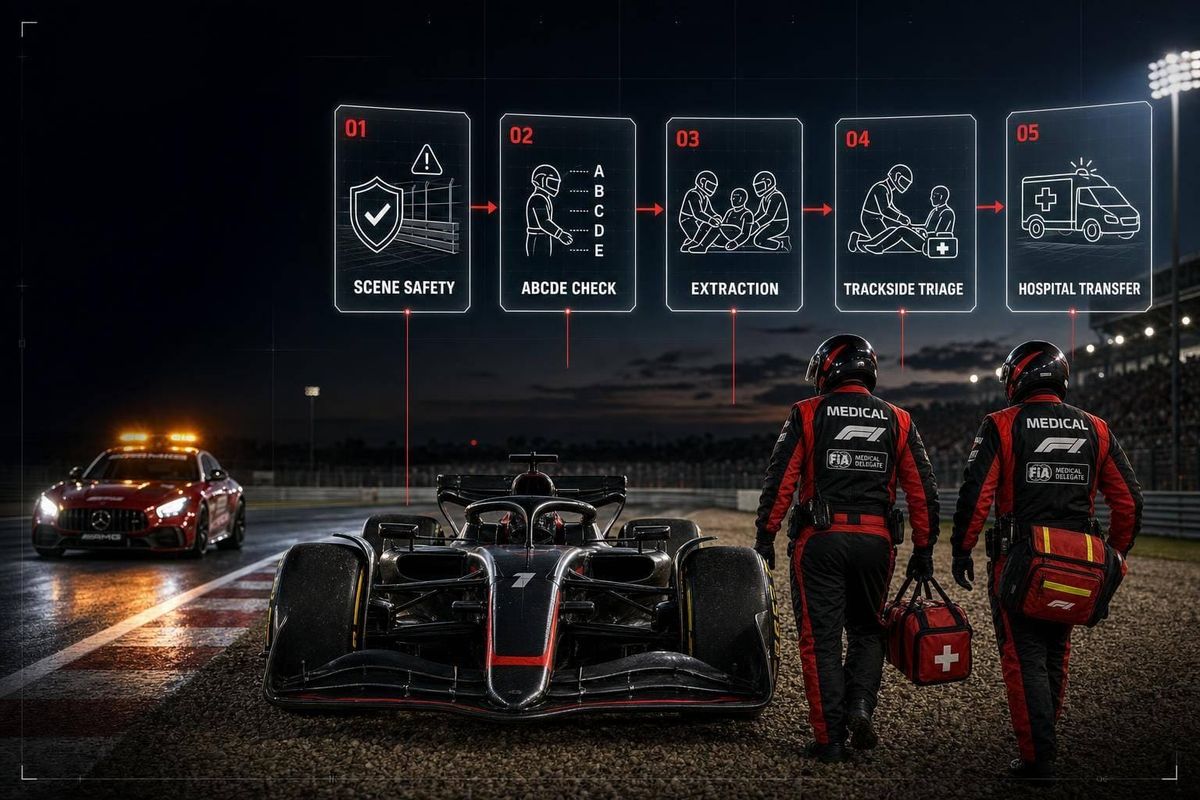
In F1, the goal is simple: get the driver stable, get them out, check for hidden injury, and move them to the right place fast. In many cases, the FIA Medical Car reaches the crash site in 15 to 20 seconds, even though the target is under 60 seconds. After that, the care path follows the same order every time: scene safety, first check, extraction, Medical Center triage, then hospital transfer if needed.
If I had to sum up the whole process in a few points, it would be this:
- Race Control starts the response with flags, the Safety Car, or a red flag
- Rescuers check ERS safety lights first before touching the car
- Doctors use ABCDE to look for airway, breathing, circulation, brain/spine issues, and visible injury
- Drivers only self-exit if they meet strict checks
- High-G hits, spine pain, failed concussion checks, burns, or loss of consciousness can lead to transfer
- The Medical Center is where hidden problems are often found, even when a driver first seems okay
That matters because some injuries do not show up right away. A driver can look alert but still have a pneumothorax, rib fractures, concussion signs, internal bleeding, or a spine risk. That is why F1 does not stop at getting the driver out of the car.
Below, I break down the path from car to care in the same order it happens at the track.
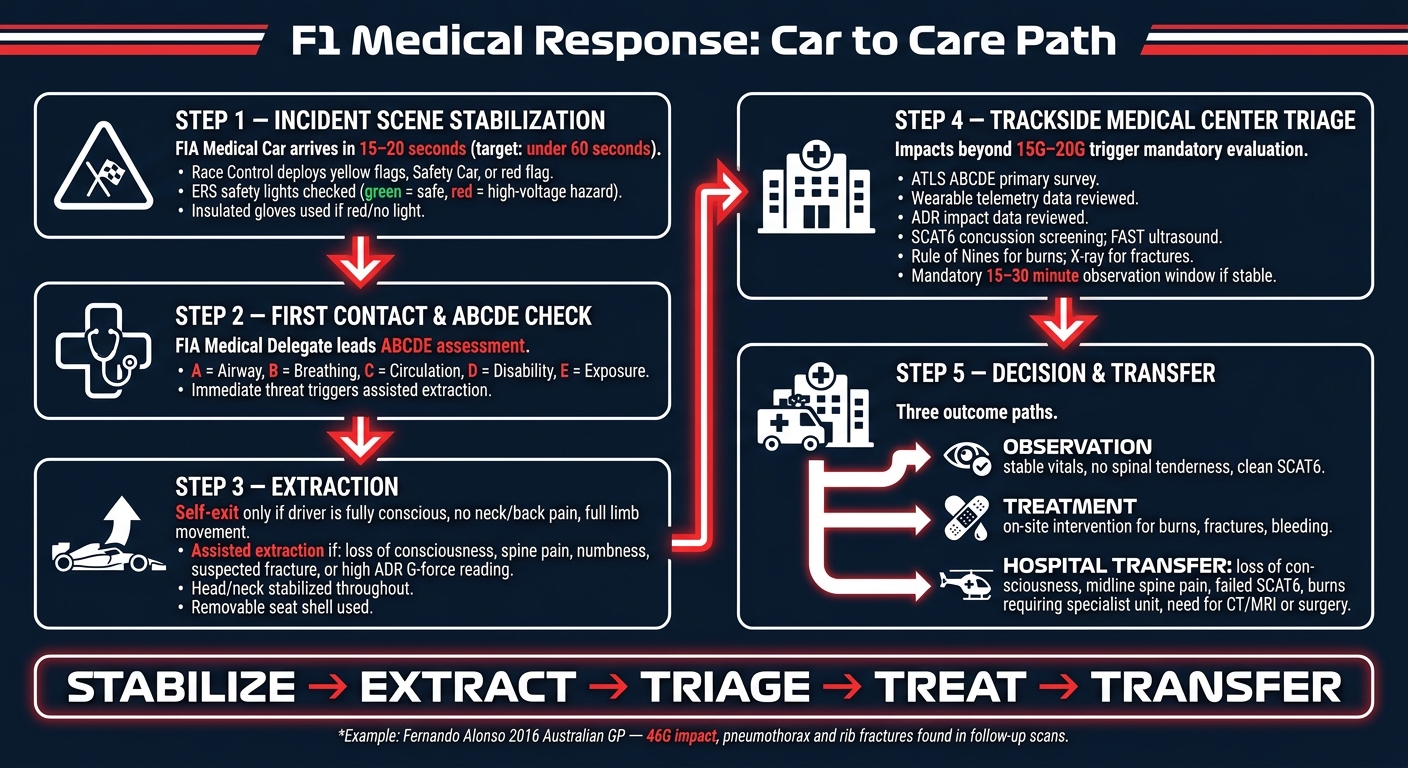
F1 Medical Response: Car to Care Step-by-Step
Inside The F1 Medical Car
Incident Scene Stabilization
Before anyone touches the driver, responders have to lock down the scene. If things stay chaotic, the risk goes up for both the driver and the rescue team.
Securing the car, track, and nearby hazards
When onboard G-force sensors detect a major impact, Race Control starts the response. Yellow flags go out to slow approaching cars. Race Control may also send out the Safety Car or red-flag the session so the track can be cleared for rescue crews.
Before making physical contact with the car, responders check the energy recovery system (ERS) safety lights on the roll hoop and rear of the car. A green light means the chassis is electrically safe to approach. A red light, or no light at all, signals a high-voltage hazard, so crews put on insulated gloves before touching the car.
Only after electrical safety is confirmed does the medical team make first contact.
First contact and initial driver checks
The FIA Medical Delegate leads the first clinical check using the ABCDE framework: airway, breathing, circulation, disability, and exposure. This helps the team spot any immediate threat before extraction. If the ABCDE check shows cause for concern, rescue crews move straight to assisted extraction and transfer.
Rescue Crew Extraction and Transfer
When self-exit ends and assisted extraction begins
After the first ABCDE check shows there isn't an immediate life threat, the focus shifts to one practical issue: can the driver get out of the cockpit alone?
A driver may self-exit only when all of the following are true:
- They are fully conscious and oriented
- They have no neck or back pain
- They can move all limbs without a neurological deficit
Assisted extraction starts if there is any loss of consciousness, confusion, pain along the spine, numbness, a suspected fracture, or an extreme G-force reading logged by the car's Accident Data Recorder (ADR).
Keeping the head and spine protected during removal
During removal, crews stabilize the head and neck and keep the spine in line. The removable seat shell helps rescuers lift the driver out of the cockpit with less twisting and fewer extra movements.
That matters for a simple reason: less movement can mean less chance of making an injury worse during the move from the car to treatment.
Transfer to the medical car or trackside medical center
Once the driver arrives, the Medical Car doctor leads triage and decides whether the driver needs immediate transfer or more care at the scene. The Chief Medical Officer and FIA Medical Delegate then confirm both the destination and the transport method.
At that point, the handoff moves the driver into the trackside Medical Center for the next level of assessment.
sbb-itb-7c68254
Trackside Medical Center Triage
Primary survey on arrival
Once the driver reaches the Medical Center, the job shifts from scene control to a full trauma workup. On arrival, the staff use the ATLS ABCDE primary survey to turn trackside findings, car data, and early checks into a treatment call.
If the driver is awake and speaking clearly, that tells the team the airway is open. From there, they check breathing and chest movement, then circulation through pulse and blood pressure. In some cases, wearable telemetry is already sending heart rate and oxygen saturation before the driver even gets through the door, so the team has baseline data waiting for them.
Next comes the neurological check. Staff assess orientation, motor function, and sensation, and they also review the car's Accident Data Recorder (ADR) plus other impact data. Impacts that usually go beyond 15G to 20G trigger a mandatory Medical Center evaluation, no matter how the driver says they feel.
Secondary exam, monitoring, and next-step decisions
If the primary survey looks stable, staff move straight into focused secondary testing. That's a big deal, because adrenaline can hide pain and push symptoms into the background for a while.
The team checks the spine, limb strength, and sensation. They map burns with the Rule of Nines, use FAST to look for internal bleeding, use X-ray for fractures, and apply SCAT6 for concussion screening.
Those findings usually send the driver down one of three paths: observation, treatment, or hospital transfer. A driver with stable vitals, no spinal tenderness, and a clean SCAT6 result may stay under a mandatory 15–30 minute observation window so staff can watch for delayed symptoms. Hospital transfer comes next when MRI or surgery is needed.
| Trigger or Finding | Immediate Action | Decision Path |
|---|---|---|
| Loss of consciousness | Immediate immobilization | Hospital transfer (CT/MRI) |
| Midline spine pain | Spinal board or vacuum mattress | Hospital transfer |
| Failed SCAT6 test | Held out of competition | Observation or hospital transfer |
| Second-degree burns | Cooling and pain management | Transfer to specialized burn unit |
Fernando Alonso's March 2016 crash at the Australian Grand Prix shows why the secondary exam matters so much. After a 46G impact, Alonso was initially cleared at the trackside medical center. Follow-up scans later found a small pneumothorax and rib fractures that weren't obvious at first, which led to tighter secondary monitoring after high-G impacts. The FIA Medical Delegate makes the final clearance decision.
Injury-Specific Treatment Paths and Key Takeaways
Head and spine cases
Once triage shows the injury pattern, the medical team moves to the matching treatment path. With head injuries, the focus stays on neurologic monitoring. If the driver has an abnormal GCS score, unusual pupil response, or a concerning SCAT result, the next step is imaging and specialist review. Impact data can also help the team gauge how severe the hit may have been.
Spine cases follow a stricter rule set. Any midline tenderness, neck or back pain, numbness, weakness, or tingling means rigid immobilization right away and urgent spine imaging. The driver is moved as one unit on a spinal board or KED, then sent for urgent imaging of the spine.
Burn and blunt-impact cases
Burns and blunt trauma come with very different priorities. In burn cases, the first concern is the airway. If there’s soot or any sign of inhalation injury, the team moves to immediate airway control, then cooling and fluid resuscitation.
Blunt trauma is trickier because internal damage doesn’t always show up at once. A high-energy impact can hide internal bleeding, even when the first look doesn’t seem dramatic. That’s why FAST and serial exams help the team decide when to escalate care.
Each injury type follows its own route from that point:
| Injury Type | First Checks | Likely Diagnostics | Immediate Treatment Priorities |
|---|---|---|---|
| Head Injury | GCS score, pupil reactivity, SCAT assessment | CT/MRI scan, impact data | Neurological monitoring, concussion management |
| Spinal Injury | Midline tenderness, motor/sensory function | X-ray, CT, MRI of the spine | Strict immobilization, urgent spine imaging |
| Burns | Airway patency, TBSA percentage, burn depth | Blood gas analysis, bronchoscopy | Cooling, fluid resuscitation, airway protection |
| Blunt-Impact | FAST ultrasound, chest/abdominal palpation | Ultrasound, X-ray, onboard telemetry | Hemorrhage control, identifying internal organ trauma |
Conclusion: The core principles of the F1 medical pathway
F1 medical care works because each step is controlled: stabilize, extract, triage, treat, transfer. Speed matters, but only after the right handoff.
FAQs
Why can’t every driver self-exit after a crash?
Drivers may not be able to get out on their own for a few reasons. They can be physically trapped, the car may be too badly damaged, or any movement could make an injury worse. In some crashes, parts like the chassis or headrest can shift and block the exit.
A driver may also have a trapped limb or possible spinal trauma. In those cases, the FIA medical team has to stabilize the driver first and deal with risks like fire or damage to the car’s structure before they can carry out a safe extraction.
What hidden injuries can appear after a high-G impact?
Even if a driver climbs out of the car after a high-G crash, adrenaline can blur the picture. It can dull pain, mask symptoms, and make serious injuries easy to miss in the first few minutes. That’s why medical crews usually wait for a short cool-down period before they make a clearer assessment.
Two of the main concerns are basilar skull fractures, which can happen when the head snaps forward with force, and concussions. Teams also keep a close watch on brain function. They use tools like the RESCUE-RACER program to spot problems that may not show up right away.
When is an F1 driver sent to the hospital?
An F1 driver is sent to the hospital when the medical team decides the incident needs more care after the on-track assessment and rescue procedures.
In plain English, that usually means the concern goes beyond immediate stabilization. Think possible head or spine trauma, major burns, or injuries linked to a heavy crash.
That’s very different from a driver who climbs out of the car, gets checked at the track, and is cleared as fit to continue.