F1 media rights: 5 cross-border rules
Five licensing rules — territorial limits, geo‑blocking, blackouts, local partner rights, and digital access — explain why F1 stops abroad.
If your F1 stream stops when you land in another country, it’s usually a rights issue, not a tech problem.
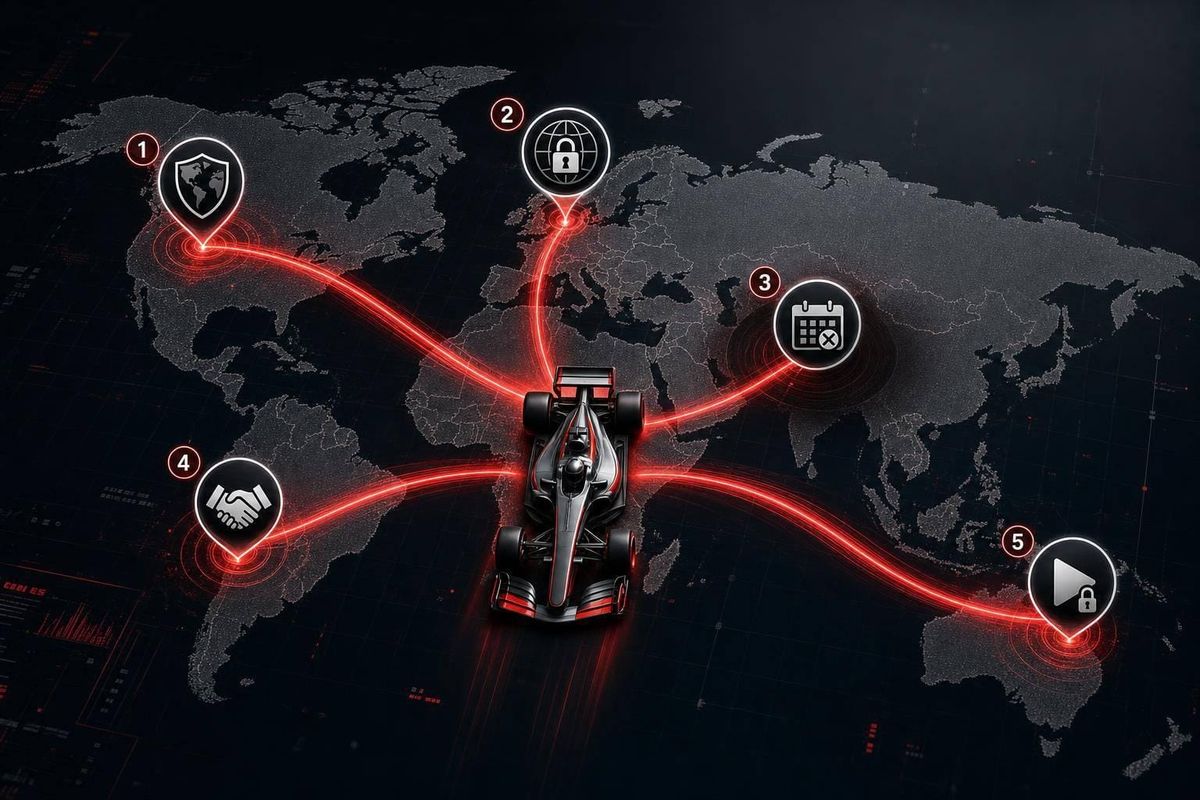
I’d sum it up like this: F1 viewing across borders is shaped by five rules - territorial limits, geo-blocking, blackout terms, local partner rights, and digital access rules. Together, they decide where you can watch, when you can watch, which app you need, and what happens when you travel.
Here’s the short version:
- Territorial limits split F1 rights by country.
- Geo-blocking uses your IP address and billing details to stop out-of-market viewing.
- Blackout terms can block live races on some services in a given market.
- Local partner rights let one broadcaster control the local feed, ads, and presentation.
- Digital access rules tie streaming access to your account, device, and home market.
A few numbers show how big this is:
- F1’s world feed is licensed to about 74 broadcasters
- Sky’s UK and Ireland deal runs through 2034
- Apple’s U.S. deal starts in 2026 at about $150 million per year
- Apple TV+ is about $99 per year in the U.S.
- 47% of new U.S. F1 fans in 2025 were ages 18–24
What this means for you is simple: crossing a border can change your F1 access at once. What it means for broadcasters is money. What it means for teams and sponsors is tighter control over audience, ads, and market-by-market reach.
How geoblocking is RUINING F1 in the UK and Ireland.
sbb-itb-7c68254
Quick comparison
| Rule | What it controls | How it hits fans |
|---|---|---|
| Territorial limits | Which company owns rights in each country | Your home service may stop working abroad |
| Geo-blocking | Where a stream can play | Travel can trigger access blocks |
| Blackout terms | When live coverage is blocked | Some services lose live race access |
| Local partner rights | Local feed, branding, and ad slots | Coverage can look different by market |
| Digital access rules | Devices, account links, and billing checks | Access may depend on account setup and country |
In other words: F1 is sold market by market, and that’s why watching it across borders gets messy fast.
Why cross-border F1 rights are so complicated
Formula One Management doesn't sell one worldwide broadcast package. It produces a single "World Feed" and then licenses that feed to about 74 broadcasters around the world.
Each broadcaster gets rights for a specific territory. And that territorial setup is the reason cross-border viewing gets messy fast.
FOM splits rights into separate layers: live TV, streaming, highlights, and archive access. Live TV rights are usually exclusive and cover practice, qualifying, and races as they happen. That exclusivity matters because it pushes up the price of the deal.
Take Sky Sports. Its deal for exclusive live rights in the UK and Ireland runs through 2034 and is worth about £1 billion. In the U.S., Apple reportedly pays around $150 million per year for its five-year exclusive streaming deal, which starts in 2026.
There’s another piece to this too. FOM uses digital augmentation to project different sponsors onto trackside barriers and run-off zones based on where the viewer is watching from. In plain English: two fans can watch the same race feed and still see different ads. That only works when territorial control is tightly managed.
Put it all together, and you get a rights system built on exclusivity, location, and separate access tiers. That’s what turns into the five practical limits fans run into when they cross a border.
1. Territorial limits
Territorial limits sit at the center of the system: FOM sells exclusive broadcast rights one country at a time. Early EU rulings allowed that setup, with exclusive broadcast contracts capped at five years for host broadcasters and three years for other licensees.
You can see how this works in the United States. In 2026, Apple took exclusive five-year streaming rights, and F1 TV Pro stopped being sold as a standalone U.S. subscription. Cross a border, and access can change on the spot.
For fans, that creates a plain headache. The service that works at home may stop working when they travel. For broadcasters, though, territorial exclusivity helps justify high rights fees. And for teams and sponsors, the tradeoff is pretty direct: exclusive deals bring in more revenue, but they also cut into reach that can help support regional sponsorship value.
That territorial line is enforced online through geo-blocking.
2. Geo-blocking
If territorial limits set the border, geo-blocking is the lock on the gate.
Geo-blocking puts territorial licensing into practice by restricting access to viewers in certain countries. In plain English, it decides where a stream can and can’t play.
Platforms usually enforce this with IP checks and billing-country verification. F1 TV also blocks known VPN ranges to protect each broadcaster's exclusive rights.
It also helps protect region-specific ad inventory, which keeps that ad space worth more for broadcasters, teams, and sponsors.
Put simply: geo-blocking controls where a stream works, while blackout terms control when it can’t air.
3. Blackout terms
If geo-blocking controls where a stream works, blackout terms control when live coverage is off-limits on a given platform. They’re contract clauses that stop live coverage in a territory for a set window. That’s the key difference: blackout terms are about timing, not just location.
Once FOM signs an exclusive rights deal, other services - including F1’s own platform - can be blocked from showing live coverage in that territory.
In the U.S., Apple TV has exclusive live rights starting in 2026, and standalone F1 TV Pro is no longer sold there. So for fans on the move, access can change the second they cross a border.
This blackout isn’t total. Apple still offers practice sessions and four to five selected Grands Prix for free in the Apple TV app. But the way it’s enforced has changed. It now runs through account linking and Apple ID integration, which makes it harder to get around than the older IP-based system.
Why do these blackout windows exist in the first place? Usually because a local broadcaster paid for exclusive live rights.
For teams and sponsors, that matters. Blackout terms help protect the paid audience promised in local rights deals, which helps keep those deals worth the money.
4. Local partner rights
Once a territory is locked, the local rights holder helps decide how the race is presented on screen and over the air. That split comes from the Concorde Agreement, the tripartite contract between the teams, FOM, and the FIA that governs how commercial rights are distributed and enforced.
In plain English, the local partner controls things like commentary, studio presentation, branding, and ad slots. ESPN used those rights from 2018 to 2025 by carrying the Sky Sports UK feed instead of producing its own commentary, while still keeping its own branding and commercial slots.
Those rights also cover the commercial side of the broadcast, including sponsor graphics tailored to each region. Trackside sponsor graphics can be swapped by region through FOM's digital augmentation system. That way, ad inventory and sponsor value stay matched to each market.
5. Digital access rules
The last layer is the one fans feel most: what you can open, on which device, and in which place. Digital access rules decide what a subscriber can legally watch on a phone, tablet, smart TV, or streaming stick. They also decide where that viewing is allowed. In practice, these rules are enforced through account linking and payment-country matching, all tied to the same territorial rights that shape F1's broadcast contracts.
Starting in 2026, U.S. fans need an Apple TV+ subscription and an F1 TV account link to stream live races, qualifying, and practice. F1 TV Pro is no longer sold to new U.S. customers.
On supported Apple devices, Multiview can show multiple feeds at the same time, so onboard, data, and tracker views stay on screen together.
That same licensing setup also limits how subscriptions travel with the fan. Leave your home market, and access can still be cut. F1 TV usually follows the subscriber's country of residence, with EU portability as the main exception. Outside the EU, payment-country checks, including cards issued in the purchase country, are used to stop cross-border sign-ups.
These rules protect the exclusivity behind rights fees.
Quick comparison of the five rules
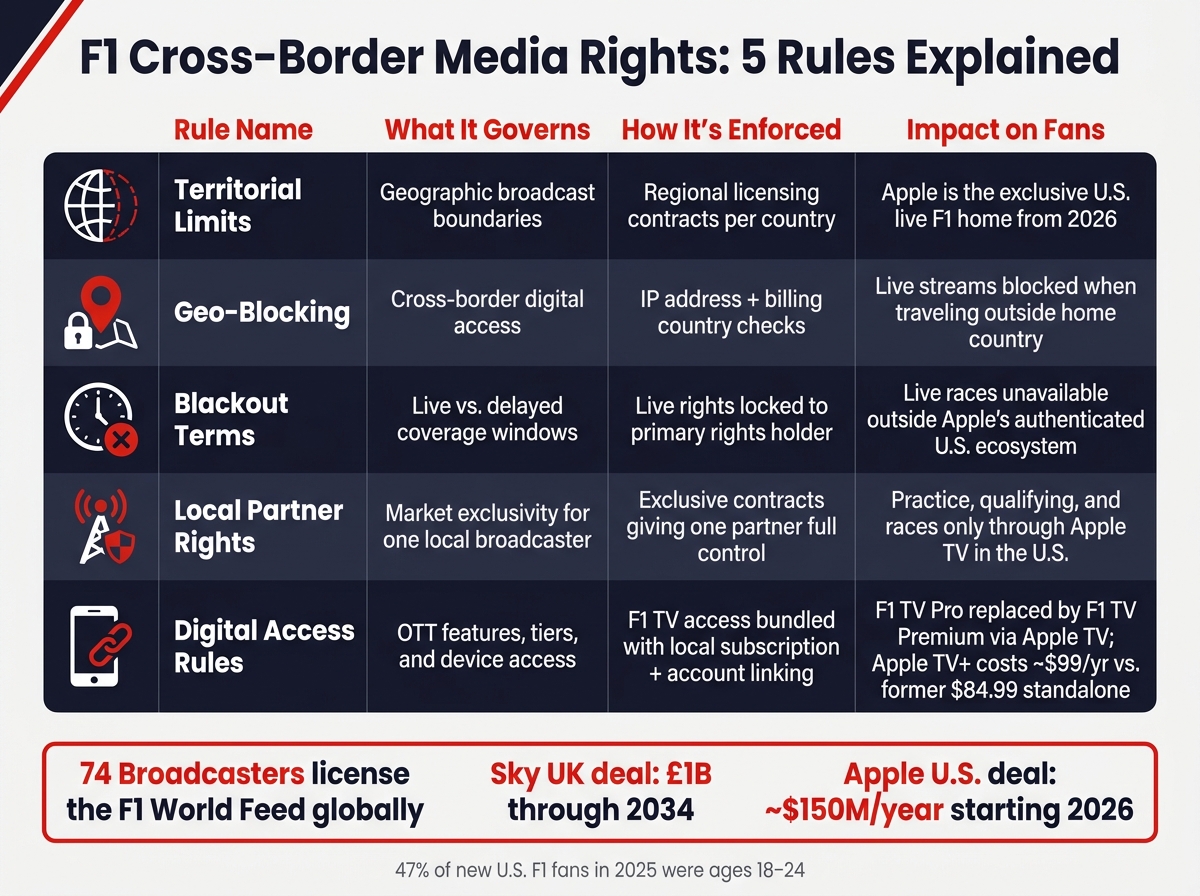
F1 Cross-Border Media Rights: 5 Rules That Control Where You Watch
Here’s the short version: each rule restricts access in its own way, but all of them help protect the value of exclusive rights. The table below puts the five rules into one simple view.
| Rule | What It Governs | How It's Enforced | What It Means for U.S. Fans | Why It Matters to Teams & Broadcasters |
|---|---|---|---|---|
| Territorial Limits | Geographic broadcast boundaries | Regional licensing contracts by country or territory | Apple is the exclusive live F1 home in the U.S. | Protects the value of exclusive regional rights fees |
| Geo-blocking | Cross-border digital access | IP and billing checks | Live streams can be blocked when traveling outside the U.S. | Keeps subscription revenue with the local rights holder |
| Blackout Terms | Live versus delayed coverage windows | Live rights stay with the primary holder | Live races unavailable outside Apple's authenticated ecosystem in the U.S. | Concentrates live audiences on the main broadcaster |
| Local Partner Rights | Market exclusivity for a single local broadcaster | Exclusive contracts giving one partner control of live sessions | Practice, qualifying, and races accessed through Apple TV | Lets the partner package F1 inside its own service ecosystem |
| Digital Access Rules | How OTT features and tiers are packaged | F1 TV access bundled with the local subscription | F1 TV Pro replaced by F1 TV Premium, accessed through Apple TV | Segments live access and premium features into a paid ecosystem |
In the U.S., Apple TV+ costs about $99 per year, compared with $84.99 for the former standalone F1 TV Pro tier.
That gap matters because it shows how rights deals shape the fan experience. Fans feel it in what they can watch, where they can watch it, and what they have to pay. Teams and broadcasters feel it in how audiences are funneled into one paid system.
What these rules mean for fans, teams, and broadcasters
Those five rules do more than control access. They also move money and attention around the sport.
For fans, the big outcome is fragmentation: watching live now depends on where you are, whether your accounts are linked, and whether travel takes you outside your home market. That split setup also changes how sponsors and rights holders sell the product.
For teams, territorial access has a direct effect on sponsor value because one market may get different branding, a different audience mix, and different ad inventory than another. In the U.S., Apple is going after younger fans, and 47% of new U.S. F1 fans in 2025 were ages 18–24. That makes regional media deals a bigger deal for sponsors trying to reach that group. For broadcasters, that same control over territory is both the prize and the headache.
For broadcasters, exclusivity helps drive subscription value, but it also means tighter geo-blocking and more friction for fans who travel.
Conclusion
Watching F1 across borders isn’t blocked by a lack of tech. It comes down to licensing.
These five rules show why access can change the second a fan enters another country. Territorial limits split the world into exclusive markets. Geo-blocking applies those market lines online. Blackout terms cut off competing viewing choices inside a market. Local partner rights protect the broadcast deals that help pay for the sport. And digital access rules connect subscriptions to residency and payment details.
The way F1 is distributed will keep shifting. But the basic setup - territorial control, local exclusivity, and digital limits - is here to stay.
FAQs
Why does my F1 stream stop when I travel?
Your F1 stream may stop when you travel because territorial licensing controls where a service can show races. Streaming platforms enforce those rights with geo-blocking, so access can change the moment your location changes.
In the U.S., exclusive F1 streaming rights belong to Apple TV as of 2026. So if you try to use your usual U.S. service while abroad, or an international service while you're in the U.S., you may run into restrictions.
Can I use my home F1 subscription in another country?
Usually, no.
F1 subscriptions are often tied to territorial broadcasting rights and geo-blocking. That means your access is usually linked to your home country, not wherever you happen to be.
There’s another catch too: some streaming services require a payment method from the same country as the account. So even signing up can be an issue if your card doesn’t match the region.
And while a VPN might sound like an easy fix, it’s often unreliable and may violate the service’s terms.
What’s the difference between geo-blocking and blackouts?
Geo-blocking stops access based on where you are, usually by checking your IP address and blocking people outside the licensed area.
Blackouts are more specific. They block certain events or broadcasts in a region that otherwise has access, often because of local partner rights or exclusive territorial deals.