MGU-K and Megajoules: 2026 Lap Time Q&A
Why 350 kW won't win races: 2026 lap time depends on when drivers charge and spend 4 MJ with the MGU-K.
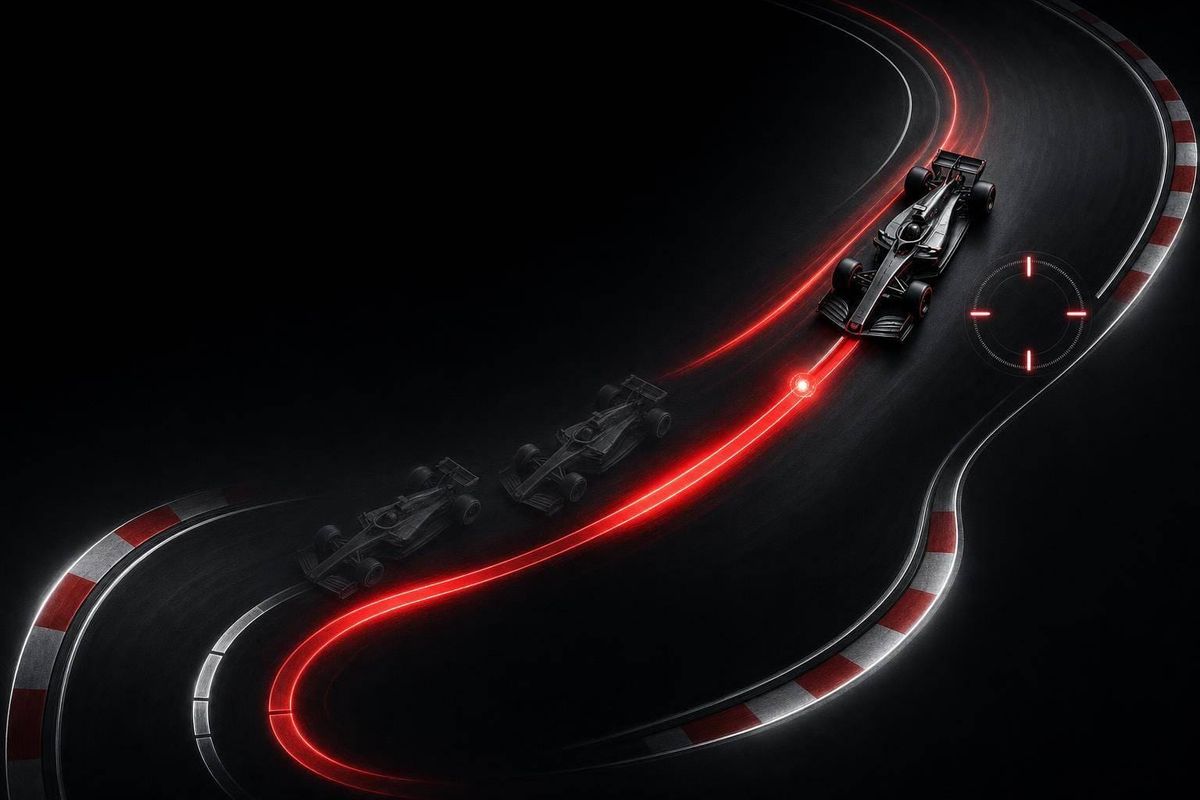
The short answer: in 2026, lap time is shaped less by peak horsepower and more by when I charge and spend electric energy.
Here’s the article in plain English:
- The MGU-K is now the main hybrid tool because the MGU-H is gone
- Electric and combustion power are now much closer to 50/50
- The MGU-K can give up to 350 kW (about 470 bhp)
- The engine is about 400 kW (around 535 bhp)
- The car can recover up to 8.5 MJ per lap
- But I can only use about 4 MJ on track
- At full 350 kW, that 4 MJ lasts only about 11 to 12 seconds
- Energy comes back mostly from braking, lift-and-coast, and super clipping
- On some tracks, weak braking zones make energy harder to recover
- If deployment cuts early, I can lose 0.4–0.5 seconds on one straight, or even more speed when the battery is low
- Standard deployment fades from about 180 mph (290 km/h) and is gone by about 214 mph (345 km/h)
In other words: the 2026 car is fast when the energy plan is right, not just when peak output looks big.
What I’d want you to take away right away:
- kW = how hard the system pushes
- MJ = how long it can keep pushing
- Battery state can decide overtakes, straight-line speed, and lap time
- One small mistake with throttle, recharge timing, or boost use can hurt the whole lap
If I had to sum up the full piece in one line, it would be this: the fastest 2026 F1 car is the one that uses its 4 MJ at the right places and gets enough of it back before the next big demand.
What the MGU-K does and how megajoules work
MGU-K in plain English: harvest under braking, deploy on acceleration
The MGU-K does two jobs, and it swaps between them based on what the driver is doing with the pedals.
Under braking or lift-and-coast, it works like a generator. It adds drag at the rear axle and turns some of the car's slowing momentum into electricity, which then charges the battery. When the driver gets back on the throttle, it switches to motor mode and sends that stored electricity to the rear wheels for extra drive.
For 2026, there's also super clipping. On a full-throttle straight, the MGU-K can pull energy from the V6 engine to help top up the battery. Recovery can hit 350 kW when the driver is fully off the throttle, but super clipping is limited to 250 kW.
That means battery state becomes the main limiter on when the full 350 kW can be used.
Power vs. energy: 350 kW is the rate, 8.5 MJ is the budget
This is where a lot of people get tripped up. The big issue isn't just peak output. It's how long the battery can keep that output going.
kW is power at a given moment. MJ is the total amount of energy available. So even if the system can hit 350 kW, it can't hold that forever. At 350 kW, 4 MJ lasts about 11 to 12 seconds at full output.
As journalist Laurence Edmondson put it:
"The MGU-K is unable to recover enough energy around the lap to guarantee the maximum 350kW of electrical power every time the driver goes full throttle."
| Term | Unit | What It Measures | 2026 F1 Context |
|---|---|---|---|
| Power | Kilowatts (kW) | Rate of delivery | 350 kW is the max push at any instant |
| Energy (harvested) | Megajoules (MJ) | Total budget recovered | 8.5 MJ is the max the system can recover per lap under standard conditions |
| Energy (deployed) | Megajoules (MJ) | Amount spent on track | 4 MJ is the maximum deployable energy per lap |
A simple way to think about it: power is how hard the system can hit, while energy is how long it can keep hitting.
2026 vs. the previous era: what changed
The big shift for 2026 is the loss of the MGU-H.
Under the 2014–2025 rules, the MGU-H recovered energy from exhaust gases and kept feeding charge back into the battery, even on long straights. That gave teams another way to keep the hybrid system supplied through the lap.
In 2026, that part is gone. The rules dropped the MGU-H to cut cost and complexity, so the battery now has to earn its charge through braking, lift-and-coast, and super clipping.
So the new setup can still produce huge electric shove. It just can't do it all the time. The output comes in short bursts, and teams will have to manage those bursts with a lot more care.
sbb-itb-7c68254
Where the battery fills and empties over a lap
When the battery recharges: braking zones, lift-and-coast, and partial throttle
Battery recharge mostly happens in three places: braking zones, lift-and-coast phases, and partial-throttle corners.
The biggest gains come under heavy braking. When a driver lifts and then brakes hard for a slow corner, the MGU-K flips into generator mode and can recover energy at the full 350 kW rate. Lift-and-coast can hit that same 350 kW ceiling, and it recharges faster than super clipping. Partial-throttle corners add some recovery too, but not as much as a heavy braking zone.
The catch is that not every track gives drivers the same chances to do this. Albert Park is a good example. Its shallower braking zones limit recovery, so teams have to rely more on lift-and-coast and super clipping. Drivers there spend about 71% of the lap at full throttle, versus roughly 55% at Shanghai. That gap helps explain why recharge windows can look so different from one circuit to another.
Why 4 MJ runs out fast at full output
The 4 MJ usable window disappears in a hurry when the system is deploying at full power. In plain English: one aggressive boost choice can change what the driver has left for the rest of the lap.
Charles Leclerc put it plainly:
"Every boost button activation, you know you're going to pay the price big time after that. So you always try and think multiple steps ahead."
In standard mode, deployment starts to taper at 180 mph (290 km/h) and drops to zero by around 214 mph (345 km/h). In overtake mode, the full 350 kW can stay on until about 211 mph (340 km/h). Once the car is above the standard speed threshold, super clipping can pull energy back at up to 250 kW.
Lap-phase comparison table
| Phase of Lap | Harvest Available | Deployment | Battery Effect |
|---|---|---|---|
| Heavy braking zone | Maximum (up to 350 kW) | Zero | Fast recharge |
| Medium-speed corner exit | Zero | Maximum (350 kW) | Fast drain |
| Straight below 180 mph | Low (super clipping) | High (350 kW) | Steady drain |
| Straight above high speed threshold | High (super clipping) | Tapered/zero (speed limit) | Net recharge |
| Lift-and-coast phase | High (up to 350 kW) | Zero | Strategic recharge |
Those limits lead straight to the next issue: when to spend energy, and when to hold some back.
2026 F1 Engine & Battery Deployement Explained (MGU-K)
How energy limits affect strategy and lap time
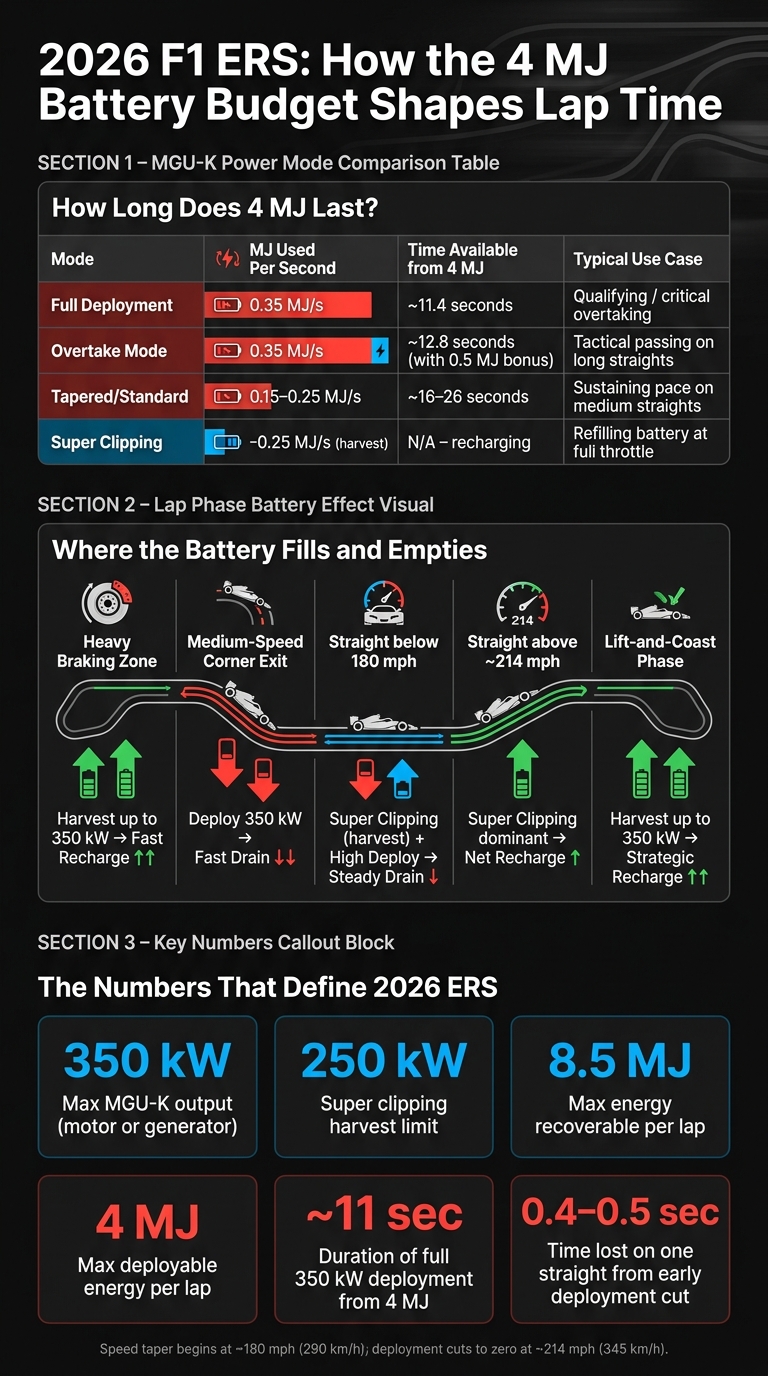
2026 F1 ERS: Power vs. Energy Explained – MGU-K Modes & Battery Budget
The trade-off between charging now and losing time now
Once you know where the battery tends to fill and where it drains, the next call is simple in theory and hard in practice: when do you spend it?
Every early lift or super-clip on a straight gives up lap time in exchange for charge. And the cost can be brutal. If a car runs low on electrical energy, it can lose more than 30 mph (50 km/h) on a straight even with the throttle pinned. That’s not some minor drop. It can wreck a lap or swing a race.
Push too hard on charging, and you pay for it right away. Heavy harvesting through aggressive lift-and-coast cuts top speed and forces the driver to brake earlier than the ideal point. Charles Leclerc summed up the mental strain like this:
"Before, it was more about who is the bravest at braking the latest, maybe now there's a bit more of a strategic mind behind every move you make." - Charles Leclerc, Driver, Ferrari
That change is plain to see. Drivers aren’t only reacting to grip, traffic, and braking markers. They’re also juggling an energy budget in real time, corner by corner, straight by straight.
Why stronger electric power does not always mean a faster lap
A jump from 120 kW to 350 kW sounds like a straight-line gain. But the speed taper changes the story.
Electrical assist starts to fade at 180 mph (290 km/h) and drops to zero at around 214 mph (345 km/h) in standard mode. So on long, high-speed straights, the extra MGU-K output often disappears right where you’d want it most.
There’s also a touchy software side to this. In April 2026, during Chinese Grand Prix sprint qualifying, Charles Leclerc lost 0.4 to 0.5 seconds on the back straight alone. The trigger was small: a 2–3% throttle lift earlier in the lap to catch a slide, which caused deployment to cut back early. That kind of loss is easy to miss if you only look at peak power numbers.
Energy mode vs. time-at-power table
This table puts the modes into time, not just kilowatts. Here’s how the 4 MJ budget plays out depending on how hard the system is used:
| MGU-K Power Mode | MJ Used Per Second | Approx. Time Available From 4 MJ | Typical Use Case |
|---|---|---|---|
| Full Deployment | 0.35 MJ/s | ~11.4 seconds | Qualifying laps or critical overtaking moves |
| Overtake Mode | 0.35 MJ/s | ~12.8 seconds (with 0.5 MJ bonus) | Tactical passing on long straights |
| Tapered/Standard | ~0.15–0.25 MJ/s | ~16–26 seconds | Sustaining pace on medium straights below the speed taper threshold |
| Super Clipping | −0.25 MJ/s (harvest) | N/A | Recharging at full throttle on straights |
A full 4 MJ charge lasts only about 11.4 seconds at full deployment. Across one lap, with several acceleration zones, that time gets eaten up fast. That’s why deployment software turned into a major separator in performance.
Conclusion: The simplest way to read 2026 ERS performance
The big 2026 question comes down to one thing: when is the car using energy, and when is it banking it? That’s the cleanest way to read ERS performance.
This is a lap-time problem, not just a headline power figure. Peak power matters, sure. But what matters more is how long the battery can hold that power. At the full 350 kW, the 4 MJ deploy window is gone in about 11 seconds.
That usable 4 MJ window shapes when a driver can go on the attack. You see the trade-off most clearly on the straight, where deployment drops off once that battery window is spent.
The easiest signs to watch for are pretty simple:
- Flashing rear lights and a drop in speed at full throttle usually point to the car recharging or clipping.
- A speed plateau at full throttle usually points to super clipping.
Put bluntly, the 2026 car acts less like a pure engine car and more like a battery-managed race car with an engine attached.
In 2026, the fastest car is the one that uses its 4 MJ window at the right moments.
FAQs
Why doesn’t 350 kW guarantee a faster lap?
Because 350 kW is just the peak output, not a bottomless supply of power. The energy store is finite, and without the old MGU-H feeding energy back in, drivers can’t run full power for an entire lap.
If the battery charge drops, electrical deployment can taper off and hurt speed. So instead of pushing flat-out in every sector, drivers have to manage their energy with care.
What makes some tracks worse for energy recovery?
Some tracks are tougher for energy recovery because they give drivers fewer chances to harvest electrical energy over a lap. In 2026, the MGU-K is the only recovery system, since the MGU-H is gone.
That makes braking zones a big deal. If a circuit has only a few of them, or the braking is light instead of hard, recharging the battery gets a lot harder. The result? Drivers may need to lean on lift-and-coast or super clipping to keep energy in check, especially at places like Albert Park, where long, fast sections limit heavy braking.
How can a small throttle lift hurt the whole lap?
In 2026, F1 cars run on a tightly managed energy budget. Their software reads very precise throttle inputs to decide when to deploy energy and when to harvest it. That means even a tiny, accidental lift can start energy recovery at the wrong moment.
The result is simple: the car gives you less electrical help, and you lose speed right away. Then that hit can ripple through the rest of the lap, not just that one corner or straight.
Put plainly, these cars are built to be driven at full attack.