F1 Team Travel Delays: Problem and Response
How missed flights, visas, and last‑mile issues disrupt F1 race prep — and how teams reroute, charter, and reprioritize staff.
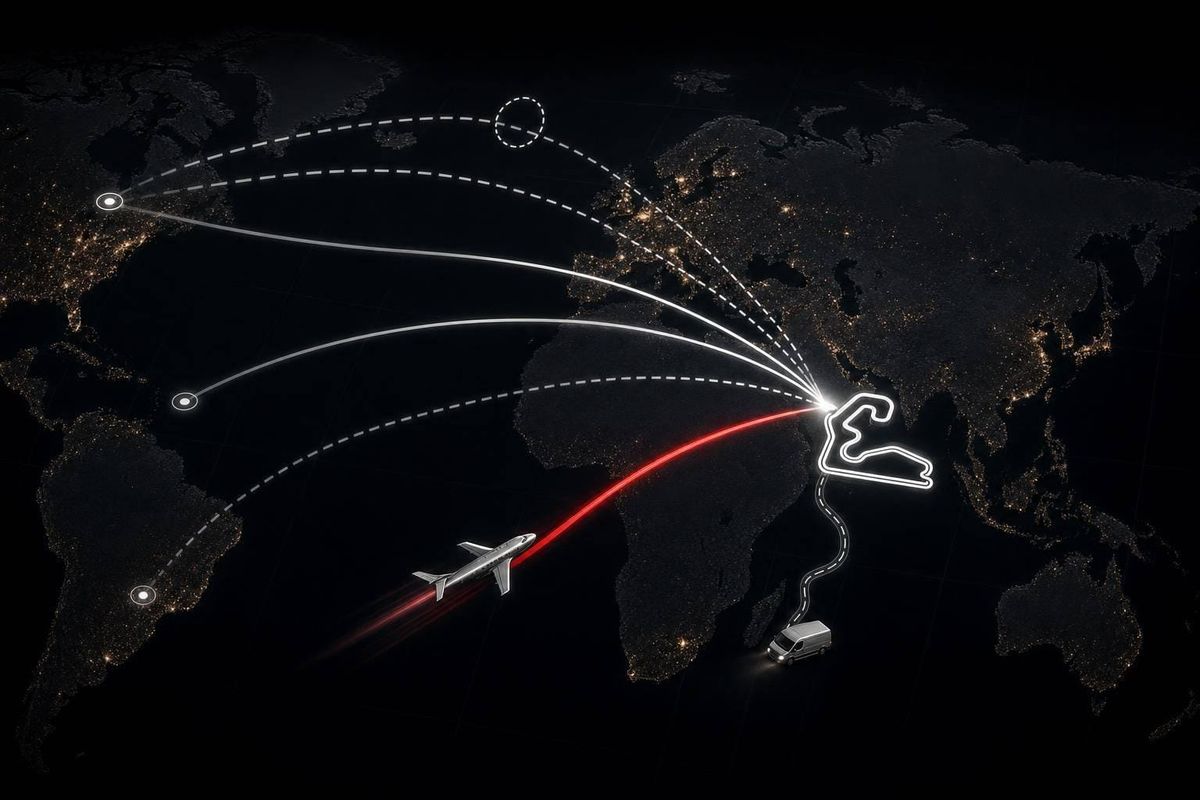
In F1, travel delays can hurt lap-time prep before a car even leaves the garage. In March 2026, about 1,000 people had to reroute before the Australian Grand Prix, and F1 used 3 charter flights to move about 500 staff after airspace closures shut down key routes.
If I had to sum it up in plain English, it’s this:
- Flights fail through major hubs like Dubai, Doha, and Abu Dhabi
- Visa and passport issues can stop staff before they leave
- Airport and road problems can delay the last part of the trip
- Teams respond by sending the most race-critical people first
- If seats disappear, they reroute, split bookings, or use charters
- If some staff still arrive late, teams shift jobs on-site and back at base
What stands out most to me is the knock-on effect. A 44-hour trip doesn’t just waste time. It leaves mechanics and engineers tired before setup starts. And when garage build time shrinks before FP1, the risk of mistakes goes up.
Here’s the short version of the problem and response:
| Issue | What it does | Common response |
|---|---|---|
| Missed connections and canceled flights | Delays setup crews and engineers | Rebook, reroute, charter flights |
| Visa or passport trouble | Stops staff from traveling at all | Check documents early, track entry rules |
| Airport or road disruption | Delays arrival after landing | Local transport backup, job reshuffle |
| Staff fatigue after long trips | Increases error risk during prep | Send key staff first, adjust shifts |
So for me, the big takeaway is simple: travel reliability is part of race performance. It affects people, timing, setup, and error risk just as much as it affects the schedule.
The Main Travel Problems F1 Teams Face
Missed connections and airline delays
Hub airports are where F1 travel plans often start to crack. A lot of team staff use commercial flights through Dubai, Abu Dhabi, and Doha to get to races in Asia and Australia. If one of those routes goes down, the impact spreads fast. Crews get stuck, setup crews arrive late, and the whole timetable tightens at once.
That’s exactly what happened in March 2026. Escalating conflict in the Middle East shut airspace across at least eight countries and grounded major airlines including Emirates, Etihad, and Qatar Airways. Around 1,000 F1 personnel had to redo their travel plans for the Australian Grand Prix. Formula 1 then stepped in and arranged three charter flights to carry about 500 staff from Europe to Melbourne after commercial services were canceled.
The damage shows up on the ground. Freight may already be sitting at the circuit, but if the people who need to unload and build everything aren’t there, teams can end up working through the night before FP1. And flights aren’t the only thing that can stop a trip. Paperwork can do the same job just as fast.
Visa, passport, and entry-rule failures
Document issues are less visible than a canceled flight, but they can shut down travel before it even starts. In Formula 1, where hundreds of staff cross borders on a fixed schedule, even a small delay with visas or entry documents can turn into a race-weekend bottleneck, not just an airport hassle.
Post-Brexit rules have made this especially hard for UK-based events. Formula 1 told the UK Department for Culture, Media and Sport that slow visa processing for European hospitality and security contractors was putting the British Grand Prix at risk year after year.
"Strict rules, especially post-Brexit, can lead to significant delays in getting hundreds of personnel into the country, increasing costs and putting the successful delivery of the Grand Prix in jeopardy each and every year." - Formula 1, written evidence to the DCMS Committee
The main problem is how those jobs are classified. Border officials can treat hospitality and security roles as lower priority, even though Formula 1 says those workers fill niche jobs that the event cannot run without. As Caroline Dinenage, MP, put it:
"Actually in sectors like F1 those skills [hospitality] are particularly niche and are needed to be given weight and not put to the back of the pile." - Caroline Dinenage, MP
And even when the paperwork is fine, teams still aren’t safe. The trip can still go wrong between the airport and the circuit.
Airport disruption and last-mile breakdowns
A flight landing on time doesn’t always mean the problem is over. Airport closures, strikes, bad weather, road traffic, and transfer delays can still leave personnel stuck on the last leg of the trip.
The fix depends on the size of the issue. One mechanic held up in traffic while garage work is already in motion is a very different headache from a hub failure that forces hundreds of people to reroute at once. That difference matters, because the response changes with it: big rerouting plans for hub failures, local recovery steps for last-mile delays.
sbb-itb-7c68254
The INSANE LOGISTICS of F1 TRAVEL!
How Teams Respond When Time Is Short
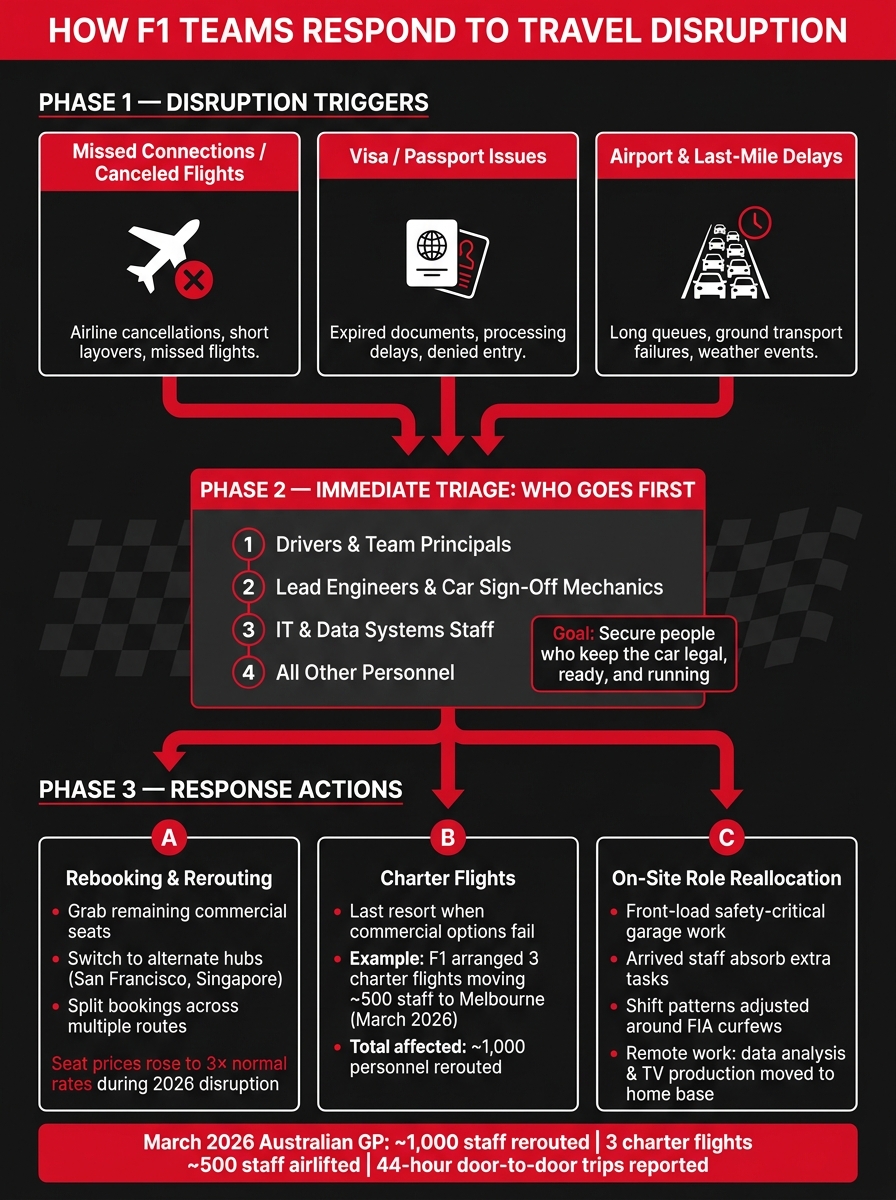
F1 Team Travel Disruption: Problem & Response Workflow
Once disruption hits, the job changes fast. It stops being about sticking to the original travel plan and starts being about triage.
Fast triage: who must arrive first and why
When plans fall apart, teams rank people by race-critical priority right away. Drivers, lead engineers, and team principals go first. After that come mechanics who need to sign off on the car and IT staff who keep the data systems running. Everyone else comes after.
The goal isn't to get every person moving at once. It's to secure the people who keep the car legal, ready, and running.
Travis Auld, CEO of the Australian Grand Prix Corporation, described that order during the 2026 travel disruption. He said drivers, engineers, and team principals were moved first, while other staff were still trying to get out, and that the race could continue without some of them.
That pecking order shapes everything that happens next. If the top roles get through, the rest of the plan can be rebuilt around them.
Emergency rebooking and rerouting steps
Once the priorities are clear, the next move is simple: get seats, any seats, that protect garage build time.
At that point, nobody cares much about the original itinerary. Internal travel teams first grabbed whatever commercial seats were left. When that stopped working, they moved to alternate hubs and split bookings across different routes. As seats vanished, prices on the remaining flights reportedly climbed to three times the usual rate.
Chris Medland showed just how tight that window became after his first itinerary collapsed. He eventually reached Melbourne on a four-leg route through San Francisco, Nadi, and Brisbane, with about 44 hours of total travel time door to door.
When commercial flights could no longer do the job, Formula 1 turned to charter flights as a last resort for staff who still could not get through.
Role reallocation when delays cannot be avoided
Sometimes, even after all that, some people still miss the window. That's when the trackside plan changes.
Teams front-load safety-critical work, let the first arrivals begin setup, and push lower-priority jobs until the rest of the crew lands. The people already on site take on extra tasks, and shift patterns get adjusted around FIA-mandated curfews so mechanics don't get worn down during a tight setup period.
That approach keeps the garage moving even when the travel plan doesn't.
Some jobs can also shift away from the track. Data analysis and remote television production can move back to home-base teams. If the shortfall is in hospitality or basic logistics, local vendors or temporary hires can take on part of the load. In practice, teams spread setup, safety, and data work across the staff already there.
Building a More Reliable Travel Operation
Once rebooking starts, strong travel teams don’t just patch the problem and move on. They look at what broke, then work backward so the same issue doesn’t hit the next trip. The goal is simple: stop avoidable failures before they start.
Pre-trip controls that prevent avoidable failures
Some of the most common travel problems are also the easiest to prevent. Expired passports and missing visas usually shouldn’t become last-minute crises. Big teams often handle passport validity, visa status, and entry rules in-house for every traveler instead of leaning only on outside agencies.
Formula 1 has flagged just how serious visa delays can become when entry rules tighten:
"Strict rules, especially post-Brexit, can lead to significant delays in getting hundreds of personnel into the country... putting the successful delivery of the Grand Prix in jeopardy each and every year."
That’s why small but mission-critical roles, like paddock security and hospitality contractors, need clearance from immigration authorities early. Teams take the same approach with equipment. They use ATA carnets to move technical gear through customs with less friction, which helps cut down on emergency rebooking later.
Route design, buffers, and regional planning
Once documents are sorted, the next weak point is the route itself. Dubai, Doha, and Abu Dhabi sit at the center of many Europe-Asia-Pacific itineraries, so when airspace shuts down, teams need another path ready to go. Preplanned options through hubs like San Francisco or Singapore give crews a fallback when commercial travel falls apart.
Equipment planning follows the same logic. F1 uses five identical sea-freight sets that rotate around the world, allowing non-competitive gear, including hospitality units, garage signage, and furniture, to arrive months ahead of time. Sea freight sent from Europe in January can still make March race dates, easing pressure on each team’s 32-tonne air-freight allowance for flyaway races. That keeps air freight available for race-critical cargo like cars and IT systems.
Another simple buffer is staggered arrival timing. Mechanics and infrastructure staff often arrive before the core race team, giving crews time to build out trackside operations before engineers and drivers land. That extra cushion can stop a minor delay from turning into a larger operations mess.
Using past disruption data to improve future decisions
After a disrupted event, the best review usually comes down to a few direct questions:
- Which hub failed?
- How long did rebooking take in practice?
- When did commercial seats dry up and force escalation?
When teams track those answers by route, airport, and season, patterns start to show up. Maybe one hub keeps failing under the same conditions. Maybe one route looks fine on paper but collapses under pressure. That history helps teams change the next plan before the same problem comes back.
It also makes escalation faster. If a team has already set triggers, like a sharp fare jump or too few seats left on commercial flights, they don’t have to debate every disruption from scratch. They can move to a reroute sooner and protect the next race trip with less guesswork.
| Travel Option | Reliability | Cost | Best Used For |
|---|---|---|---|
| Commercial (hub routing) | Lower reliability in geopolitical risk zones | Lower, but subject to sharp price spikes during disruption | Standard travel on stable corridors |
| Air freight | Very high; reroutable on short notice | Premium | Race-sensitive equipment on every flyaway |
| Sea freight | High; dispatched months in advance | Cost-effective for bulk, non-competitive gear | Hospitality, signage, and garage infrastructure |
Conclusion: Travel Reliability Is Part of Race Performance
In Formula One, travel problems don't just slow people down. They can hurt race-week prep in a very direct way. Missed connections, visa delays, closed airspace, and last-mile transport failures all hit hard when the gap between landing and practice is counted in hours, not days.
The March 2026 Australian Grand Prix made that plain. About 1,000 personnel had to reroute after Middle Eastern airspace closures, and F1 moved roughly 500 staff from Europe on three charter flights.
That fix worked for one reason: teams had already made the hard calls about who needed to move first and what rerouting paths to use under pressure. The teams that handle this best send the right people first, keep backup flight plans ready, and avoid putting race-critical freight onto tight passenger air capacity when they can.
And the cost isn't just on the ops side. When commercial travel falls apart, 44-hour door-to-door trips can leave staff drained. That fatigue can increase error risk and dump more work onto the crew already at the track.
Travel reliability is part of race performance because it helps keep people rested, key roles filled, and the whole operation functioning.
FAQs
Why do travel delays matter so much in F1?
In Formula 1, travel delays hit hard because the schedule is high-pressure and every minute matters. On Sprint weekends, teams get only one free practice session. So when travel runs late, engineers lose time to study data and dial in the car setup.
The human cost is rough too. Staff can end up stuck in 44-hour trips and deal with heavy fatigue. On top of that, visa issues or airspace closures can stop key personnel from getting to the garages and hospitality areas needed to run the event.
Who gets priority when team travel plans break down?
When Formula 1 travel plans fall apart, Formula 1 management steps in to help move drivers, teams, and other essential personnel needed to keep the event on schedule.
The first focus is the people who are critical to race operations. The goal is simple: get them to the venue on time and keep disruption to the race weekend as low as possible.
How do teams reduce travel risk before a race?
Teams cut travel risk by relying on dedicated travel specialists. These people handle complex itineraries, keep up with international entry rules, and make sure visa and passport requirements are in order.
On the freight side, teams split shipments based on what matters most. They usually send non-race infrastructure by sea, while sensitive equipment moves on charter flights.
When plans go sideways, Formula 1 and the teams fall back on contingency plans and work together on rerouting if airports, airspace, or transport hubs are disrupted.