How Track Surface Shapes F1 Tire Grip
How asphalt age, aggregate, roughness and sealing change F1 tire temperatures, grip, wear and pit strategy across a race weekend.
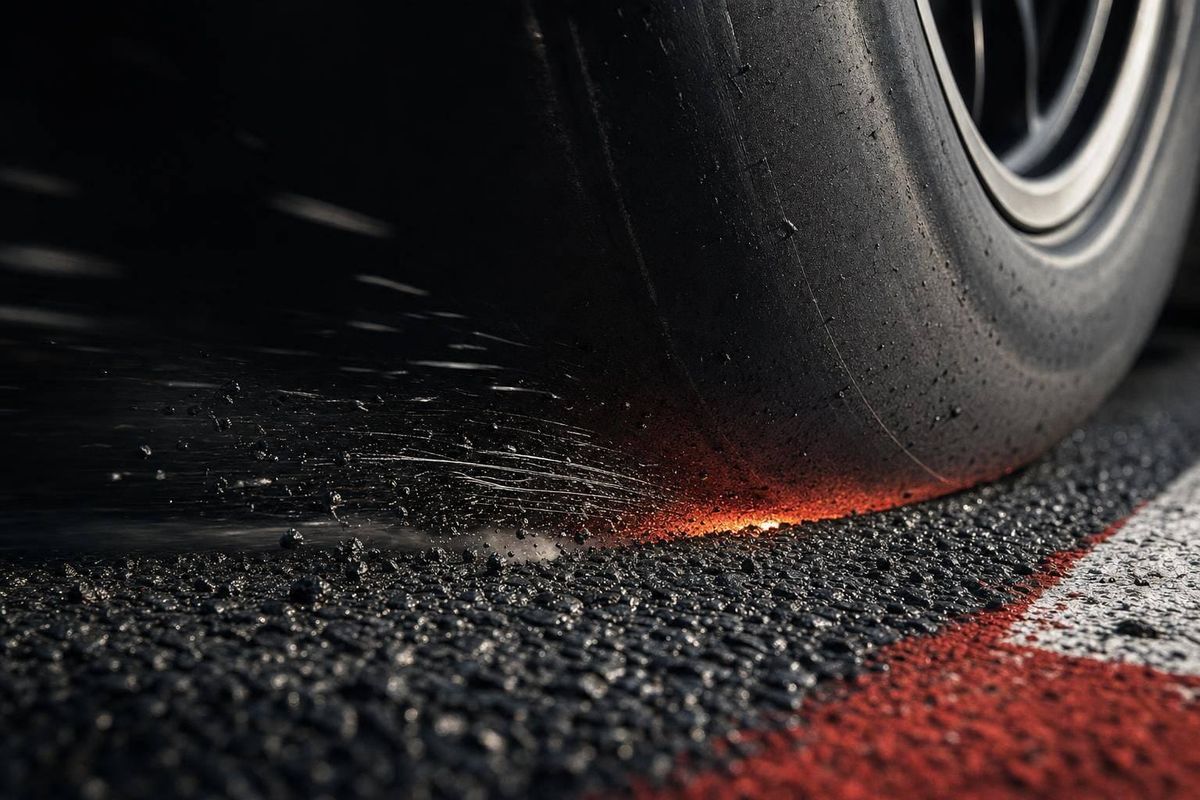
Track surface can change tire grip before a team even leaves the garage. I’d sum it up like this: asphalt age, stone type, sealing, and roughness shape how fast tires warm up, how much grip they make, and whether they grain, overheat, or wear out.
Here’s the short version:
- New, dark asphalt often runs hotter and can push track temps past 122°F (50°C), which can overheat tires.
- Older, rougher asphalt usually gives more mechanical bite, but it can wear tires down faster.
- Smooth tracks with high micro-roughness can look easy on tires but still build heat fast. Miami in 2022 is a good example.
- Bitumen-treated surfaces can lose grip on the racing line as the weekend goes on, like Shanghai in 2024.
- Patchy resurfacing can give drivers two grip levels in one lap, as seen at Monaco in 2026.
- Teams use FP1, FP2, and FP3 to check if the surface is behaving as expected, then change setup, tire pressures, ride height, and stint plans.
What matters most is simple: the surface sets the grip baseline, practice data checks it, and setup plus race plans follow from there. I see this article as a straight link between asphalt traits, telemetry clues, driver feedback, and tire life over a stint.
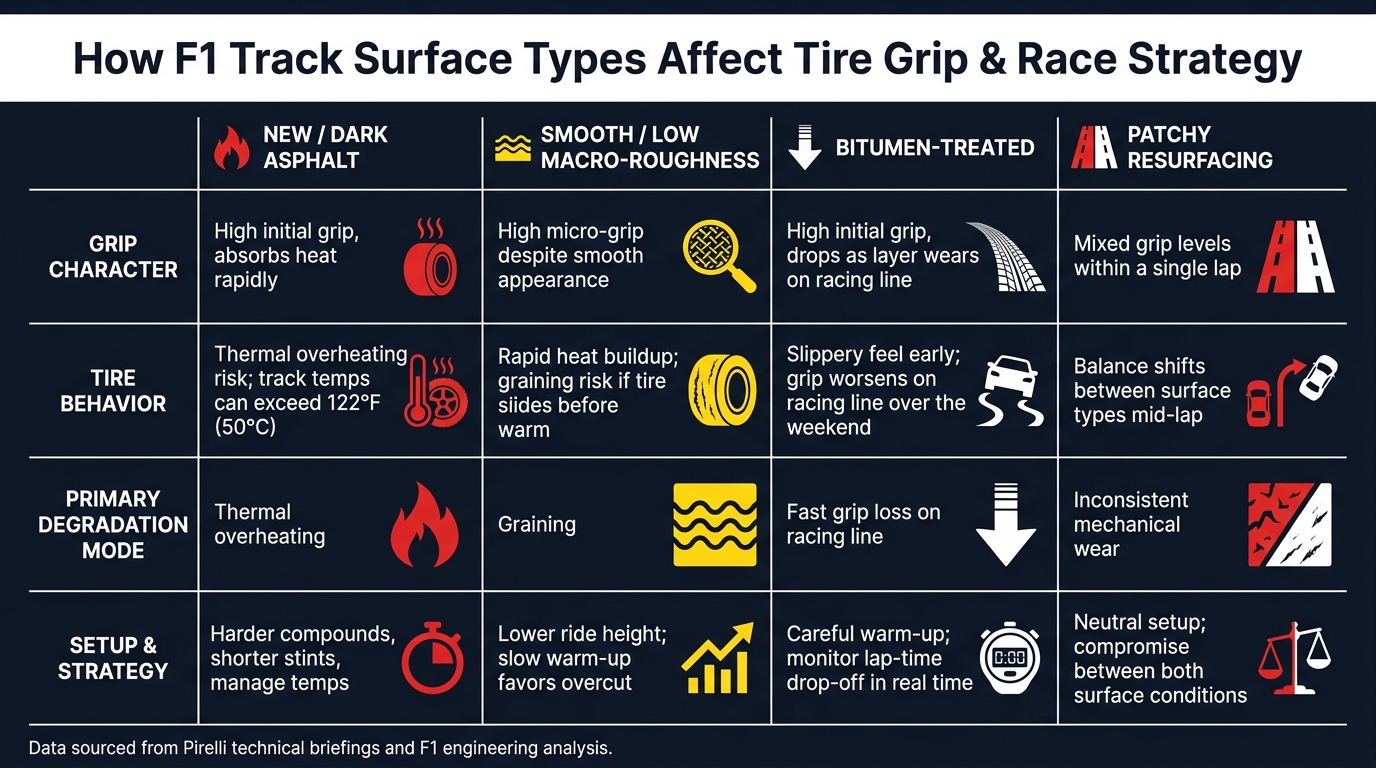
F1 Track Surface Types: Grip, Tire Behavior & Race Strategy
Reading the surface before the car leaves the garage
Before a car heads out on Friday morning, engineers usually already have a solid read on what the track surface is likely to do to the tires. That early picture comes from Pirelli's pre-event roughness scans, along with a close look at the asphalt's age, color, and how it was built. Teams use that baseline as a reference, then compare it with FP1 data to see if grip is landing where they expected. FP1 is the first proper check: was the early read right, or is the surface moving around more than planned?
How asphalt age and weathering affect grip
Fresh asphalt behaves nothing like a surface that's been through a few seasons of racing, heat, and rain. New asphalt is usually darker and smoother than older pavement, and that darker color has a big effect. It absorbs more sunlight, which can send track temperatures well past 122°F (50°C) on a sunny day. Once that happens, the tire can get pushed out of its ideal operating range, and overheating becomes a bigger risk.
As asphalt gets older, the bitumen coating slowly wears away and more of the aggregate underneath gets exposed. The surface then becomes lighter in color, more abrasive, and rougher in a mechanical sense. Weathering can also calm a surface down over time. Miami in 2022 is a good example. During the first race weekend, the track chipped away and left small stones offline, but that was expected to settle as the surface cured. Older and rougher asphalt often gives the car more bite, but it also puts more stress on the tires. So teams have to walk a fine line between outright pace and degradation. That first read on temperature and grip feeds straight into the setup work that starts as soon as the car leaves the garage.
Aggregate, sealing, and patchy resurfacing
The stone used in the asphalt mix has a direct effect on how abrasive the surface feels and how that surface changes as it polishes. High-silica aggregates can keep bite at the microscopic level even after polishing starts. Granite-based aggregates, by contrast, tend to polish with time and slowly lose that bite.
Sealed or bitumen-treated surfaces make things even trickier. At the 2024 Chinese Grand Prix, Pirelli's Mario Isola pointed out that a liquid bitumen treatment had been applied to the Shanghai circuit:
"The track is going to change quite a lot during the weekend, because this layer of bitumen is disappearing, especially on the race line, and not on the other lines." - Mario Isola, Head of F1 and Car Racing, Pirelli
On that kind of surface, the racing line can lose grip as the weekend goes on, which flips the usual pattern of track evolution on its head.
Patchy resurfacing causes a similar headache. If only certain sections are relaid, the car ends up moving between grip levels in the same lap. That happened at Monaco in 2026, where the start/finish straight and Turns 7 and 8 were repaved. In practice, that means one lap can feel like two separate grip problems stitched together. Drivers feel that split right away, and the first telemetry traces usually show it too.
| Surface Type | Grip Character | Tire Behavior | Setup Implication |
|---|---|---|---|
| Fine / New Aggregate | High chemical and micro-grip | Rapid heat buildup; graining risk if the tire slides | Lower pressures to widen contact patch |
| Coarse / Aged Aggregate | High mechanical grip | Higher abrasive wear; faster degradation | Prioritize tire preservation and cooling |
| Sealed / Bitumen-Treated | High initial grip, then drops as the layer wears | Slippery feel early; grip can worsen on the racing line | Careful warm-up and thermal management |
| Patchy Resurfacing | Mixed grip across a single lap | Balance shifts between surface types | Neutral setup to handle both sections |
Macro-roughness versus micro-roughness
Macro-roughness shapes mechanical bite and drainage. Micro-roughness affects adhesion and heat. So a track can look smooth in one sense but still be hard on the tires in another. Miami's 2022 asphalt is a perfect example: its macro-roughness was very low, yet its micro-roughness was the highest Pirelli had measured at that point. As Mario Isola put it:
"In terms of numbers, this asphalt was different from the others because the macro roughness was very, very low, but the micro roughness was I believe the highest of the championship." - Mario Isola, Head of F1 and Car Racing, Pirelli
For engineers, that mix changes the setup picture. Because the surface is smooth at the large scale, the car can run stiffer suspension and a lower ride height. But because the fine-grain texture still puts heat into the tires, the surface can remain hard on tire temperatures. Those roughness readings become the benchmark for FP1, and FP1 then tells the team whether those numbers line up with the car's actual grip window.
sbb-itb-7c68254
Measuring grip changes across practice sessions
Once teams know the asphalt profile, practice sessions show whether the track is doing what they expected. FP1 is the first check. It either confirms the pre-weekend grip model or tells engineers they need to rethink it. Teams watch sector-time trends to see which parts of the lap are changing faster than expected, especially around resurfaced patches or worn bitumen on the racing line. When grip isn’t even across the lap, sector deltas usually flag it first.
FP1 tells teams where grip is moving. FP2 tells them whether that grip will stick around. That’s why FP2 matters so much for long-run work. Engineers compare tire compound degradation lap by lap, then work out whether the car is short on front grip in cooler conditions or losing rear traction as track temperature climbs. F2 and F3 rubber can also add a clear step in grip before F1 gets going. By FP3, the circuit is often close to its most rubbered-in point before qualifying. Street tracks like Monaco are a different story. Overnight traffic can scrub the surface back down, so grip may fall off again each morning.
Data traces that indicate low or high grip
After engineers know the grip level, they look at how the driver is dealing with it. The steering trace is one of the first places they check. A saw-tooth pattern, with lots of small corrections, is a strong sign of low grip or a surface that isn’t consistent.
The braking trace often backs that up. If brake pressure jumps around in heavy braking zones, the tires may not be finding enough mechanical purchase. Throttle traces tell the same kind of story on corner exit. On a slippery track, drivers often feed in throttle with a few hesitant stabs. On a well-rubbered surface, that trace usually turns into one smooth, aggressive ramp. Rising track temperatures can also push the tires toward a thermal limit, which makes grip less steady.
Matching driver feedback to telemetry data
Driver comments and telemetry almost never say the same thing in the same words, so engineers spend a lot of time translating one into the other. When a driver says the "front isn't biting," engineers will usually see that in the data as front tire surface temperature swings and understeer in the steering trace. Put simply, that points to graining or not enough heat in the front contact patch.
"Rear sliding on exit" points somewhere else. That often matches high rear slip ratios and hesitant throttle traces through slow corners. In many cases, it suggests a polished or sealed surface that isn’t giving the rear tires enough traction.
When a driver says the car rides bumps poorly, engineers treat that as a different kind of clue. They check the ride data for vertical G-load spikes and look for skid wear on the floor. That link helps them decide what to chase next: more front bite, calmer rear traction, or more compliance over bumps.
| Driver Comment | Telemetry Signal | Likely Surface Cause |
|---|---|---|
| "Front not biting" | Surface temp fluctuations, understeer in steering trace | Graining; insufficient front tire heat |
| "Rear sliding on exit" | High rear slip ratio, hesitant throttle trace | Polished or sealed surface; low traction |
| Car rides bumps poorly | Vertical G-load spikes, skid wear on floor | Rougher surface than predicted; suspension too stiff |
Turning grip readings into setup changes
Once engineers understand the track surface, they turn that read into setup changes right away. The first levers are usually suspension and ride height, because those two shape how the car deals with the road underneath it.
Suspension, ride height, and mechanical balance
On rougher surfaces, teams usually lean toward softer suspension. The goal is stability more than outright grip. A car that stays settled over bumps gives the driver something they can trust, even if it gives away a bit at the limit.
On smoother, newly resurfaced tracks, the focus shifts. Teams want to run the car lower to get more from the aerodynamics. But that comes with a catch: the lower the car runs, the more likely it is to wear the skid block and damage the floor. Andrew Jarvis of McLaren put it like this:
"Fewer bumps around the track may mean we can run lower – but lower brings with it the potential to heat the skid and cause damage to the bib area at the front of the floor." - Andrew Jarvis, Engineer, McLaren
Patchy resurfacing makes life harder. If one part of the lap is smooth and another is rough, teams can't tune the car fully for either one. So they go for a middle ground that stays stable through the change in surface conditions.
Once that platform is under control, attention shifts to the tire window.
Pressure, camber, and heat management
Surface texture also changes the targets for tire pressure and camber. On rough, weathered asphalt, a more conservative mechanical setup helps keep the car settled. On smooth or sealed surfaces, the bigger issue is heat build-up rather than graining, so pressure and camber changes are aimed at keeping internal tire temperatures in check.
Aero balance and brake bias on inconsistent surfaces
When grip changes from one corner to the next, braking on entry can feel uneven and hard to predict. Teams answer that with a steadier aero balance and small brake-bias changes, so the driver gets a more consistent car on turn-in and more confidence in the braking zone.
Those setup calls also feed straight into tire wear and stint length.
How surface traits drive stint length and race strategy
Forecasting degradation and compound behavior
Engineers start with a simple question: will this surface cook the tire, or will it tear it up? That call shapes compound choice and stint length from the outset.
New, dark asphalt can send track temperatures past 122°F (50°C). When that happens, the main danger shifts to thermal overheating, not pure mechanical wear. Teams usually answer that with harder compounds and shorter stints so they can keep tire temperatures under control.
Surface texture matters too. Higher macro-roughness tends to push the tire toward mechanical wear. By contrast, smooth surfaces with low macro-roughness are more likely to bring on graining, especially if the driver leans on the compound before it reaches its operating window.
| Surface Type | Primary Degradation Mode | Strategic Risk |
|---|---|---|
| New/Dark Asphalt | Thermal overheating | Harder compounds and shorter stints; grip drops off sharply if pushed too early |
| Smooth/Low Macro-Roughness | Graining | Slow warm-up; overcut gains value |
| Bitumen-Treated | Fast grip loss on the line | Grip can drop on the racing line as the treatment wears off |
Adjusting race plans as grip shifts on race day
Once practice shows where the grip window sits, Sunday becomes a timing game: how long will that window hold?
Cooler race-day conditions can pull the tire away from its operating range. So a compound that looked strong on Saturday may need gentler handling once the race starts. Rubber build-up often helps extend stint length, but street circuits can shed that rubber overnight. That means Sunday grip may begin lower than practice data hinted. Teams treat that like a new baseline and move pit windows based on how fast the track rubbers in again.
When grip changes during the race, strategy has to move with it. On bitumen-treated or patchy surfaces, the racing line can lose grip faster than other parts of the track. As that treated layer wears away under race traffic, strategy teams track lap-time drop-off in real time instead of leaning only on pre-race degradation models.
Conclusion: Linking asphalt, data, setup, and stints
Surface age, texture, and treatment shape the grip curve. Practice data then turns that curve into setup calls and stint plans.
FAQs
Why can a smooth track still overheat F1 tires?
A smooth track can still overheat F1 tires because surface texture is only one part of the story. Dark asphalt soaks up a lot of heat from the sun, which pushes track temperatures up and can send tires past their ideal operating window.
High-speed corner sequences add even more energy to the rubber. So even though a smooth surface cuts down on mechanical wear, hot weather and lower abrasive cooling can still lead to overheating.
How do teams tell if the track surface is changing in practice?
Teams keep a close eye on tire data such as grip, wear, and temperature. Then they line that up with lap times and handling patterns as more rubber gets laid down on the racing line.
They also inspect surface roughness and note any changes caused by resurfacing work. Sharp grip changes in different parts of the track can hint that the circuit is still changing, while drivers help fill in the picture with live feedback on subtle vibrations and shifting grip.
How does track surface affect pit strategy and stint length?
Track surface shape has a big effect on pit timing and stint length because it changes tire grip and wear as asphalt roughness, aggregate, sealing, and temperature shift through the weekend.
Rough, abrasive surfaces usually lead to more wear, shorter stints, and more pit stops. Smoother surfaces can cut wear, but they can also make it harder to get tires into the right temperature and grip window. That trade-off matters. A track that looks easy on tires at first can still cause problems if the tires never switch on properly.
Teams watch practice data closely, especially grip levels, tire degradation, and whether the tires warm up too slowly or run too hot. They use that information to tweak setup and fine-tune undercut or overcut timing.