F1 turbo lag guide: causes, fixes, trade-offs
Explains causes of F1 turbo lag, how teams reduce it (turbo sizing, anti‑lag, MGU‑K torque fill) and the performance trade-offs.
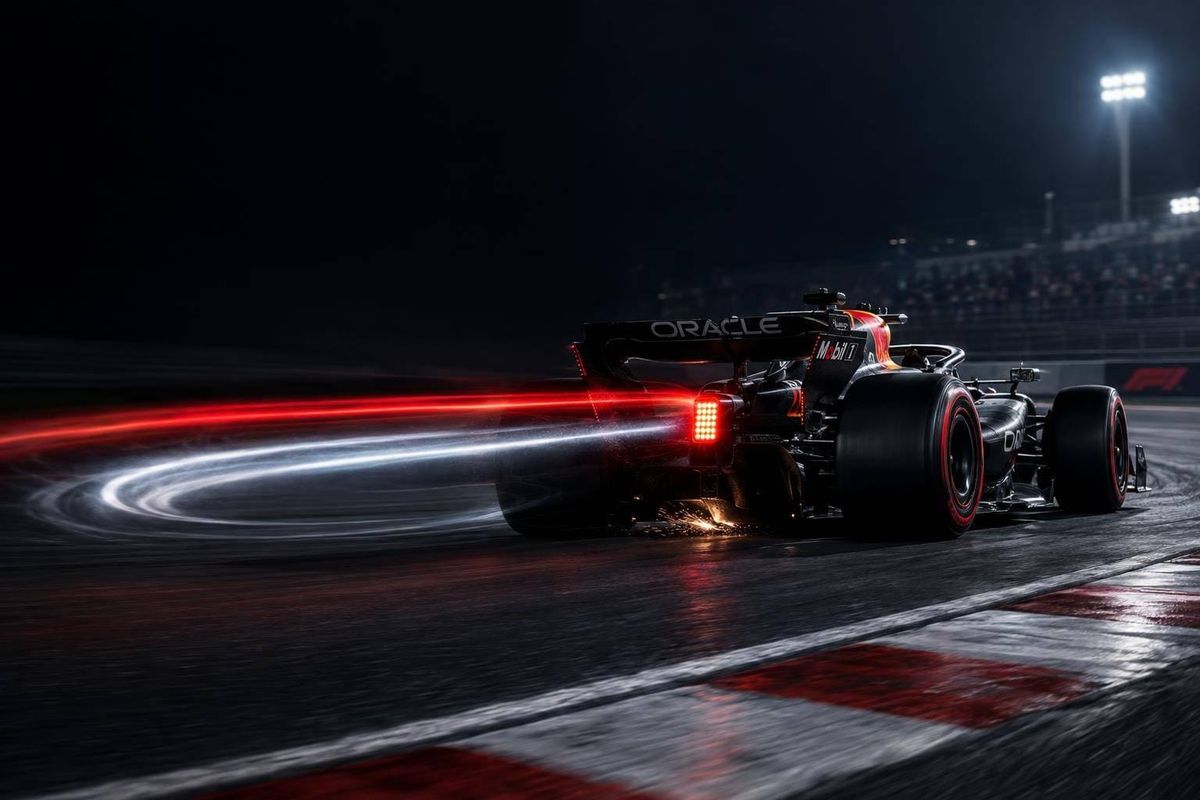
F1 turbo lag is the wait between pressing the throttle and getting the requested boost. To judge its effect, compare throttle input, boost, wheel torque, and tire slip - not acceleration alone.
From 2014–2025, the MGU-H could electrically spin the turbo. In 2026, that system is gone: the MGU-K can add drivetrain torque while boost builds, but it cannot spin the turbo directly.
The main fixes come with costs:
- Smaller, lighter turbos can spool faster but may restrict airflow at high rpm.
- Pre-spooling and anti-lag keep the turbo ready but consume energy and can add heat and wear; their use depends on the rules.
- Engine and exhaust design shape response within airflow and packaging limits.
- Electrical torque fill, torque maps, and driver settings help control delivery but must account for battery use and tire grip.
The goal isn't just less lag. It's predictable torque the tires can use, without draining energy needed later in the lap.
Turbo Lag Explained: Why F1 2026 Dropped Its Lag Killer
sbb-itb-7c68254
How F1 turbo response changed through 2026
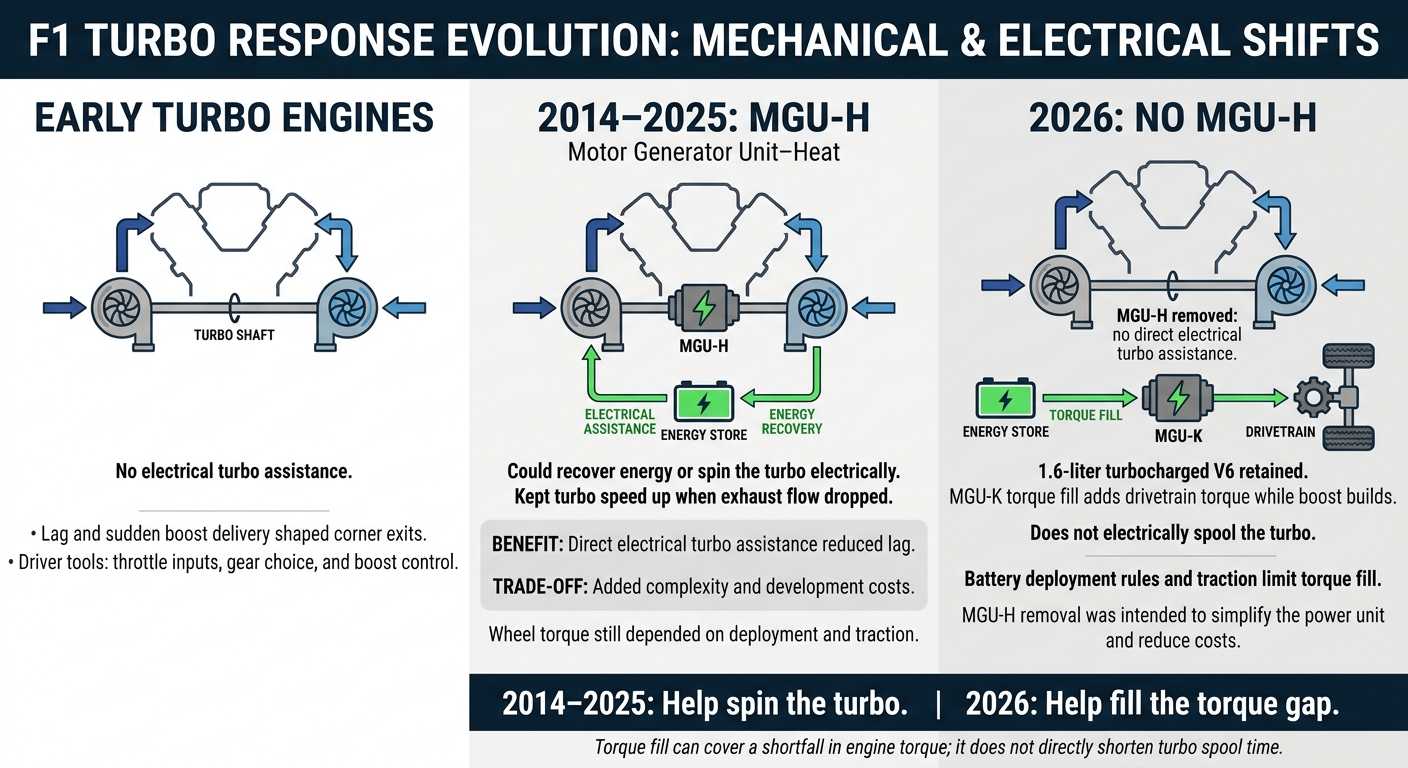
F1 Turbo Lag: MGU-H vs. MGU-K Torque Fill
Turbo lag changed as F1 changed how it drove the turbo.
Early turbo engines: Lag and sudden power delivery
Early turbo F1 engines had no electrical turbo assistance. Lag and sudden boost delivery shaped corner exits, so drivers used throttle inputs, gear choice, and boost control to time the power and keep the car stable. Hybrid systems changed that approach.
2014–2025: Direct turbo assistance from the MGU-H
The Motor Generator Unit–Heat (MGU-H) sat on the turbo shaft and could either recover energy or spin the turbo electrically. From 2014 through 2025, it kept turbo speed up when exhaust flow dropped. That made it both an energy-recovery device and a tool for reducing lag, though torque at the wheels still depended on deployment and traction.
This control added complexity and increased development costs. Removing the MGU-H was intended to simplify the power unit and cut those costs. The next rule change did away with that direct turbo assistance.
2026: Turbo response after MGU-H removal
The 2026 regulations keep the 1.6-liter turbocharged V6 but remove the MGU-H - and with it, direct electrical assistance for the turbo. The MGU-K now supplies the main electrical torque through the drivetrain. Its torque fill can cover a shortfall in engine torque while boost builds, but it does not electrically spool the turbo.
The task shifts from keeping the turbo spinning to covering its delay with drivetrain torque. Battery deployment rules and traction limit how much of that torque fill reaches the driver. Engineers must then weigh the fixes that sharpen response against the costs each one brings.
Turbo-lag fixes and their costs
| Method | Mechanism | Benefit | Penalty | F1 applicability |
|---|---|---|---|---|
| Smaller turbo | Lowers rotating inertia if the assembly is lighter | Can shorten spool time | May limit high-rpm airflow and peak power | Current design trade-off |
| Pre-spooling | Builds turbo speed before torque is requested | Cuts the delay after throttle application | Uses electrical or combustion energy | Historical or current, depending on the permitted mechanism |
| Combustion-based anti-lag | Uses combustion energy to maintain turbine speed | Keeps boost available when engine-torque demand is low | Adds fuel use, exhaust heat, and component wear | Restricted and era-dependent |
| MGU-K torque fill | Adds drivetrain torque while engine torque builds | Fills the torque gap without directly shortening spool time | Uses electrical energy that may be needed later | Current: 2026 onward |
| Engine geometry and exhaust design | Shapes combustion and gas flow | Can improve turbine response and efficiency | Must balance airflow, heat, and packaging needs | Current, within tightly defined engine rules |
| Torque maps and driver settings | Shape torque requests and electrical deployment | Make power delivery smoother and more predictable | May soften acceleration or use more battery energy | Current, subject to control-system restrictions |
Turbo size, inertia, and airflow
With the MGU-H gone, turbo size and matching matter more again. A smaller turbo can spool faster, but it may limit peak airflow. Lower rotating inertia helps the turbo accelerate, while turbine sizing and compressor matching still need to support airflow at high rpm.
Pre-spooling and combustion-based anti-lag
Combustion-based anti-lag uses late ignition and extra fuel to keep the turbine spinning when the driver is off the throttle. Whether it's legal depends on the era's fuel, throttle, and engine-control rules. The price is more heat, fuel use, and component wear.
Electrical turbo assistance vs. torque fill
In 2014–25, the MGU-H could spin the turbo shaft directly. In 2026, the MGU-K adds drivetrain torque instead - not turbo shaft speed. That shifts the task from controlling turbo speed to shaping torque delivery.
Engine design, torque maps, and driver settings
Engine geometry and exhaust design set the baseline response that calibration must work with. Torque maps can smooth the handoff between combustion and electrical power, but software can't create energy.
Driver settings determine when to deploy electrical energy and when to save it. They make delivery more predictable and the delay easier to manage, rather than removing lag. Drivers still have to account for that delay through throttle timing, gear choice, and traction.
How turbo lag affects driving and lap time
The power unit sets the response. The driver’s job is to turn that response into speed out of the corner.
Throttle timing, gear choice, and traction
Getting on the throttle earlier only helps if the rear tires can handle the torque when it arrives. Exit speed depends on traction, gear choice, and how smoothly usable torque builds.
That balance also guides setup decisions throughout a run - not just through one corner.
Setup and energy use across a lap
Repeated corner exits over a stint reveal the trade-off: delivering usable torque sooner can improve exit speed, but it also increases tire and deployment energy costs.
How to read boost and torque data
Compare throttle, boost, delivered torque, wheel slip, and battery state on a data trace. Together, they show whether usable torque arrives soon enough to improve exit speed without causing wheelspin or using deployment energy too quickly.
Conclusion: Predictable torque matters more than spool time alone
Turbo lag matters only when the driver can use the wheel torque that follows.
From 2014 to 2025, the MGU-H electrically spooled the turbo, improving response while adding cost and complexity. With its removal, the 2026 electrical system takes on more of that work through drivetrain torque fill.
The target is repeatable torque the driver can use every lap. Assess any fix by efficiency, durability, heat, packaging, and energy use across a full lap - not spool time alone.
FAQs
How can I distinguish turbo lag from traction limits?
Turbo lag is a pause followed by a surge in power after you apply the throttle, even with good grip. That delay happens while the turbo builds speed.
Traction limits cause immediate wheelspin or limit acceleration even when you hold the throttle steady. Better grip, short-shifting, or less torque can ease the problem.
F1’s MGU-H can reduce lag by keeping the turbo spinning, so persistent drivability problems are more likely related to traction.
Which corners expose turbo lag the most?
Turbo lag is most noticeable in corners where drivers lift off the throttle, cutting exhaust flow, then need hard acceleration on exit. Think slow corners that require heavy braking, such as Monaco-style tight turns, or chicanes with a long pause before drivers accelerate hard. With less exhaust energy during that pause, keeping the turbo spinning becomes harder without extra hybrid assistance.
Can torque fill hurt performance later in a lap?
Yes. Using electrical torque to spin the turbo shaft eliminates lag on corner exits, but it draws energy that could otherwise power the car or be saved for later. That creates a trade-off: FIA rules limit energy deployment, including the MGU-K’s 4 MJ per lap limit. Using stored energy early may mean cutting power use later, potentially reducing straight-line speed or leaving fewer options to defend a position.