Miami Circuit Drainage: Track Build Study
Examines Miami F1 track drainage planning, data gaps, and why design intent isn't proof of wet-weather performance.
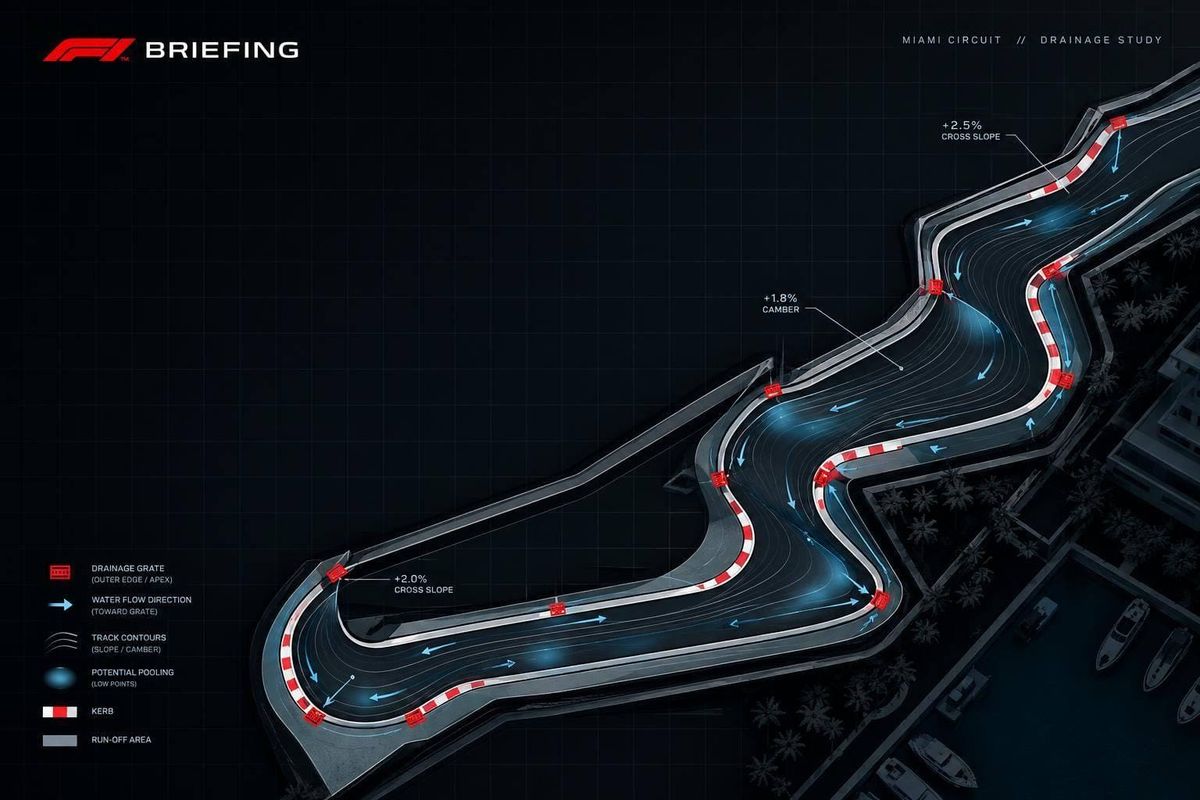
I see Miami’s drainage as a planning case - not proof of heavy-rain performance. The reported ACO Qmax slot drains suit the stadium site’s shallow excavation limits, but the available sources do not verify drainage capacity or wet-weather results.
My takeaway: check the entire water route, not just the drains.
- Below ground: High groundwater limits excavation; storage volumes and discharge limits remain unconfirmed.
- At the surface: Track slopes and inlet levels need survey checks. Resurfacing alone does not prove better drainage.
- Before race week: Check for blocked inlets and keep temporary structures out of runoff paths.
I’d apply the same test to Zandvoort and Madrid: separate plans from installed work, then check drawings and rain-event records. <u>Design intent is not measured performance.</u> Without those records, claims about ponding or hydroplaning remain unverified.
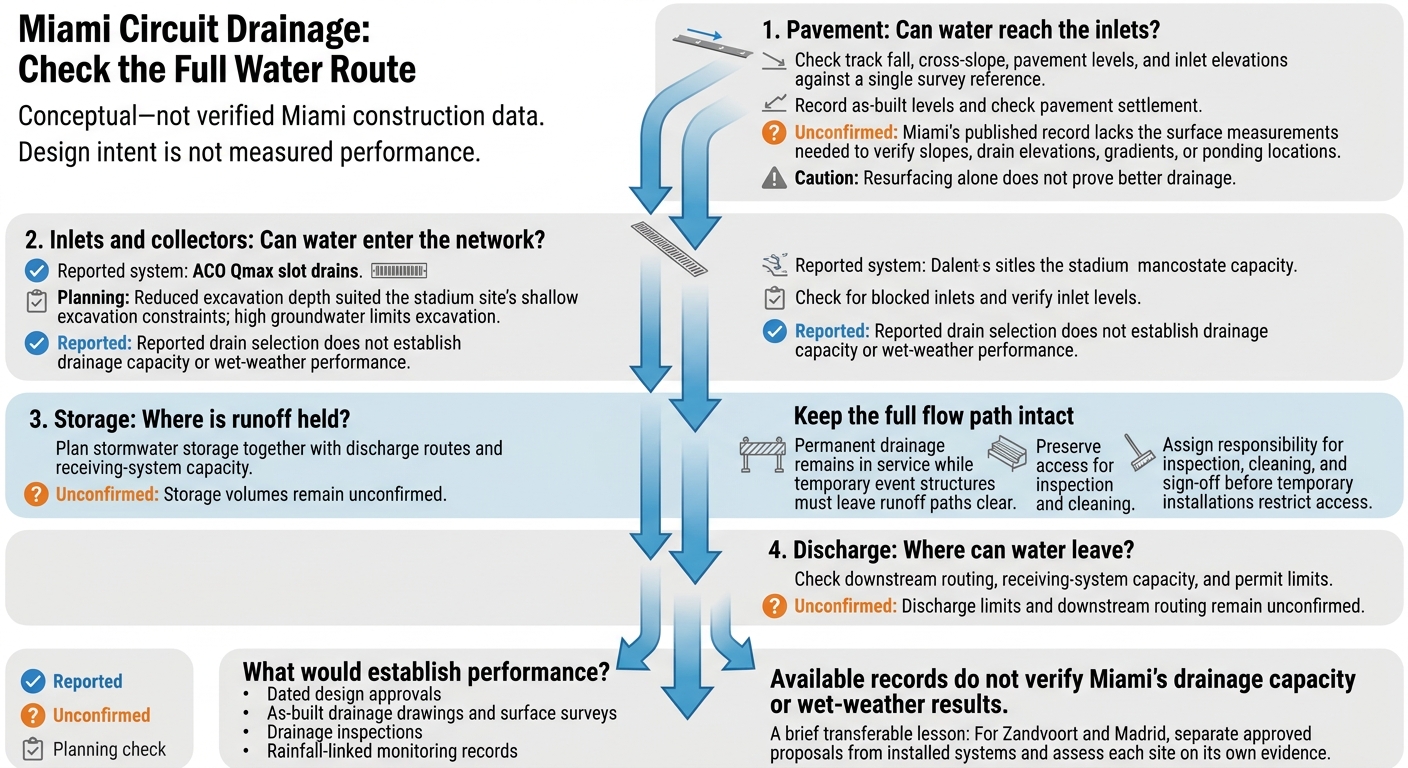
Miami Circuit Drainage: Check the Full Water Route
Water Collection, Storage, and Discharge
ACO’s Reported Shallow Drain Design
The available sources identify ACO Qmax slot drains as the shallow system used to collect runoff from the racing surface. Their reduced excavation depth suited the stadium’s tight site constraints.
On a flat site, shallow drains preserve the slope needed for gravity flow. That makes surface elevation control the next key factor in Miami’s drainage performance.
Stormwater Storage and Discharge Limits
The published record does not confirm storage volumes, discharge limits, or downstream routing for the drainage system.
The next issue is how the track surface itself sheds water.
sbb-itb-7c68254
Track Shape and Surface Drainage
Surface Surveys and Pavement Levels
With the drain network already constrained, track geometry determines whether runoff reaches it. Miami’s published record lacks the surface measurements needed to check track fall, cross-slope, or drain elevation. It therefore cannot support dimensions in feet or inches, identify ponding locations, or establish drain gradients. Drainage toward the shallow collectors remains an inference, not a verified finding.
The sources also do not confirm LiDAR-based surface models. Without those models or project drawings, a Miami-specific cross-section showing surface slopes, drain entries, and underground connections would lack support. Any diagram should be labeled conceptual - not verified Miami construction data.
Resurfacing and Drainage Performance
The same data gap limits what can be said about later surface work. The available sources provide no dated technical account of Miami’s early surface concerns or later resurfacing. They also lack before-and-after surface surveys, drainage inspections, and rainfall-linked track observations needed to assess hydraulic performance.
Claims that resurfacing corrected ponding - or that grip and surface wear concerns proved drainage defects - remain unsupported. The sources also provide no measured standing-water depth or linked tire, speed, and spray data to support Miami-specific hydroplaning claims.
How the Miami F1 Track was Built
Temporary Event Builds and Permanent Assets
Once the race-week build is in place, surface runoff must still reach the shallow drainage network described above. Miami uses a hybrid setup: the permanent drainage network stays in service, while race-week structures must leave runoff paths clear.
Stadium Sites vs. Purpose-Built Circuits
Miami’s event layout must fit within the stadium grounds. Even when the subsurface drainage network stays unchanged, temporary structures can redirect runoff or restrict access to drains.
| Planning issue | Miami stadium-site considerations |
|---|---|
| Drain access | Keep covers and inlets reachable around temporary installations |
| Runoff routes | Keep temporary footprints clear of flow paths toward drains |
| Maintenance access | Leave room for inspection and cleaning before race week |
The priority in Miami is to check that water can still reach the drains as designed after the race-week build is installed.
Drain Checks Before Race Week
Pre-race inspection is the final check that the temporary build has left drainage paths intact. Miami’s pre-race maintenance includes blocked-drain checks and inlet-level verification. Inspections should also check for pavement settlement that could disrupt flow toward the shallow system’s inlets.
Assign responsibility for inspection, cleaning, and sign-off before temporary installations restrict access. Before race week, inspect drains and confirm that barriers, grandstands, and hospitality structures do not cover inlets.
Drainage Lessons for New Formula One Venues
Miami’s lesson is simple: design intent is not proof of performance. The available record does not verify drainage capacity or wet-weather results. Miami therefore serves as a planning case - not evidence that the drainage system performs as intended.
Drainage Planning Checklist
Before finalizing the layout, survey seasonal groundwater, map overland flow paths, and set rainfall design criteria. Plan storage, discharge paths, receiving-system capacity, and permit limits together.
Before paving, align crossfall, curbs, pavement layers, and inlet elevations to a single survey reference. Then record as-built levels. Assign responsibility for inspection, cleaning, and rain-event monitoring across both permanent assets and temporary builds.
These standards help separate useful case studies from unsupported claims.
Drainage Projects at Zandvoort and Madrid
For Zandvoort and Madrid, separate approved proposals from installed systems. Use only dated design approvals, as-built drainage drawings, and rainfall-linked monitoring records. Assess each project against its own terrain, groundwater, receiving-system capacity, and permit limits.
Conclusion: Connecting the Drainage System
A circuit drains only when pavement, inlets, storage, outfalls, and maintenance work together, keeping the full flow path intact.
At Miami’s stadium, temporary layouts need complete drainage planning so race-week structures don’t block the flow paths the permanent system relies on.
Public race-week summaries offer no technical data on ponding, clearance time, or discharge compliance. That makes Miami a case study in how drainage components work together - not a proven benchmark for heavy rain.
FAQs
How can high groundwater affect track drainage?
High groundwater levels leave soil with less room to absorb surface water. Once the ground is saturated, runoff can pool on the track, reducing grip and increasing the risk of hydroplaning.
Drainage systems must account for local groundwater conditions. This helps prevent lingering moisture from weakening the track and putting safety at risk during rainfall.
What data would prove Miami’s heavy-rain performance?
Engineers and analysts use sector times and lap deltas to pinpoint when grip loss slows the pace compared with dry conditions. Onboard video and driver radio feedback provide context on spray, standing water depth, and stability under braking.
Reports from marshals and spotters at key corners help confirm drainage conditions. Combined with FIA-reported slippery-surface flags, these inputs help teams assess how well drainage works during heavy rain.
Can effective drainage eliminate hydroplaning?
Good drainage lowers hydroplaning risk by reducing standing water, but it can't remove that risk during extreme weather. Heavy rainfall can overwhelm drainage systems and leave water on the track.
A properly designed track surface directs water away from the racing line, helping tires maintain grip. Teams and race control use real-time feedback - including driver reports of hydroplaning - to track changing conditions and manage safety.