Hamilton vs Verstappen: Qualifying Under Pressure
Aggressive one-lap peak now outperforms long-term qualifying consistency; recent tests favor attack while experience wins when conditions get messy.
If you want the short answer: I’d give Verstappen the edge in recent high-pressure qualifying, while Hamilton still has the stronger long-term pole record.
From the article, I see a clear split:
- Hamilton owns the career numbers, with 101 poles as of October 2021
- Verstappen looks stronger in the more recent pressure test, especially from 2021 onward
- Hamilton’s teammate bar was higher: 7.0/10 average difficulty vs. 5.6/10 for Verstappen
- Verstappen’s pole-to-win rate was better in the 2021 snapshot: 63.6% vs. 58.4%
- The key 2021 sessions split both ways:
- Bahrain: Verstappen by 0.388s
- Silverstone: Hamilton by 0.075s
- São Paulo: Hamilton fastest by 0.438s before disqualification
- Abu Dhabi: Verstappen by 0.371s
What stands out to me is simple: Verstappen tends to hit a higher one-lap peak when the car is sharp and the lap rewards full commitment. Hamilton looks stronger when the lap gets messy, grip shifts, or the car needs more care through braking and rear movement.
So if you’re asking who is better under qualifying pressure, my read is:
- Recent edge: Verstappen
- Career edge: Hamilton
- Cleaner execution in unstable conditions: Hamilton
- Higher one-lap ceiling in the right setup: Verstappen
Here’s a quick side-by-side view.
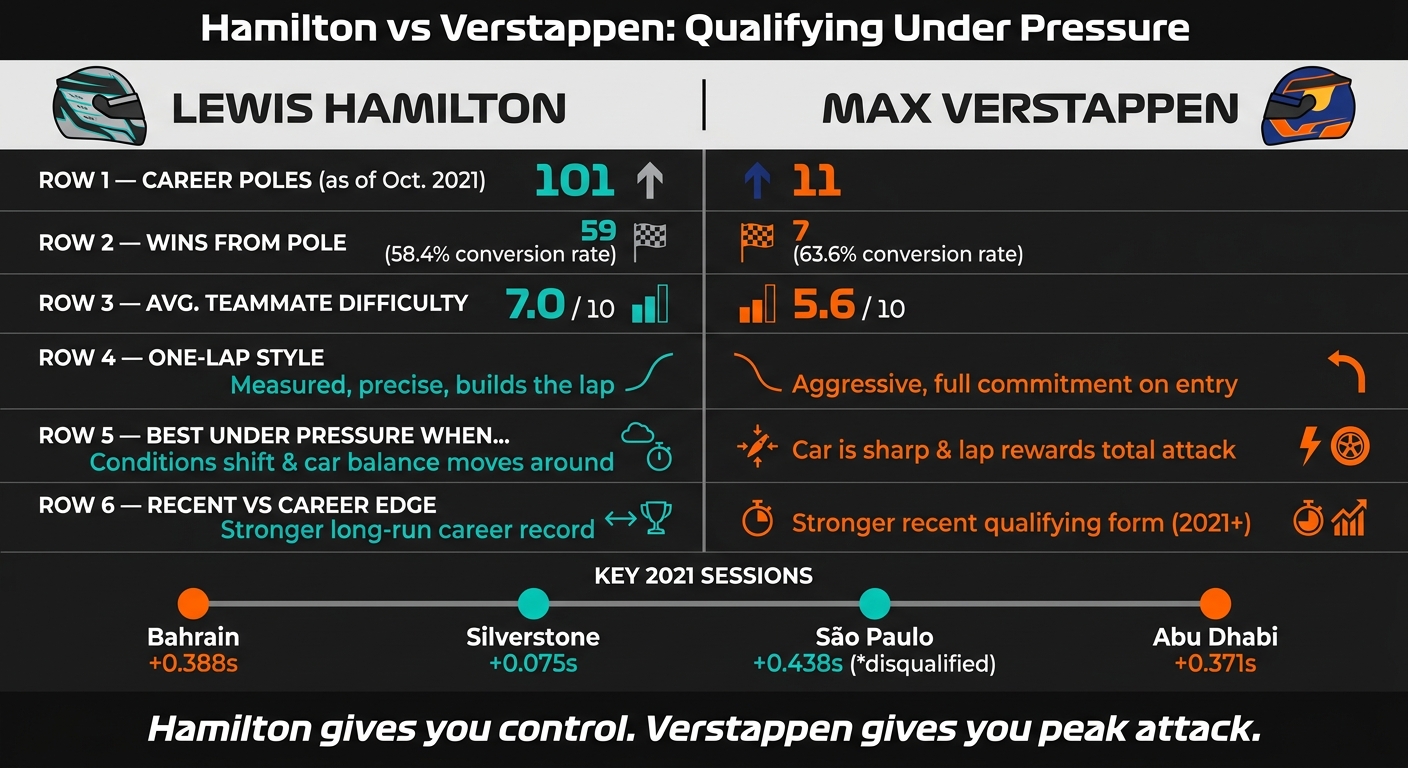
Hamilton vs Verstappen: Qualifying Pressure Head-to-Head
Quick Comparison
| Criteria | Lewis Hamilton | Max Verstappen |
|---|---|---|
| Career poles (Oct. 2021) | 101 | 11 |
| Wins from pole (Oct. 2021) | 59 | 7 |
| Pole-to-win rate (Oct. 2021) | 58.4% | 63.6% |
| Avg. teammate difficulty | 7.0 / 10 | 5.6 / 10 |
| One-lap style | Measured, precise, builds the lap | Aggressive, early commitment |
| Best under pressure when... | Conditions change and car balance moves around | Car is pointy and the lap rewards attack |
| Main article verdict | Strong long-run record | Stronger recent edge |
If I had to sum up the whole piece in one line, it would be this: Hamilton gives you control; Verstappen gives you peak attack.
sbb-itb-7c68254
Hamilton vs Verstappen: Qualifying Numbers Side by Side
Career pole totals lean hard toward Hamilton. But if you're trying to judge who has been better in qualifying, the cleaner test is what happened after 2021.
Hamilton's 101 poles versus Verstappen's 11, as of October 2021, say a lot about era and car as much as raw one-lap pace. So the gap is real, but it doesn't tell the whole story.
How Each Driver's Qualifying Form Has Changed Since 2021
After 2021, Verstappen became the driver to beat over one lap, while Hamilton was trying to extract lap time from a Mercedes that wasn't as sharp as before. That shifts the frame a bit. It's no longer just about totals. It's about what each driver does when the lap has to be nailed.
| Season Snapshot | Lewis Hamilton | Max Verstappen |
|---|---|---|
| Poles (career, October 2021) | 101 | 11 |
| Wins from pole (October 2021) | 59 (58.4% rate) | 7 (63.6% rate) |
| Avg. teammate difficulty | 7.0 / 10 | 5.6 / 10 |
As of late 2021, Verstappen's pole-to-win conversion rate was higher than Hamilton's, even with far fewer poles overall. It's a small sample compared with Hamilton's, sure. Still, it hints at something worth noticing: when Verstappen gets track position at the front, he tends to cash it in.
Pressure Indicators Beyond Pole Count
Two things cut deeper than raw pole numbers: teammate strength and how a driver reacts to a car on the limit.
Hamilton has spent his career qualifying against teammates rated at an average difficulty of 7.0 out of 10. Verstappen's teammates sit at 5.6 out of 10, with Sergio Perez rated at 5/10. That gap matters. Hamilton has had to scrape out tenths against strong qualifiers in the same machinery, not just drivers filling the other seat. Rosberg is cited as the toughest qualifier Hamilton has faced, and those fights pushed Hamilton to sharpen his prep and become more complete.
Verstappen's edge shows up a little differently. It comes through in his ability to "overdeliver" in the moments that decide grid order. In 2026, he was also noted for picking up car degradation issues during sessions that Red Bull's own engineers and telemetry missed. That's the kind of feel drivers talk about but stats don't always catch. On a single hot lap, that sensitivity can be the difference between a strong lap and pole.
"Max's mental strength is the strongest point... The mental games that he's playing as well, Lewis is doing the same thing." - Johnny Herbert, Former F1 Driver
Those numbers start to frame the sessions where the gap stops being abstract and starts showing up on the stopwatch.
The Qualifying Sessions That Show the Difference Most Clearly
Four 2021 qualifying sessions make the gap in style easier to see than career totals ever could: Bahrain, Silverstone, São Paulo, and Abu Dhabi. Each one brought a different kind of stress test - outright pace, home-race pressure, penalties, or title-deciding tension. And each one revealed something different about how these two drivers handled qualifying when the room for error got tiny.
| Session | Date | Pole | Margin | Key technical factor | Pressure point |
|---|---|---|---|---|---|
| Bahrain GP | 03/27/2021 | Verstappen | 0.388s | RB16B floor/diffuser updates | Season-opening statement of intent |
| British GP | 07/16/2021 | Hamilton | 0.075s | Mercedes W12 aero upgrades | Home crowd & inaugural Sprint format |
| São Paulo GP | 11/12/2021 | Hamilton* | 0.438s | New ICE | Title pressure |
| Abu Dhabi GP | 12/11/2021 | Verstappen | 0.371s | Soft tires, Pérez slipstream | Winner-takes-all title finale |
*Hamilton was fastest in the session but was later disqualified due to a DRS wing infringement.
Bahrain and Silverstone: Raw Pace vs Precise Execution
Bahrain felt like a clear opening shot. Verstappen put the RB16B on pole by 0.388 seconds. It was a clean, sharp lap built on front-end confidence, and it showed right away that Red Bull had a car that could attack over one lap.
Silverstone turned that picture around. Hamilton hit back at his home race with a 0.075-second margin - the sort of gap that can vanish with one small twitch in a fast corner. Track temperatures kept shifting, so grip wasn’t sitting still from lap to lap. Hamilton handled brake pressure and rear instability better than Verstappen. That mattered even more because of the first-ever Sprint format. One small error in qualifying could throw off the whole weekend before Sunday even arrived. If you want the cleanest example of Hamilton making the most of a tiny opening, Silverstone is probably it.
São Paulo and Abu Dhabi: Qualifying When the Title Is on the Line
São Paulo showed Hamilton with everything turned up. He had a five-place grid penalty, which meant every single place still mattered. His lap was 0.438 seconds quicker than Verstappen, though it was later erased from the official record because of a DRS wing infringement. Even so, the lap itself showed what he could do with the title fight pressing down on every session.
Abu Dhabi delivered Verstappen’s reply. In a winner-takes-all finale, Red Bull used Pérez’s slipstream to help blunt Mercedes’ straight-line edge. The result was a 0.371-second pole. Put those two sessions next to each other, and the contrast stands out: same pressure, different setup, different route to the limit.
Why Hamilton and Verstappen Handle Qualifying Pressure Differently
Their laps split for three main reasons: technique, car balance, and mindset. You can see that gap right away in how each driver approaches a single qualifying lap.
Driving Style and What Telemetry Shows
Hamilton’s qualifying style is built on precision. He’s known for modulating brake pressure to match how downforce falls away as the car slows, which helps him keep grip right at the edge without locking a wheel. He also tends to use a sharper, later-apex line through the corner, then get on the throttle earlier.
Verstappen goes about it in a different way. He’s often described as fully committed on corner entry, with a high tolerance for entry instability that teammates like Pierre Gasly and Alex Albon struggled to copy in the same car. Put simply: where Hamilton manages the car’s behavior, Verstappen attacks through it.
| Dimension | Lewis Hamilton | Max Verstappen |
|---|---|---|
| Driving style | Precise brake and throttle modulation; sharper, later-apex line | Aggressive, committed at every corner entry |
| How pace builds across runs | Builds rhythm; refines braking points across runs | Reaches peak pace early; commits when the car is in its window |
| Preferred balance | Responsive front end; high tolerance for rear instability | Sharp front-end setup; thrives on a pointy, rotation-focused car |
How Car Behavior Affects Each Driver Under Pressure
Driving style only works if the car gives the driver something to work with. That’s why Verstappen tends to be stronger in a sharp, front-end-heavy car, while Hamilton is better at managing a car that moves around more at the rear .
Hamilton has long preferred a stiff, responsive front end with a softer rear for traction. He is also unusually strong at dealing with rear instability that other drivers find hard to live with, using exact brake and throttle inputs to keep the car balanced as grip changes. When conditions shift - grip, wind, or temperature - Hamilton leans on experience to protect the lap and reset for the next corner. Verstappen, by contrast, stays committed on entry and trusts the car to rotate underneath him .
Mental Approach When Only One Lap Remains
This is where experience starts to matter even more. Hamilton has spoken plainly about how pressure builds across a title fight:
"I remember what it was like when I had my first [title fight] and it definitely mounted up. It was difficult. It was intense... through experience you find that balance, and you know that it's not all won on one corner."
That idea shows up in the way he qualifies. Hamilton is more likely to build toward the final lap, using experience to judge when to push and when to settle the car. Verstappen’s instinct points the other way: commit early, pull the most from the car while it’s in its operating window, and trust his feel for the limit.
Conclusion: Who Performs Better When Qualifying Pressure Peaks?
The earlier qualifying extremes point in one direction. Verstappen has the stronger recent edge. Hamilton has the stronger long-run record. Verstappen went 16-0 against Yuki Tsunoda in Grand Prix qualifying in 2025, while Hamilton was out-qualified 13-5 by Charles Leclerc over the same stretch. Their mental edges aren’t the same either: Verstappen leans more on resilience, while Hamilton leans on title-fight experience .
Key Takeaways from the Head-to-Head
These differences stand out most in four areas.
| Factor | Verstappen's Edge | Hamilton's Edge |
|---|---|---|
| Recent qualifying form | 16-0 vs. Tsunoda in 2025 | - |
| Teammate difficulty | - | 7.0/10 vs. Verstappen's 5.6/10 |
| One-lap approach | Attacks the limit | Protects the lap |
| Car behavior | Excels in a fast, difficult-to-drive car | Handles rear instability better than most |
That split is pretty simple. Verstappen has the edge when the car is sharp and the lap rewards total commitment. Hamilton looks like the safer pick when conditions change and precision counts for more. So under qualifying pressure, Verstappen’s ceiling looks higher in the right car, while Hamilton’s control shows more when the lap gets messy.
FAQs
Why does teammate difficulty matter here?
Teammate difficulty is a helpful benchmark because it compares drivers in the same car. That matters a lot. When the equipment is identical, it’s much easier to see who’s getting more out of the package. And when a driver is up against a tough teammate, weak spots are harder to hide.
Qualifying puts that pressure front and center. A strong teammate demands sharp focus, precise setup work, and clean laps, because even a tiny mistake can cost places on the grid and hurt a driver’s shot at a win.
How much does car setup shape qualifying results?
Car setup plays a huge role in qualifying because teams tune the car for one thing above all else: raw speed.
For a single flying lap, they’ll usually cut drag, stiffen the suspension, and lower the ride height. The goal is simple. Get as much aero efficiency and straight-line speed as possible for that one lap when everything has to click.
Of course, there’s a catch. Those setup calls come with trade-offs, because the car still has to stay steady and usable in the race, not just over one lap. That push and pull between qualifying pace and race consistency can lead to gaps of several seconds per lap.
Why focus so much on the 2021 sessions?
The 2021 season is the clearest point of comparison in this rivalry because it was the only year both drivers battled for the championship in cars that could win on pace.
That made it a rare pressure test. Hamilton leaned on the experience of seven world titles, while Verstappen went into his first genuine title fight. Their repeated clashes, and the sharp contrast in how they raced, show how each man dealt with pressure when the stakes were at their highest.