How Regulation Changes Reshaped F1 Aerodynamics
How F1 rule changes (2009–2026) shifted downforce, wake behavior and the move to ground-effect and active aerodynamics.
Formula 1's aerodynamic evolution is shaped by regulation changes aimed at improving racing quality, safety, and performance. Key shifts include:
- 2009/2014: Simplified wings and reduced downforce improved overtaking but introduced wake turbulence challenges.
- 2017: Wider cars with increased downforce boosted lap times but worsened wake turbulence, making overtaking harder.
- 2022: Ground-effect designs reduced "dirty air" and improved close racing, though teams later exploited loopholes that diminished benefits.
- 2026: Upcoming rules focus on reducing downforce and drag, improving wake management, and introducing active aerodynamics for closer, more strategic racing.
Each era reflects F1's ongoing effort to balance speed, competition, and new technologies.
1. 2009/2014 Regulations
Downforce Distribution
The 2009 regulations brought a massive overhaul to F1 aerodynamics. The FIA reduced the front wing width from 1,800 mm to 1,650 mm and limited the number of wing elements. This change drastically affected how downforce was generated across the car, slashing total downforce by 50%. Teams had to completely rethink their designs to adapt to this new reality.
Jean Todt, who was FIA President at the time, explained the reasoning behind these changes:
"The 2009 regulations were a necessary step to ensure the safety of drivers while also promoting closer racing through reduced downforce."
These adjustments didn’t just impact downforce distribution; they also reshaped how cars behaved in each other’s wake, influencing overtaking dynamics.
Wake Behavior and Overtaking
The simplified aerodynamics introduced in 2009 improved wake conditions significantly. By removing double-decker diffusers and simplifying wing structures, the regulations reduced wake turbulence. This created a cleaner aerodynamic flow, particularly noticeable 20 meters behind the car. For drivers following closely, this meant less performance loss in the "dirty air", making overtaking easier.
However, the story shifted with the 2014 regulations. While these rules also simplified wing designs, the introduction of hybrid power units and subsequent aerodynamic developments led to higher overall downforce levels. This increase brought back more turbulent wake conditions, making it harder for trailing cars to stay close. Nikolas Tombazis, FIA Single-Seater Director, highlighted this challenge:
"By 2014, the increased downforce levels had created a more turbulent wake, which made it difficult for cars to follow closely and overtake."
Design Direction
To adapt to the evolving regulations, teams had to innovate quickly. For example, Mercedes introduced a narrow front wing design, while Ferrari focused on reducing drag. These approaches reflected how teams navigated the restrictions and shaped race dynamics.
The 2014 regulations also accelerated the use of outwash aerodynamics. This technique, which directs airflow around the front tires instead of through them, became a key strategy for teams seeking an edge within the tighter regulatory framework. While effective, this approach worsened wake turbulence for trailing cars, setting up challenges that future rule changes aimed to resolve.
sbb-itb-7c68254
2. 2017 Regulations
Downforce Levels
The changes introduced in the 2017 regulations brought a bold departure from the more conservative designs of previous years. The FIA widened the cars by 8 inches (200 mm) and increased the front and rear tire widths by 1 inch (25 mm) and 1.2 inches (30 mm), respectively. These updates resulted in a 25–30% increase in downforce compared to the 2016 models. This leap in aerodynamic performance translated into faster lap times and higher cornering speeds.
Mercedes, for example, reported that their W08 delivered lap time improvements of over 1 second per lap at circuits like Silverstone compared to the 2016 car. This impressive gain was largely attributed to the new aerodynamic rules. James Allison, Technical Director at Mercedes-AMG Petronas F1 Team, described the impact of the changes:
"The 2017 regulations have transformed the way we approach car design, allowing us to exploit aerodynamics in ways we couldn't before."
However, while the added downforce boosted performance, it also introduced new challenges, particularly in how airflow behaved behind the cars, known as wake behavior.
Wake Behavior and Overtaking
Although the 2017 regulations brought significant performance gains, they also highlighted a key trade-off. The increase in downforce came with more complex wake dynamics, making it harder for cars to follow each other closely. While the simplified front wing design - reduced from four elements to three - helped manage airflow around the tires, the overall aerodynamic complexity of the cars still created turbulent air that hindered overtaking.
This balance between improved performance and competitive racing proved tricky. Nikolas Tombazis, FIA Single-Seater Director, explained the intent behind the changes:
"The 2017 regulations were a significant step towards improving the racing spectacle by allowing cars to follow each other more closely without losing downforce."
In reality, the gains in close-following were limited. The higher sensitivity of the cars to turbulent air often canceled out the intended benefits, making overtaking just as challenging, if not more so, than before.
Design Direction
To tackle these aerodynamic hurdles, teams pursued bold design innovations. Mercedes, for instance, developed a front wing with a more intricate endplate and a wider main element to better manage airflow around the tires. Ferrari’s SF71H featured a striking "shark fin" engine cover, which improved airflow to the rear wing, enhancing stability and downforce at high speeds. These adaptations reflected how teams were forced to rethink their aerodynamic strategies to address the wake-related challenges.
Craig Scarborough, an F1 Technical Expert, captured the essence of this shift:
"The 2017 regulations have pushed teams to rethink their entire aerodynamic philosophy, focusing on maximizing downforce while managing the wake created by the car."
Another significant trend during this era was the growing emphasis on floor-based aerodynamics. Teams increasingly invested in optimizing the car's underfloor to generate downforce more efficiently, minimizing drag penalties. This focus on the car's floor laid the groundwork for even greater developments in subsequent seasons.
3. 2022 Regulations
Downforce Generation
The 2022 regulations brought a major shift in Formula 1 aerodynamics, moving away from the heavy reliance on wing-generated downforce seen in earlier years. Instead, the focus returned to ground effect principles, which hadn't been a central feature for decades. The FIA introduced a simplified floor design featuring Venturi tunnels that directed airflow under the car. This created a low-pressure zone underneath, effectively pulling the car closer to the track. While this approach reduced overall downforce by about 30% compared to the 2017–2021 cars, it forced teams to rethink how they approached cornering and acceleration. Beyond just changing downforce levels, this shift also aimed to improve how air flowed behind the cars, setting the stage for better racing dynamics.
Wake Behavior and Overtaking
One of the primary goals of the 2022 regulations was to tackle the issue of "dirty air" - the turbulent airflow behind cars that made overtaking difficult. Early results showed promise. Downforce retention for a car following at a distance of 20 meters (roughly 66 feet) improved dramatically, going from about 50% under the old rules to 80–85% in the early part of the 2022 season. Raised diffusers played a key role by pushing the wake upward, reducing its disruptive effects on trailing cars.
Nikolas Tombazis, the FIA's Single-Seater Director, highlighted this improvement:
"The 2022 cars started off with a significant improvement in their wake characteristics... downforce at approximately 20 metres behind went from about 50% on the previous generation of cars to about 80 or 85% to start with on the 2022 cars."
Andy Stevenson, Aston Martin's Sporting Director, also praised the changes:
"A lot of work has been done so that we can create these cars that will give us much closer racing."
However, as teams began to explore loopholes in the regulations, they reintroduced outwash aerodynamics, which gradually undermined the wake improvements. By the middle of the regulation cycle, downforce retention for following cars had dropped back to around 70%.
Design Philosophy
The new aerodynamic rules not only improved wake behavior but also completely reshaped car design strategies. Teams were pushed toward in-wash aerodynamics, with Ferrari, for example, developing a distinctive rear wing to optimize airflow. The emphasis on underfloor aerodynamics became the key battleground, as teams worked to reduce drag - by as much as 40% - while still maintaining competitive cornering performance. This balance between straight-line speed and handling further underscored how crucial floor design had become in the 2022–2025 development era.
I Ran CFD on the 2026 F1 Regulations - This is What the Flow Looks Like
4. 2026 Regulations
The 2026 regulations mark a major shift in Formula 1, following the ground-effect advancements introduced in 2022. This new set of rules focuses on reshaping how cars manage airflow, aiming to redefine downforce, drag, and overall aerodynamic performance.
Downforce and Drag
Compared to the 2022–2025 cars, downforce will drop by about 30%, while drag is expected to decrease by around 55%. To achieve this, the FIA is replacing the Venturi tunnels with a flatter floor and a larger diffuser. This change not only minimizes the ride-height sensitivity and porpoising issues from 2022 but also allows for softer suspension setups. Additionally, the chassis dimensions are shrinking: wheelbase reduces from 3,600 mm to 3,400 mm (~141 in to ~134 in), width narrows from 2,000 mm to 1,900 mm (~79 in to ~75 in), and the car's weight drops by 30 kg to hit the 768 kg target. These changes align with the FIA's vision of more agile cars.
Wake Management
The 2026 rules directly address wake turbulence, a persistent challenge during the 2022–2025 seasons. The front wing is now 100 mm narrower and restricted to three elements, while sidepods incorporate in-washing wheel wake control boards to direct airflow inward and reduce turbulence for trailing cars.
Nikolas Tombazis, the FIA's Single-Seater Director, highlighted the progress:
"We believe that the start of the new cycle will be more like 90% [downforce retention], better than it's ever been."
This is a notable improvement from the approximately 70% retention at the end of the previous regulatory cycle.
Active Aerodynamics and Racing Impact
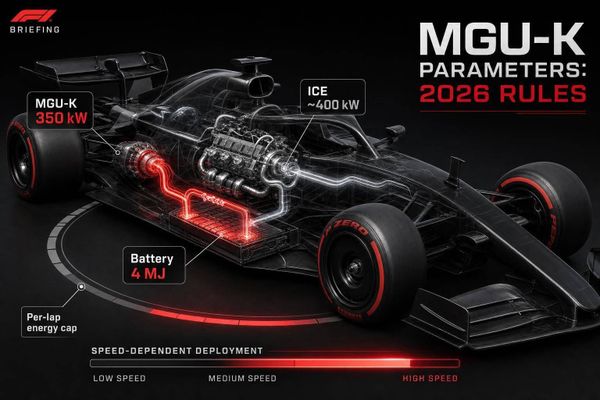
The introduction of active aerodynamics replaces the DRS system. Moveable front and rear wings now switch between high downforce (Z‑mode) and low drag (X‑mode). With 2026 power units splitting power equally between internal combustion (400 kW) and electrical systems (350 kW), reducing drag on straights becomes critical for energy management.
A new "Overtake Mode" adds another layer of strategy. Following cars can deploy an additional 0.5 MJ of electrical energy, providing up to 350 kW at speeds up to 337 km/h (~209 mph). Meanwhile, leading cars see their energy deployment taper off above 290 km/h (~180 mph). Simone Resta, Deputy Technical Director at Mercedes, explained the impact:
"It's going to be quite different... every driver will be running moveable front and rear wings together, at many points in the lap, and they will be using the energy to help overtaking."
Design Direction
Teams are already exploring creative ways to interpret the new rules. Ferrari, for instance, reportedly found a loophole during pre-season testing in Bahrain, positioning the differential 60 mm behind the rear axle to create space for a flow-turning vane that extends the diffuser ramp beyond the regulated limit. McLaren opted for a shorter wheelbase of 3,300 mm - less than the 3,400 mm used by Mercedes and Red Bull - to help meet the 768 kg weight target, though at the cost of floor area. Mercedes, meanwhile, mounted its front wing nose to the middle element instead of the bottom plane, aiming to optimize airflow to the underfloor.
Andrea Stella, Team Principal at McLaren, emphasized the complexity of this transition:
"The work that has gone into the design, the realisation and the build of the 2026 cars is, from what I can remember, almost unprecedented... probably the biggest new car project that I have ever been part of."
These changes combine structural, aerodynamic, and energy management innovations, all designed to make racing faster, closer, and less predictable. How teams navigate these regulations will undoubtedly shape the competitive landscape for years to come.
Pros and Cons of Each Regulation Era
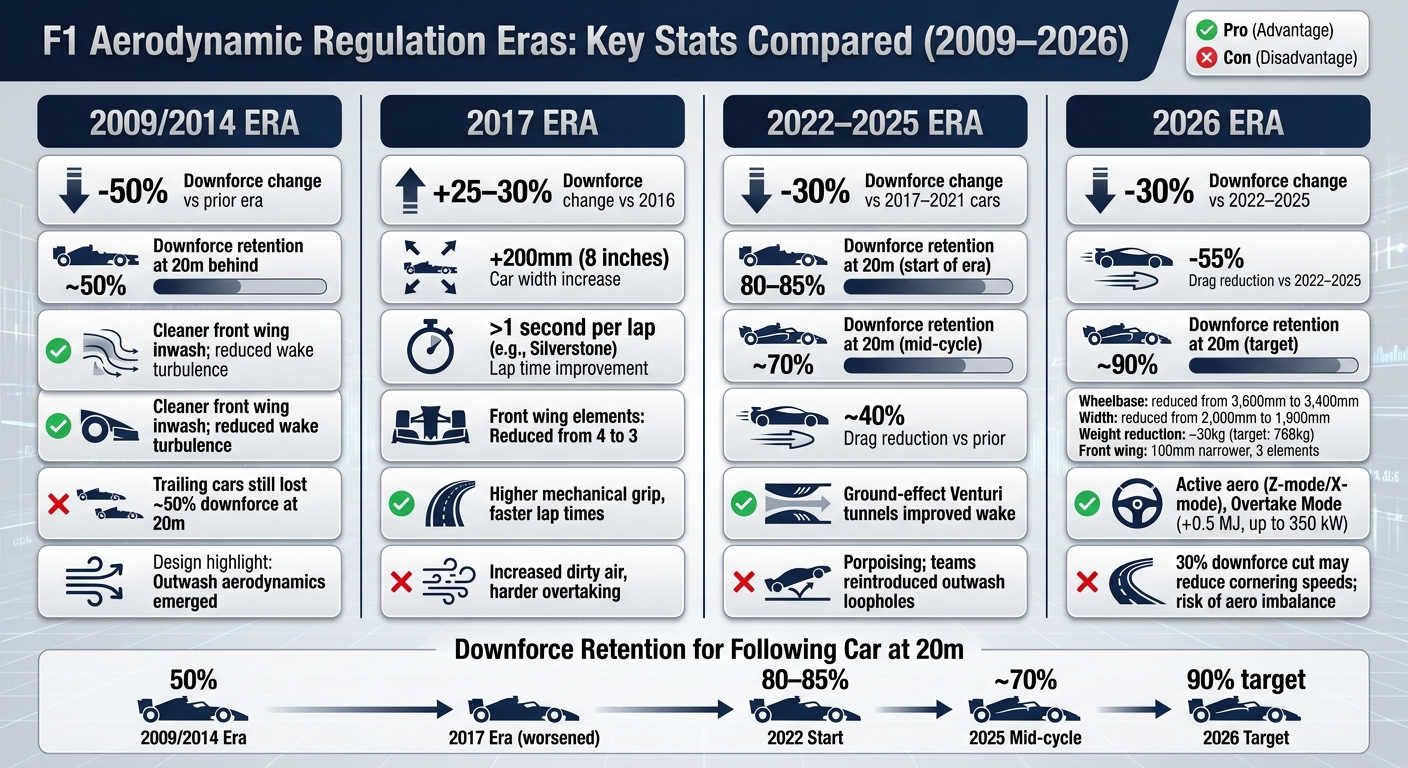
F1 Aerodynamic Regulation Eras: Key Stats Compared (2009–2026)
Every major regulation change in Formula 1 has brought a mix of benefits and challenges, showcasing the ongoing evolution of aerodynamic strategies. Here's a breakdown of the key aerodynamic gains and trade-offs from each regulation era:
| Era | Key Aerodynamic Pros | Key Aerodynamic Cons |
|---|---|---|
| 2009/2014 | Cleaner front wing inwash design reduced wake; hybrid power units improved energy efficiency | Cars still created significant turbulent wake; trailing cars lost about 50% of their downforce at 20 meters (66 feet) behind |
| 2017 | Greater downforce and wider car profiles improved mechanical grip and lap times | Increased dirty air from wider bodywork made close racing and overtaking much harder |
| 2022–2025 | Ground-effect Venturi tunnels initially retained 80–85% of downforce; raised diffusers directed wake upward | Porpoising issues led to stiff suspension setups; teams gradually reduced the initial benefits |
| 2026 | Active aerodynamics target 90% downforce retention - the highest ever - and a flat floor aims to eliminate porpoising | A 30% downforce cut and 55% drag reduction may slow cornering speeds; potential aerodynamic imbalance if wing transitions are poorly timed |
These trade-offs directly impact race performance and team strategies, highlighting how F1's design philosophy has shifted over time. For instance, the 2022 regulations initially improved wake management, but teams eventually found ways to reintroduce outwash within the rules, reducing the intended gains.
Looking ahead, the 2026 regulations take a bold approach by adopting an inwash aerodynamic philosophy, drawing airflow inward instead of pushing it outward around the tires. Whether teams will exploit loopholes in this new framework remains uncertain as the next era begins.
Chris Papadopoulos, a former Renault engineer, offered a sharp perspective on the 2026 changes:
"The cars will be louder, slower on the corners and harder to handle, but more sustainable for the planet."
This ongoing balancing act between downforce and wake control reflects F1's commitment to promoting closer racing. The 2026 rules represent a deliberate step toward unpredictability and sustainability, even if it means sacrificing some outright speed.
Conclusion
From the introduction of simplified front wings in 2009 to the ground-effect tunnels of 2022, each regulation change in Formula 1 has reshaped aerodynamic strategies. The 2009 and 2014 rules aimed to improve wake behavior, though "dirty air" issues lingered, while the 2017 regulations boosted downforce but made close racing harder. The 2022 rules, featuring Venturi tunnels, initially showed promise but saw their benefits gradually diminished by innovative outwash solutions. These developments paved the way for the sweeping changes set to debut in 2026.
The 2026 regulations promise the boldest reset yet. Cars will be 30 kg lighter, 100 mm narrower, and built around an inwash aerodynamic philosophy designed to retain 90% of downforce for trailing cars - the highest figure Formula 1 has ever targeted. FIA Single-Seater Director Nikolas Tombazis explained:
"We believe that the start of the new cycle will be more like 90%, better than it's ever been."
What sets 2026 apart is the integration of aerodynamics with power unit strategies. This marks a new era in F1's technical evolution, drawing from lessons of past regulations. The shift to a 50:50 split between internal combustion engines (ICE) and electric power makes low-drag X-mode critical - not just for overtaking but also for maximizing battery energy recovery on straights. Teams are already exploring different interpretations of these rules, laying the groundwork for a reshaped competitive landscape.
One lesson remains constant across all regulation eras: teams that master the new platform early often gain the upper hand. McLaren’s resurgence in 2023 - achieved by thoroughly understanding their car concept before making changes - serves as a recent example of this strategy. With the added complexity of the 2026 rules, success will likely depend more on precision and patience than on sheer development speed.
FAQs
What exactly is “dirty air,” and why does it stop cars from following closely?
When an F1 car speeds through the air, it leaves behind a turbulent wake known as "dirty air." This chaotic airflow interferes with the smooth, laminar air that a following car relies on to produce downforce. Without stable airflow, the trailing car struggles to maintain grip, often sliding and risking tire overheating or even losing control. As a result, drivers are forced to ease off to keep the car stable.
How do outwash vs. inwash aero concepts change overtaking?
Outwash designs channel turbulent air outward, leaving behind a chaotic wake that makes it tough for trailing cars to overtake. Starting in 2026, new regulations will require inwash designs, which redirect turbulent air inward. This approach aims to reduce the disruptive wake and allow cars to race closer together. Alongside this shift, active aerodynamics and an Overtake Mode - offering an extra energy boost - are set to make passing other cars much simpler.
How will 2026 active aerodynamics replace DRS in wheel-to-wheel racing?
Starting in 2026, Formula 1 will introduce a new active aerodynamics system to replace the Drag Reduction System (DRS). This updated system will be accessible to all drivers at designated points on the track and will feature two distinct modes:
- Straight Mode: Designed to cut down drag, this mode enhances energy efficiency during straight-line driving.
- Corner Mode: Optimized for maximum downforce, it provides better grip and stability through corners.
For overtaking, drivers will rely on a new Overtake Mode, which utilizes extra electrical energy to assist in passing maneuvers. This change aims to balance performance with energy efficiency while keeping the racing exciting.