How teams run post-race debriefs
Data-driven F1 post-race debrief: urgent track checks, factory review, one owner per action with deadlines and verified fixes.
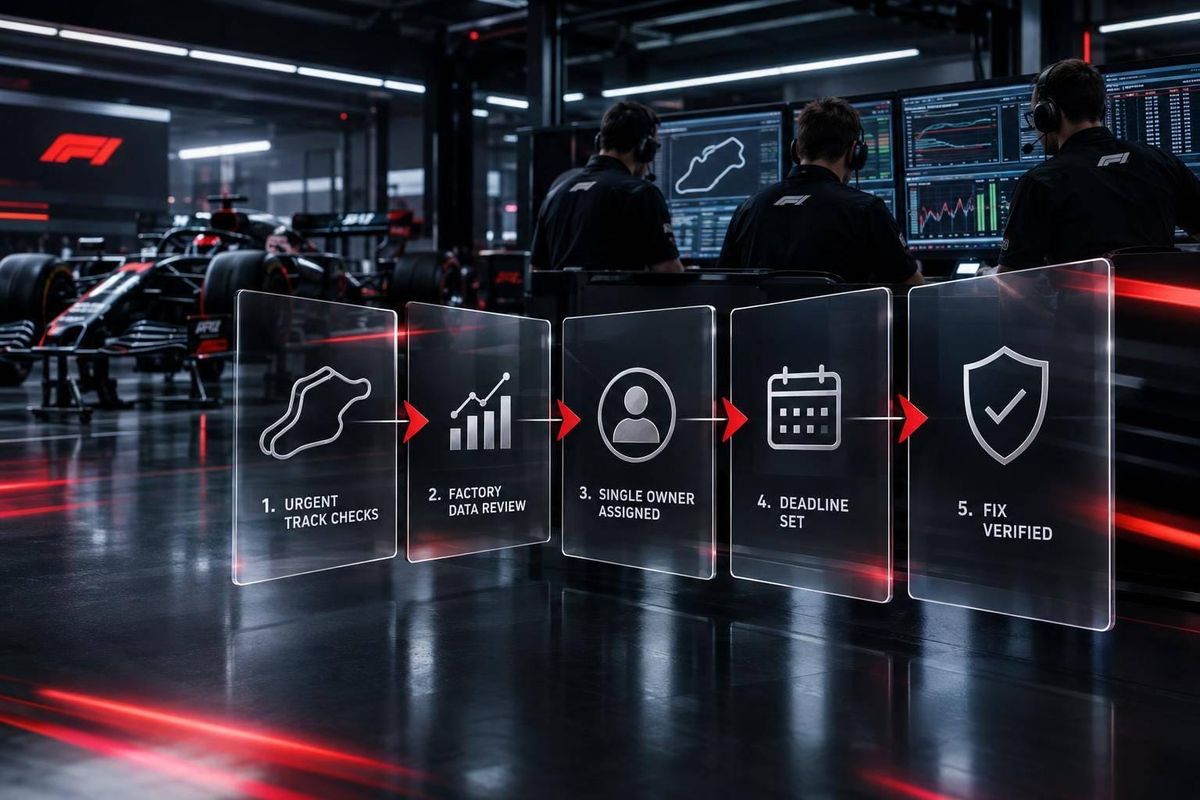
I’d judge an F1 post-race debrief by what happens next: each action needs 1 owner, a deadline, and a check that the fix works. The aim isn’t just to explain the result. It’s to decide what to change before the next race.
Here’s how I’d break down the process:
- Meet in two stages: handle urgent checks at the track, then review new findings with factory staff.
- Compare feedback with facts: check driver comments against timing, telemetry, tire data, and the information available when race decisions were made.
- Turn questions into tasks: compare race pace with forecasts, assign follow-up work, and test proposed fixes.
My rule: keep measurements, estimates, and simulations separate - and <u>verify the result before closing the task</u>.
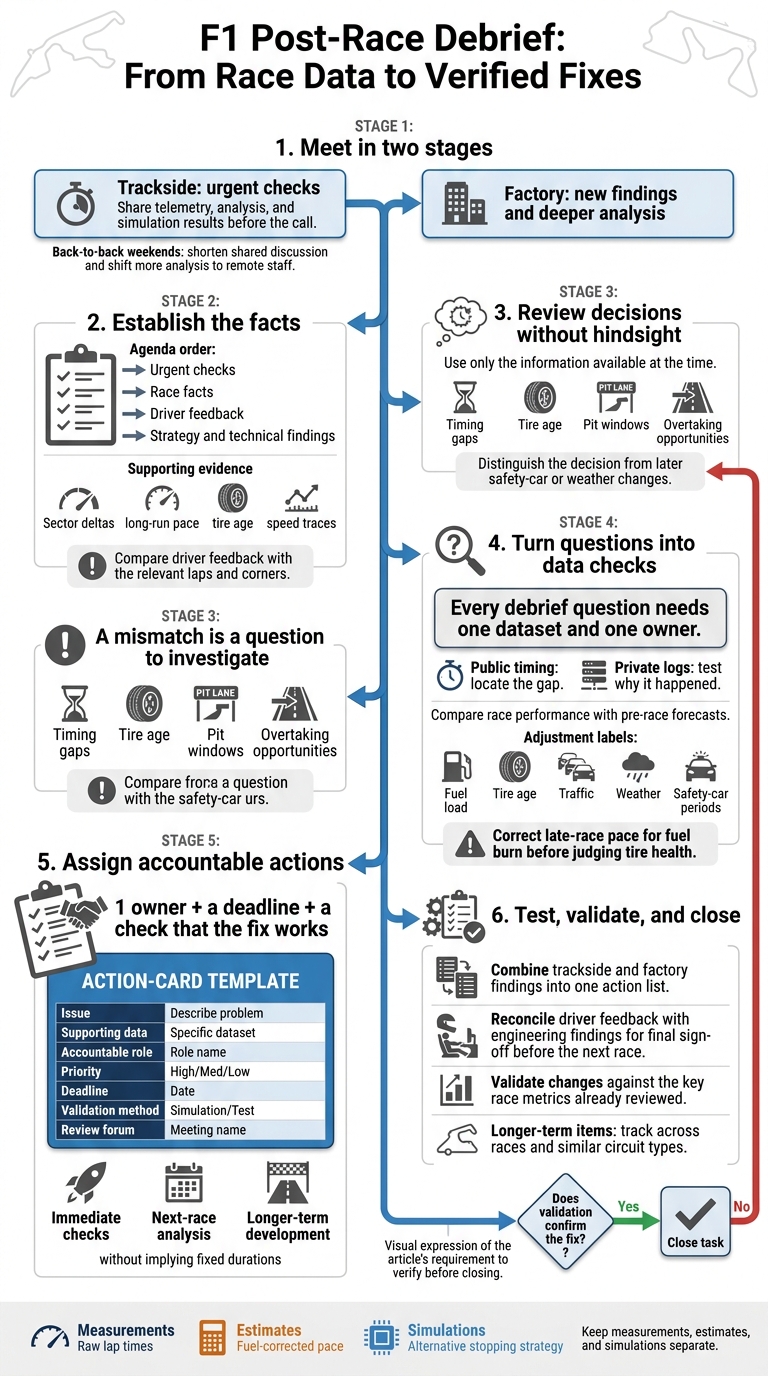
F1 Post-Race Debrief: From Race Data to Verified Fixes
Step 1: Plan the reviews and bring the team together
Schedule trackside and factory reviews
Keep the immediate trackside debrief separate from the deeper factory review. Trackside engineers handle urgent checks, while factory specialists investigate follow-up questions. Schedule drivers around media duties and travel, but let engineers start urgent checks before driver feedback arrives.
Treat Monday’s factory session as a separate checkpoint for new findings, not a repeat of Sunday’s meeting. On back-to-back race weekends, shorten the shared discussion and shift more analysis to remote staff instead of waiting for everyone to return.
Bring drivers, engineers, and factory staff into the review
Let the questions determine who attends. Include drivers, race and performance engineers, strategy staff, technical specialists, and senior leaders according to the topics being discussed. Bring in staff whose day-to-day work is affected, rather than asking everyone to attend every technical session. Use driver feedback to frame the questions, then involve the specialists who can answer them.
Put one person in charge of confirming attendance, sending the meeting link, and coordinating start times across time zones. At the track, choose a space where the team can stay focused. Factory staff can join through communications links.
Share telemetry, analysis, and simulation results before the call so remote staff have the same information and everyone can move straight to the agenda.
sbb-itb-7c68254
Step 2: Set the meeting agenda
Address urgent issues and assess car performance
Once the right people are in the room, work through the agenda in this order: urgent checks, race facts, driver feedback, then strategy and technical findings. Start with compliance, car configuration, and race operations. Flag questionable data before it influences any judgment, and base the discussion on measurements rather than guesses.
Establish the race facts before interpreting them. Use sector deltas, long-run pace, tire age, and speed traces as the baseline, then assess pace and setup against that record.
Compare driver comments about balance, tires, and traffic with telemetry from the relevant laps and corners. Check speed, throttle, brake, and gear traces. A mismatch is a question to investigate, not proof that the driver or the data is wrong.
Review race decisions and technical findings without blame
Reconstruct each important strategy call using only the information available at the time. Review timing gaps, tire age, pit windows, and overtaking opportunities before looking at the outcome. A lap-by-lap replay helps distinguish a poor call from a sound one disrupted by a later safety car or change in weather.
Apply the same precision to technical findings. Use measured evidence to resolve disagreements without blame and coordinate follow-up work. Record each decision, any open questions, and who owns each follow-up task.
Step 3: Analyze the data and assign follow-up work
After the meeting, turn every open question into a data check and assign someone to act on it.
Match each performance question to the right data
Start with public timing data to find where the gap opened. Then use private logs to test why it happened. Every debrief question needs one dataset and one owner.
| Data source | Question answered | Primary technical group |
|---|---|---|
| Sector deltas and lap times (public) | Where was the most time lost relative to rivals? | Trackside engineers |
| Speed, throttle, brake, gear, and DRS traces (public) | Did the driver miss an apex or lift early? | Driver performance group |
| Energy deployment logs (private) | Was the speed delta caused by ERS recharging? | Powertrain and systems engineers |
| Tire carcass temperatures and wear data (private) | Did the tires overheat during the middle of the stint? | Tire science and vehicle dynamics |
| Unbroadcast radio and pit-stop records (private) | Why was the pit stop or position swap mistimed? | Strategy and race operations |
| Aerodynamic pressure taps and chassis telemetry (private) | Did the new wing package deliver the expected downforce? | Aero department |
Once you locate the gap, compare it with the pre-race model. That helps separate a forecast error from a change on race day.
Compare race performance with pre-race forecasts
Compare full-tank practice runs with race stints, accounting for fuel load, tire age, traffic, weather, and safety-car periods. Correct late-race pace for fuel burn before judging tire health. Keep measured results separate from model estimates and alternative strategy simulations.
Hypothetical comparison - not a team’s race record. These illustrative figures show how to structure the review, not proven causes.
| Metric | Pre-race forecast | Race observation or revised estimate | What to investigate |
|---|---|---|---|
| Lap 10 pace | 1:38.500 | 1:39.200 | Traffic and dirty air; compare fuel load and tire age |
| C3 tire life | 22 laps | 18 laps | Track temperature and how “usable life” was defined |
| Pace loss as tires age | Predicted degradation curve | Fit from comparable race laps | Exclude traffic and neutralized laps; correct for fuel |
| Pit window | Laps 18–22 | Stop on lap 15 | Whether an early safety car justified moving the stop |
| Safety-car scenario | Planned green-flag stop | Recalculate under neutralization | Compare estimated pit-time savings and rejoining position |
Add an annotated stint-pace chart only if lap data is available. Label raw lap times as measurements, fuel-corrected pace as an estimate, and an alternative stopping strategy as a simulation.
Give each remaining question an owner, a deadline, and a validation test.
Set owners, deadlines, and checks for each action
Assign one owner per task. Use the register below to separate immediate checks, next-race analysis, and longer-term development.
| Issue | Supporting data | Accountable role | Priority | Deadline | Validation method | Review forum |
|---|---|---|---|---|---|---|
| Energy software fault | Energy recovery logs and fault data | Lead software engineer | Immediate if safety-related | Before release | Regression and system testing | Systems review |
| Setup weakness | Chassis traces and driver feedback | Vehicle dynamics lead | Next race | Before setup sign-off | Simulation, then practice comparison | Race preparation |
| Strategy or pit-window mismatch | Comparable stint laps, pit windows, and radio | Chief strategist | Next race | Before strategy sign-off | Replay against recorded conditions | Strategy review |
| Chassis integrity concern | Sensor alarms and impact data | Chief mechanic | Immediate | Before component reuse | Inspection and non-destructive testing | Factory technical review |
| Aerodynamic discrepancy | Pressure readings and chassis behavior | Aero lead | Longer term | Before development sign-off | Simulation-to-track correlation | Departmental technical review |
Conclusion: Check the work before the next race
Once each action from the race observations has an owner, combine trackside and factory findings into one action list. Then reconcile driver feedback with engineering findings for final sign-off before the next race.
After the debrief, test proposed fixes in simulation before the next track session. Validate those changes against the key race metrics already reviewed.
Keep longer-term items on a season tracker. Before closing them, verify gains across races and similar circuit types.
FAQs
How do teams resolve conflicting driver feedback?
Teams work through conflicting driver feedback by sharing data openly and holding structured discussions without assigning blame. When a driver’s feedback doesn’t match telemetry or sensor data, the driver describes what they feel on track in precise engineering terms. Engineers then use that input to refine models and investigate issues such as suspension geometry or aerodynamic performance. The focus stays on solving problems together and improving team performance, not blaming individuals.
How do teams isolate a fix’s effect on performance?
Teams bring telemetry, driver feedback, and simulation data together in a performance dashboard. After making a change, engineers check track results against pre-race predictions for lap time, tire degradation, and fuel consumption.
Tools like ATLAS help teams visualize performance, reconstruct events from sensor data, and test “what-if” scenarios. Teams also measure response time and decision accuracy to see whether specific adjustments lead to measurable improvements.
What happens when a fix misses its deadline?
When a Formula 1 fix misses its deadline, teams review what went wrong and adjust their procedures. Engineers check whether communication gaps, planning errors, or technical hurdles caused the delay. The setback becomes input for the next round of work, not a final failure. Teams feed their findings into simulations and AI models to improve predictions, future training scenarios, and development timelines.