F1 Sponsor Visibility: Past 20 Years In Review
Two-decade analysis of F1 sponsor exposure measuring readable logo screen time across broadcast, onboard, and social formats.
I judge F1 sponsor visibility by readable logos - not just cars on screen. Across 2006–October 18, 2026, the test stays the same: Can you read the logo, how often does it appear, and who actually sees it?
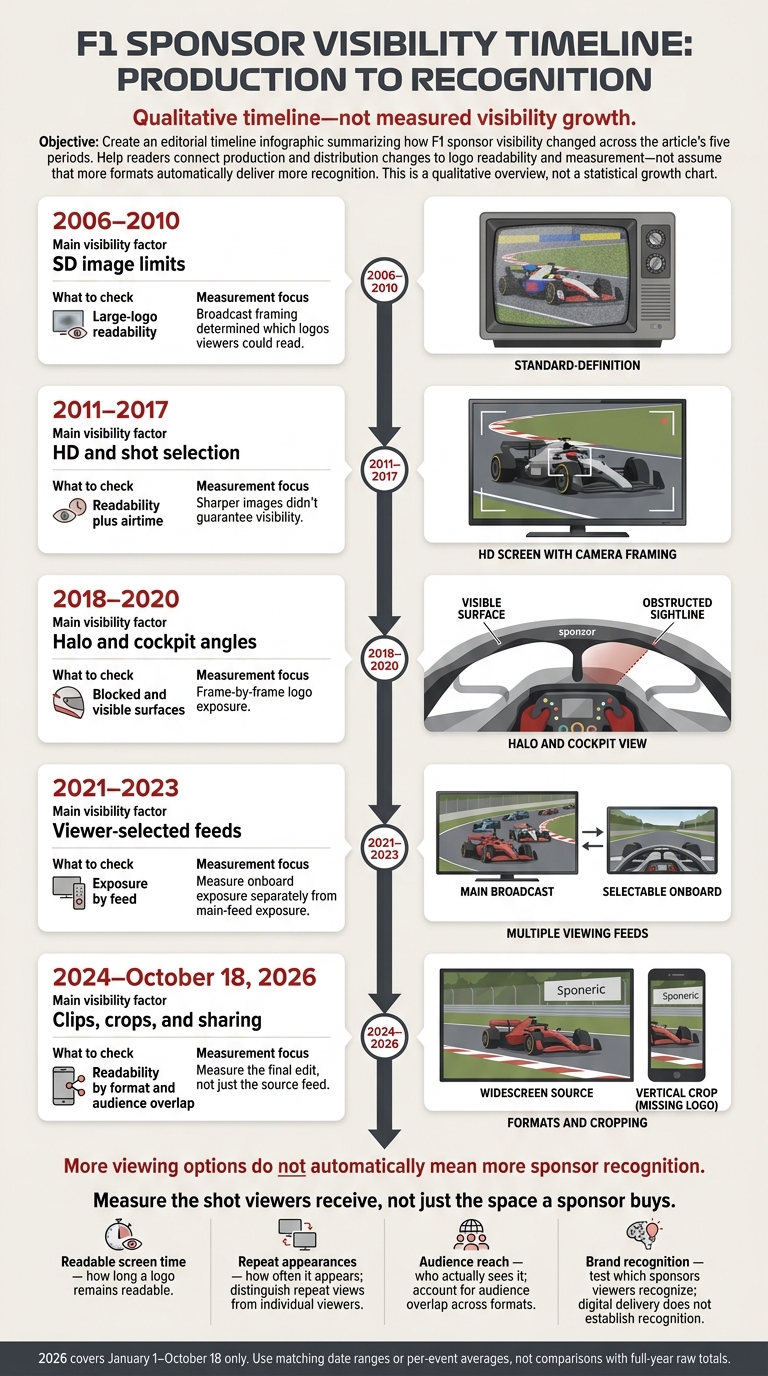
I review five periods:
- 2006–2010: SD screens favored large logos and team colors.
- 2011–2017: HD made smaller marks easier to read, but camera choices still decided exposure.
- 2018–2020: The halo added branding space while blocking some cockpit views.
- 2021–2023: Selectable onboard feeds gave some sponsors longer screen time.
- 2024–October 18, 2026: Social clips and phone-screen crops made the final edit part of the visibility test.
My takeaway: <u>Measure the shot viewers receive, not just the space a sponsor buys.</u> I separate readable screen time, repeat appearances, audience reach, and brand recognition - and compare partial-year 2026 with matching dates, not full-year totals.
Quick Comparison
| Period | Main visibility factor | What I would check |
|---|---|---|
| 2006–2010 | SD image limits | Large-logo readability |
| 2011–2017 | HD and shot selection | Readability plus airtime |
| 2018–2020 | Halo and cockpit angles | Blocked and visible surfaces |
| 2021–2023 | Viewer-selected feeds | Exposure by feed |
| 2024–October 18, 2026 | Clips, crops, and sharing | Readability by format and audience overlap |
More viewing options do not automatically mean more sponsor recognition.
F1 Sponsor Visibility Timeline: 2006–2026
1. 2006–2010: Standard-Definition TV
Placement and Logo Clarity
On standard-definition TV, a car’s livery carried its sponsor identity because small logos were hard to read. Tight technical rules also made the cars look increasingly alike.
Gordon Murray noted that the cars would all look much the same if painted the same color.
Team colors and sponsor placement therefore mattered even more. Broad color blocks did more work than fine graphic details on SD screens.
Camera Exposure and Repetition
Damage and pit stops could put the same logos on screen across several shots. Front wings were prime spots for sponsor exposure, but they were also frequent contact points. When damage led to a nose change or pit stop, those logos could appear again in live coverage and replays.
Distribution and Audience Reach
Sponsor value depended on broadcast reach. Despite SD’s limited clarity, logos still needed to reach enough viewers to support the teams’ funding model.
Branding Control and Measurement
Measurement centered on what appeared in the broadcast, rather than digital analytics. In practice, broadcast framing determined which logos viewers could read.
sbb-itb-7c68254
2. 2011–2017: HD and More Camera Angles
Placement and Logo Clarity
HD made small sponsor marks easier to read, but sharper images didn’t guarantee visibility. Livery still did most of the visual work. Viewers could see finer details only when cameras showed them.
Camera Exposure and Repetition
More camera angles didn’t guarantee more exposure, either. Broadcast choices depended on keeping viewers watching and delivering sponsor value. The gap between image quality and screen time shaped this era.
Distribution and Audience Reach
For new teams, those broadcast choices mattered as they tried to turn global coverage into brand recognition.
Haas entered in 2016 to use F1’s global reach to promote Haas Automation, with only one U.S. race on that year’s calendar.
Branding Control and Measurement
Sponsors focused on exposure per dollar. Airtime alone wasn’t enough; value depended on how much visibility each dollar bought.
3. 2018–2020: The Halo and Cockpit Visibility
Placement and Logo Clarity
The halo’s introduction in 2018 changed cockpit visibility more than sponsor placement across the car. Cockpit branding became more dependent on camera angles and how shots were cropped.
Camera Exposure and Repetition
Halo, helmet, and cockpit-side logos need separate checks. For each, the question is whether live shots and replays keep the logo readable.
Distribution and Audience Reach
TV, streaming, and social edits don’t use the same framing. Cropping can make cockpit logos harder to read, especially when onboard footage moves beyond the broadcast feed into shorter, repackaged clips.
Branding Control and Measurement
During this era, measuring visibility meant looking beyond the car’s overall livery to check frame-by-frame logo exposure across distribution formats.
4. 2021–2023: Onboard Viewing and Streaming Choices
Placement and Logo Clarity
Following the halo era’s focus on cockpit visibility, onboard footage became a more deliberate tool for sponsors in 2021–2023. Coverage expanded, and viewers gained more control over their viewing angle.
Camera Exposure and Repetition
Viewer-selected onboard feeds could keep a sponsor on screen for longer stretches. The main feed still switched between cars and incidents, so repeat exposure depended on the feed: broadcast directors controlled main-feed appearances, while onboard viewing could give sponsors longer screen time.
Distribution and Audience Reach
F1 TV offered more targeted coverage for digital viewers. Fans who chose a particular driver’s onboard feed could see that car’s sponsors for extended periods. Brands on other cars, meanwhile, had fewer chances to appear.
Branding Control and Measurement
Exposure needed to be measured by feed, because time on an onboard feed and time on the main broadcast deliver different value.
5. 2024–October 18, 2026: Social Video and Coverage Across Formats
As F1 shifted from viewer-selected feeds to repackaged clips, sponsor visibility began to depend on the platform. It’s no longer just about who watches. How footage gets cropped, clipped, and shared matters, too.
Placement and Logo Clarity
Measure the final edit, not just the source feed. Compare live coverage, social clips, vertical edits, and archives. When widescreen footage is cropped for phones, check whether logos stay in frame and remain readable on a phone screen.
Camera Exposure and Repetition
Separate first-run exposure from replays and shared clips. Track repeat views apart from the number of individual viewers reached, and measure readable screen time separately from repeat appearances. Seeing a car doesn’t mean viewers can read its sponsor’s logo.
Distribution and Audience Reach
For 2024–2026, report U.S. audience delivery separately from global totals. Where the data allows, also separate live, social, and archive viewers.
Branding Control and Measurement
Formula One Group controls commercial rights; teams control their identities and sponsor placement. Compare reach, repeat views, and readable logo duration as separate measures. Digital tracking measures delivery - not recognition.
Treat 2026 through October 18 as a partial year. Use matching date ranges or per-event averages instead of comparing its raw totals with full-year figures for 2024 and 2025.
How Branding and Camera Choices Shape Visibility
After platform choice comes framing. The same logo can be clear in one shot and unreadable in the next.
Logo Placement and Readability
Seeing the car doesn’t mean you can read its sponsors. Large sidepod logos work best when the car fills the frame. Small technical-partner marks usually need close-ups. Curved bodywork, motion, and camera angles can all make logos harder to read.
| Branding type | Exposure | Camera dependence | Exposure duration |
|---|---|---|---|
| Large sidepod placements | Strongest when the car fills the frame | Side-on tracking shots; less useful from onboards | While the branded surface remains in frame |
| Small technical-partner marks | Usually require close-ups | Tight pit-lane or component shots | Until the camera cuts away |
| Helmets and uniforms | Driver close-ups, podiums, and press conferences | Depends on whether the camera shows the branded surface | Can appear beyond race footage |
| Cockpit and halo branding | Repeated opportunities in onboard footage | Depends on camera position and facing surface | Can remain in frame throughout an onboard sequence |
Halo blockage and cockpit depth affect visibility in different ways. The halo can block the camera’s sightline. Cockpit depth can hide driver and suit branding. Driver numbers existed before the halo, so its arrival changed framing, not identification.
Compared with pre-halo views, sponsors gained another branding surface but had to account for different sightlines. Later, onboard-focused coverage gave surfaces facing the camera longer periods of exposure.
| Cockpit period | Visibility | Obstruction risk | Safety constraints | Camera dependence |
|---|---|---|---|---|
| 2006–2017: pre-halo | Helmet and shoulder branding are easier to see | Lower | Open-cockpit rules still applied | Standard trackside and onboard angles |
| 2018–2020: early halo | Some views are restricted, but the structure also creates a new branding surface | Higher | Halo mandatory | Modified onboard angles |
| 2021–2026: onboard-centric coverage | Visibility depends on camera angle and the surface facing it | Angle-specific | Safety-first packaging remains | Driver’s-eye and cockpit-facing views |
Placement determines where branding sits. Camera angle determines whether viewers can read it.
Camera Angles, Airtime, and Replays
Wide shots show the race but shrink logos. Close-ups make smaller marks easier to read. Pit-lane footage can show component branding, while podiums and press conferences favor uniforms. Slow motion gives viewers more time to inspect a surface, but it can’t restore detail missing from the original image.
Changes in production affected image detail, but they didn’t improve every type of exposure equally.
| Production feature | Detail and legibility | Shot variety | Replay value |
|---|---|---|---|
| 2006–2010: SD production | Limited fine detail favors large marks | Already included multiple camera angles | Repetition adds exposure, not missing detail |
| 2011–2017: HD production | Small marks become clearer when focus, lighting, and framing allow | Trackside, pits, garages, and onboards | More opportunity to inspect small marks |
| 2018–October 18, 2026: multi-camera, selectable feeds | Readability varies by camera, delivery, and surface shown | More viewing choices, including cockpit perspectives | Additional angles can reveal otherwise hidden branding |
Judge the shot, not the surface size.
Front-wing branding can disappear from view after damage or a nose change; small suspension marks may never become readable in a wide shot.
Measure onboard exposure separately from main-feed exposure.
Distribution, Brand Control, and Measurement
When framing changes, distribution determines where sponsor exposure remains visible. Measurement determines whether that exposure can be counted.
Where Coverage Reaches Audiences
Availability is not reach. TV carries the main feed. Streaming adds selectable onboards and replay libraries, while social video takes edited moments beyond live coverage. Access varies by territory, but access alone does not prove anyone saw a readable sponsor logo.
Onboards can show cockpit branding; timing screens usually do not. Radio helps audiences recognize drivers, not see logos. Feed selection and cropping decide which branded surfaces stay in view. So format choice affects visibility, not just distribution.
Who Controls Branding and How Exposure Is Measured
Teams control their liveries, sponsor placements, race suits, and team-produced social content, within applicable rules. FOM controls the World Feed: which cars appear, how long they stay on screen, which angles viewers see, and which replays air. A team can buy the surface; it cannot control the shot.
The same image can deliver very different exposure depending on who controls the feed.
| Format | Reach | Duration | Branding control |
|---|---|---|---|
| Main feed | World Feed audiences | Full race | FOM selects shots and replays; teams measure the resulting logo exposure. |
| Onboard feeds | Selectable-feed audiences | User-defined | FOM controls camera framing; viewers choose feeds, affecting cockpit and halo exposure. |
| Timing screens | App and web users | Continuous | FOM controls the interface; viewing data usually provides no logo exposure. |
| Replay clips | Broadcast and social audiences | Short clips | FOM or broadcasters select moments and repeat visible branding. |
| Social clips | Social audiences | Often under 60 seconds | Teams or FOM control edits and crops, keeping or removing sponsor marks. |
Report follower counts, views, watch time, and distinct viewer counts separately. None measures readable logo exposure. Also report screen time, legibility, repetition, and measured reach as separate metrics. Account for audience overlap before combining formats.
For a 2006–2026 comparison, use consistent definitions and flag missing historical data. An available archive does not prove anyone watched it, and repeated replay exposure does not necessarily add reach. When comparable viewing data or logo-level records are missing, explain the gap rather than giving a precise growth figure.
Conclusion: More Formats, Uneven Sponsor Exposure
Across these periods, editing and reusing footage gave logos more screen time. But split audiences and cropped frames meant sponsors weren’t equally visible across formats.
The table below compares viewing conditions in qualitative terms:
| Period | Reach | Logo readability | Repeat exposure | Targeting | Framing control |
|---|---|---|---|---|---|
| 2006–2010 | Broad | SD-limited | Broadcast-led | Broad | Broadcast-led |
| 2011–2017 | Global | Improved with HD | Broadcast and replay | Moderate | Broadcast-led |
| 2018–2020 | Segmented | Angle-dependent | Streaming and replay | Selective | Feed-dependent |
| 2021–2023 | Fragmented | Feed-dependent | Viewer-selected | Direct | Feed-dependent |
| 2024–October 18, 2026 | Broad, platform-dependent | Crop-dependent | Cross-format reuse | Selective | Edit-dependent |
Test recognition, not just exposure. Show viewers TV shots, onboard footage, vertical clips, and archive footage. Then ask which sponsors they recognize. Check whether branding stays readable after vertical cropping and in lower-resolution archives.
Observations for 2024–October 18, 2026 reflect coverage through that date only.
FAQs
How can sponsors test whether viewers remember their logos?
Sponsors can use surveys and focus groups to measure unaided recall (remembering without prompts), aided recall (remembering with prompts), and how people feel about the brand.
Media tracking and Advertising Equivalent Value (AEV) calculations measure how long logos appear during broadcasts and how prominently they’re displayed. Brand-specific promo codes or dedicated landing pages can help connect race-day visibility to consumer engagement and sales.
Which logo placements best balance TV and mobile visibility?
Logos on high-contrast, static surfaces - especially main bodywork panels like the sidepods and engine cover - offer the most reliable visibility on TV and mobile. They stay visible in long-range shots and readable on smaller screens, helping brands stand out alongside telemetry and timing graphics.
How can sponsors avoid double-counting cross-platform audiences?
Sponsors should use unified attribution methods to link engagement across platforms to one user or session. Dedicated landing pages, platform-specific promotional codes, and integrated media analytics help track how these interactions connect.
Combining these data sources gives sponsors a single view of audience activity, so they don’t count the same person as separate audience members across channels.