VGT vs wastegate turbo in F1
VGT boosts corner-exit response, but wastegate turbos prevail in F1 for legality, heat durability, and race-long reliability.
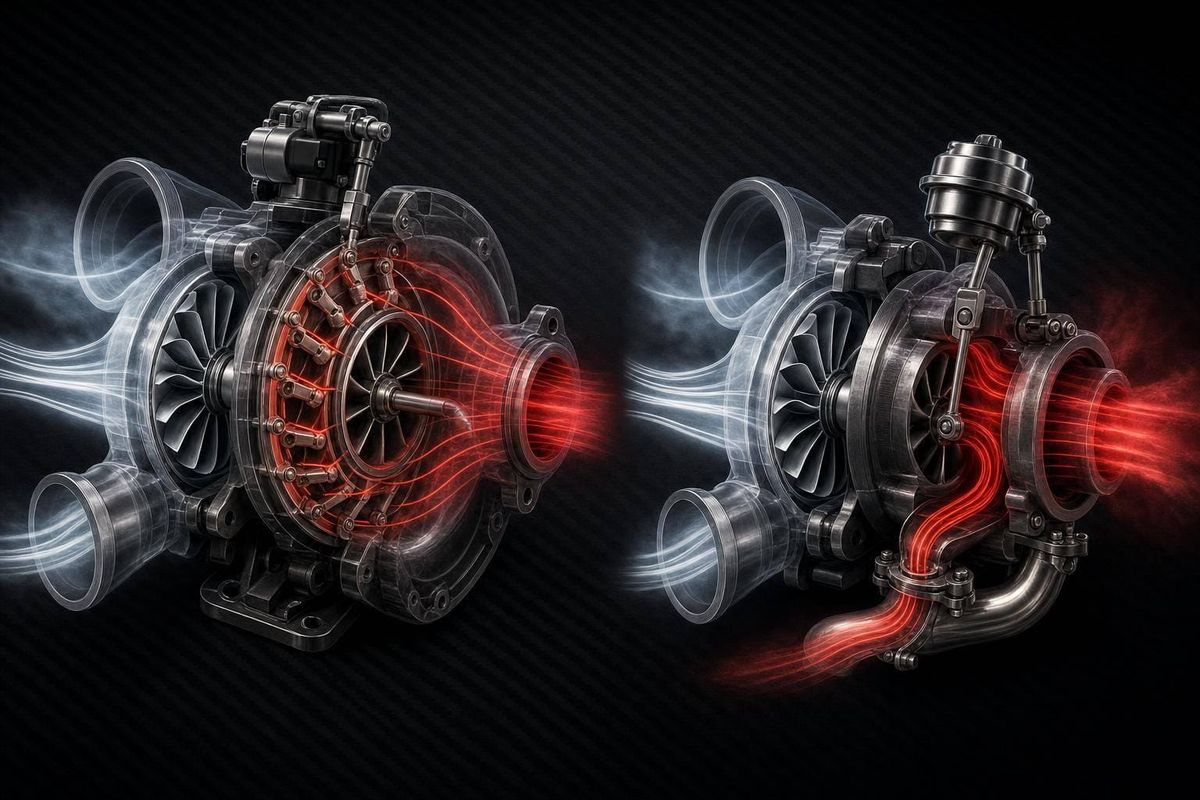
If you want the short answer: a VGT would help response, but a fixed-geometry wastegate turbo is the better fit for modern F1 because it is legal, simpler on the hot side, and better suited to race-distance use.
I’d sum it up like this:
- VGTs are banned in current F1 rules
- Wastegate turbos are the legal F1 setup
- VGTs cut lag by changing turbine vane angle
- Wastegate turbos control boost by bypassing exhaust gas
- The loss of the MGU-H in 2026 makes turbo response matter more again
- F1 turbos can spin up to 125,000 rpm
- Exhaust heat can go past 700°C (1,300°F)
- That heat is a big problem for moving vanes inside a VGT
If I strip the debate down to one line, it’s this: VGT is better for corner-exit response, while a wastegate turbo is better for heat load, peak-flow use, packaging, and rule compliance.
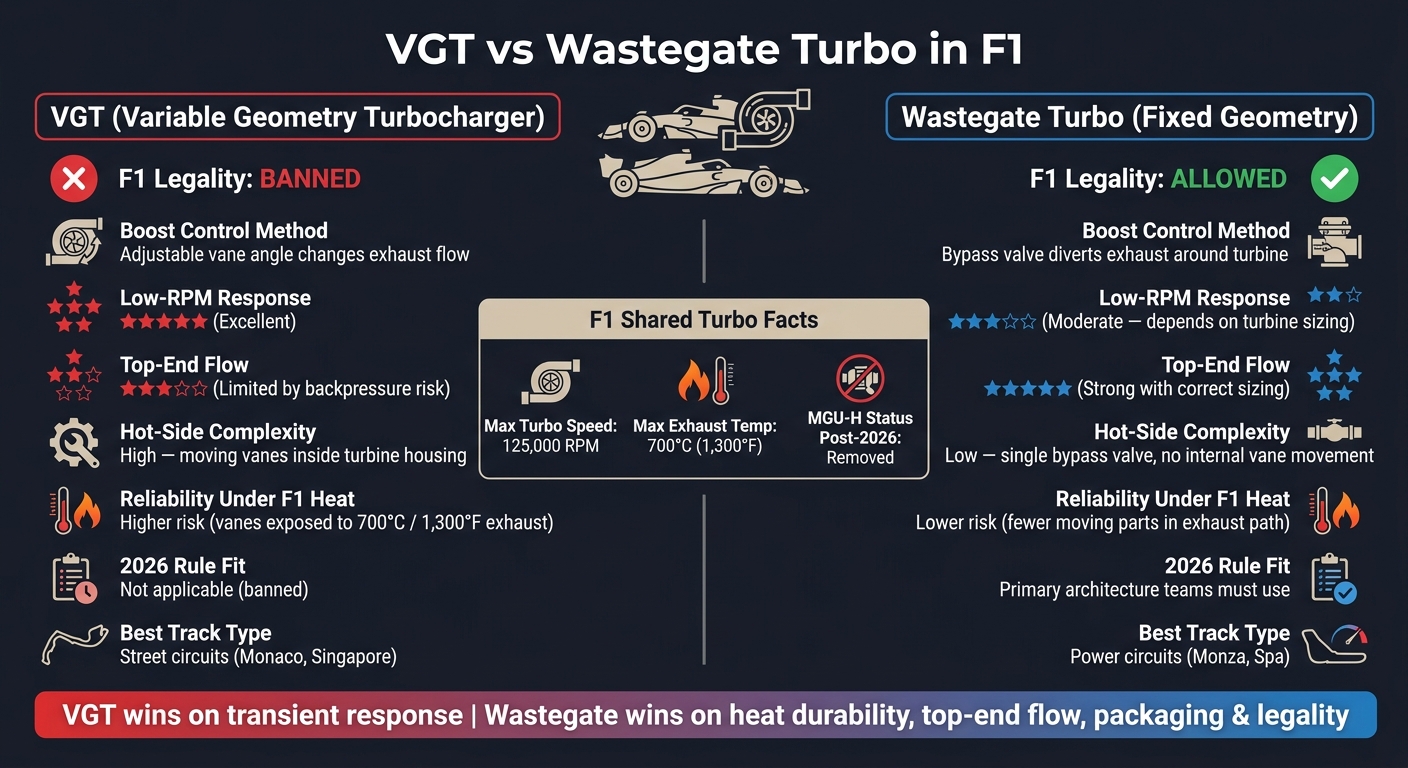
VGT vs Wastegate Turbo in F1: Side-by-Side Breakdown
Variable Geometry Turbocharger VS WasteGate Turbocharger (WHATS’S THE DIFFERENCE??)
sbb-itb-7c68254
Quick Comparison
| Item | VGT | Wastegate Turbo |
|---|---|---|
| F1 legality | Banned | Allowed |
| Low-rpm response | Better | Weaker |
| Top-end use | Good in theory, but heat is a problem | Strong if sized well |
| Boost control | Vane angle changes flow | Wastegate bypasses flow |
| Hot-side parts | More moving parts | Fewer moving parts |
| Reliability under F1 heat | More risk | Lower risk |
| 2026 fit | Not legal anyway | Main path teams must use |
So if you’re asking which one suits F1 best, the answer is the wastegate turbo. Not because VGT is a bad idea on paper, but because F1 puts huge stress on turbo parts, and the rules already shut the door on VGT use.
How each turbo system works
Both systems control boost, but they go about it in very different ways. A VGT changes how exhaust hits the turbine. A wastegate setup lets some exhaust skip the turbine. That one design split shapes everything else: spool, top-end flow, and how tightly boost can be managed.
VGT: adjustable vanes and how they shape boost
A variable geometry turbocharger uses adjustable vanes inside the turbine housing to change the turbine’s effective throat area. At low engine speeds, those vanes close and tighten the throat. That speeds up the exhaust gas, helps the turbine spin up faster, and lets boost come on earlier.
As engine speed climbs, the vanes open. That cuts backpressure and helps stop the turbine from overspeeding. In plain English, the turbo can work well across more of the rpm band instead of being tuned for just one sweet spot.
That’s the upside. The catch is heat and stress. Those moving vanes have to live in exhaust temps that can top 700°C, and modern F1 turbochargers can spin at 125,000 rpm. That’s a brutal place for any moving part.
Wastegate turbo: fixed turbine geometry and bypass-based boost control
A fixed-geometry turbo uses a turbine housing with no internal vane movement. Instead, boost is controlled by a wastegate valve. Once intake pressure hits a set limit, the valve opens and diverts extra exhaust gas around the turbine. That bypass flow keeps shaft speed and boost in check.
The tradeoff is pretty simple:
- A smaller fixed turbine usually spools faster, but it can choke high-rpm flow
- A larger turbine usually flows better at high rpm, but it tends to respond more slowly down low
That balance gets harder under the 2026 rules. So the next step is to look at which setup reacts sooner, flows better at the top end, and keeps boost under control in race conditions.
Performance comparison: spool, top-end flow, and control
With the hardware difference out in the open, the next step is simple: which setup gives you better response, more pull at the top end, and tighter boost control?
Spool response and turbo lag out of slow corners
A VGT has its biggest edge on corner exit. The vanes help the turbo build boost earlier, which cuts lag and sharpens throttle response. A fixed-geometry wastegate turbo can't do that as well. Its response depends mostly on turbine size and shaft inertia.
That matters even more in 2026. Without the MGU-H, teams lose the electrical support that used to help hide turbo lag. So the turbo itself has to do more of the work. Ferrari's 2026 setup points toward a smaller turbo, which means lower shaft inertia and faster spool. Mercedes went the other way with a larger unit aimed more at top-end output.
That edge off slower corners doesn't come for free. Once exhaust flow climbs, the balance starts to shift.
Top-end flow, backpressure, and peak power
At high rpm, the tradeoff flips. A larger fixed-geometry turbo is a better fit for steady high-speed power on long straights. A VGT can open its vanes to cut backpressure near the top of the rev range, which sounds great on paper.
But this is Formula 1, not a mild street-car setup. Exhaust temperatures can go past 700°C, and shaft speed can hit 125,000 rpm. That's a brutal job for moving vanes and their actuators. A fixed-geometry turbo sidesteps that problem. It gives up some flexibility, but if it's sized well, it can still deliver strong top-end flow without the extra hot-side moving parts.
Beyond pure response, though, race pace comes down to something more practical: how well the system can hold target boost lap after lap.
Control logic and boost management in race conditions
VGT control is continuous. Vane angle changes in real time as exhaust flow changes, so boost can be managed with a lot of precision. Wastegate control is less exact by nature. The bypass valve opens or stays shut to limit boost, which is a simpler way to manage the system.
In F1, that simpler setup has been backed up by advanced engine mapping and, up to 2026, the MGU-H. That support helped cover some of the weak spots a fixed-geometry turbo would otherwise show.
| Control Factor | VGT | Wastegate Turbo (F1) |
|---|---|---|
| Boost response precision | High - continuous vane adjustment | Moderate - bypass valve |
| Lag management | Mechanical (vane closure) | Electrical (MGU-H, pre-2026) or turbine sizing (2026+) |
| Backpressure control | Optimized across rpm range | Fixed geometry; wastegate reduces but doesn't eliminate backpressure |
| Actuator demands | High - vanes must move in extreme heat | Lower - single bypass valve |
| Power unit integration | Standalone hot-side system | Integrated with engine mapping and, until 2026, MGU-H support |
Once the MGU-H disappears, wastegate turbos have less cover on corner exit. That puts more pressure on turbine sizing and engine mapping. VGT still holds a control edge in theory, but in F1 that edge stays theoretical because the rules ban it.
Heat strain, reliability, and why F1 uses wastegate-based turbo architecture
Thermal load and hot-side mechanical stress
That extra response comes with a cost on the hot side. In F1, exhaust temperatures can go past 1,300°F (700°C), and turbine speeds can hit 125,000 rpm.
That’s brutal hardware territory.
A VGT places moving vanes and actuators right in that exhaust flow. So now you’re asking small moving parts to survive intense heat, repeated thermal cycling, sticking risk, and a higher chance of mechanical failure. It’s easy to see the problem: the smarter the hot-side hardware gets, the more it has to live in the worst possible place.
A fixed-geometry turbine sidesteps that issue. There are no internal vanes sitting in the hottest part of the housing, waiting to warp or seize. Instead, the wastegate dumps extra exhaust flow without adding moving parts inside the turbine flow path.
Packaging, failure risk, and serviceability
Heat isn’t the only headache. F1 power units are packed incredibly tight, so every extra part has a cost.
In split-turbo layouts, more hot-side hardware makes cooling harder. It also makes access and service work tougher, which matters when everything is squeezed into a very small space. In a setup like that, simpler parts often win because there’s less to route around, less to shield from heat, and less that can go wrong.
How regulations and power-unit design favor wastegate turbos
Those limits matter even more because the turbo isn’t working alone. In F1, it sits inside a tightly packed hybrid power unit, so the choice of fixed geometry comes down to system integration, not heat tolerance alone.
F1 leaned toward wastegate turbos because the MGU-H already controlled turbo spool and response electronically. That took away much of the response edge a VGT would normally bring. Once that benefit shrinks, the tradeoff looks a lot less attractive.
So even setting the MGU-H aside, wastegate architecture still fits F1 better: it’s simpler, tougher, and easier to package in an already crowded power-unit design.
Race use cases and final verdict
With response, flow, and heat already laid out, the main gap now comes down to one thing: how each turbo works from track to track.
Where a VGT would help and where it would fall short
On street circuits like Monaco or Singapore, a variable-geometry turbo would show its upside right away. You'd get faster spool-up, sharper throttle response, and better drivability when traction is limited. At tracks where corner exit has a big effect on lap time, lower turbo inertia can turn into a clear on-track edge.
But that edge starts to shrink on long straights. Adjustable vanes can add backpressure at peak RPM, which cuts top-end flow and puts more strain on battery deployment. The heat side is brutal too. Those moving vanes face a serious reliability problem over a full race distance.
Where a wastegate turbo fits F1 better
That same trade swings the other way at high-speed tracks. At power circuits like Monza or Spa, a well-sized fixed-geometry turbo is the better fit. It can move more air at sustained speed, which helps the internal combustion engine make more raw power and cuts the need to lean on battery energy.
That matters even more under the 2026 rules, where battery deployment is limited each lap. A turbo that lets the ICE produce more natural power gives engineers more room in how they manage stored energy over a stint.
Conclusion: the better turbo choice for modern F1
VGT wins on transient response. The wastegate turbo wins on top-end flow, heat durability, and simpler race-distance use. VGTs are banned under current F1 rules, so this is mostly a theoretical case on the VGT side.
| Race Scenario | VGT | Wastegate Turbo |
|---|---|---|
| Race starts / corner exit | Faster spool-up, lower turbo inertia, better drivability | Slower response from more turbine inertia |
| Straight-line speed | Backpressure risk at peak RPM | Higher mass flow, more ICE power |
| Reliability | Moving vanes vulnerable to heat failure | More reliable under sustained heat loads |
For most F1 circuits, and for the full load of a race weekend, the wastegate turbo is the stronger and more practical setup.
FAQs
Why are VGTs banned in F1?
VGTs are explicitly banned by current Formula One technical regulations.
They work well in road cars because they help manage exhaust backpressure and make the powerband broader. But Formula One doesn’t allow them in its power units.
Instead, F1 requires fixed-geometry turbochargers. To handle turbine speed control and energy recovery, the sport uses the MGU-H. In plain English, that system does the job a VGT would otherwise do.
How much response is lost without the MGU-H?
Without the MGU-H, F1 power units lose the ability to electronically pre-spin the turbo and cut turbo lag. So the engine now has to spin the turbine first before the car gets full boost, and that brings a clear delay in throttle response.
This also changes how teams think about turbo size. A smaller turbo is easier to spool and gets up to speed with less delay. A larger turbo can deliver more power at high speed, but it takes longer to spool, which makes that delay harder to manage.
Could a VGT survive full-race F1 heat?
Probably not, at least not in a reliable way.
An F1 turbo has to survive over 700°C (1,292°F) and spin at up to 125,000 RPM. That’s brutal. Add a VGT on top, with its adjustable vanes and actuators, and you’re adding a big failure point in a place that’s already under extreme heat and nonstop transient loading.
Here’s where things get messy:
- Thermal expansion can change clearances and make the vanes stick
- Back-pressure swings can put extra stress on the system
- Centrifugal forces at those shaft speeds can make moving parts even harder to control
Put that together, and vane sticking or actuator seizure starts to look like a serious risk, not just a small drawback.
That extra complexity is a big reason F1 sticks with fixed-geometry turbos and leans on advanced energy recovery instead.