Weight vs Downforce in F1 Cars
Explains how reduced 2026 F1 weight and downforce rules affect lap times, tire wear, and active aerodynamics tradeoffs.
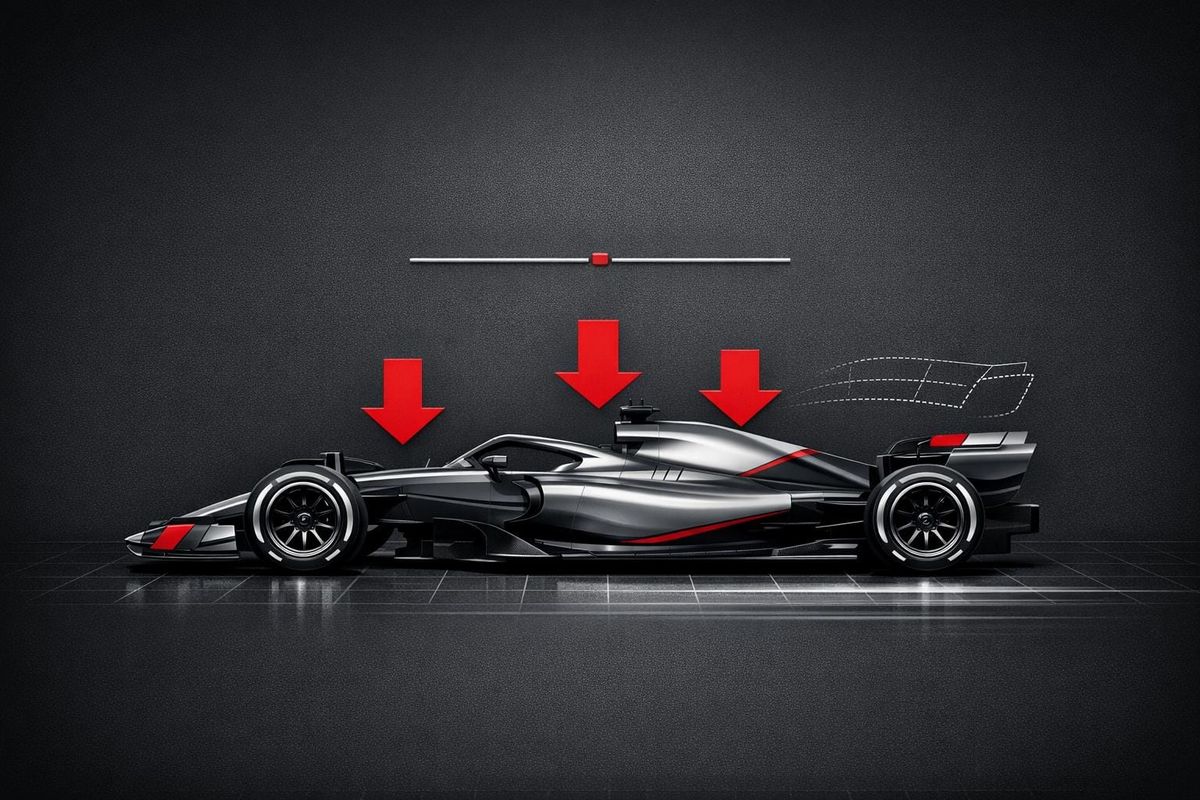
Formula 1 performance hinges on two key factors: weight and downforce. Weight impacts acceleration, braking, and tire wear, while downforce enhances grip and stability, especially at high speeds. Here's what you need to know:
- Weight: The minimum car weight for 2026 is 768 kg, 30 kg lighter than before. Every 10 kg adds 0.3–0.35 seconds per lap. Excess weight increases tire wear and reduces agility.
- Downforce: Generated by aerodynamic components, it increases grip without adding mass. However, it also creates drag, slowing straight-line speed.
- 2026 Updates: New regulations reduce downforce by 30%, drag by 55%, and fuel capacity from 110 kg to 70 kg. Active aerodynamics now adjust grip and drag dynamically during laps.
Quick Comparison
| Factor | Impact | 2026 Adjustments |
|---|---|---|
| Weight | Slows acceleration, increases tire wear, reduces agility | Reduced by 30 kg (768 kg minimum) |
| Downforce | Adds grip at speed, improves cornering, but increases drag | Reduced by 30%, with active aerodynamics |
| Fuel Capacity | Heavier cars burn more fuel and stress tires | Lowered from 110 kg to 70 kg |
| Aerodynamics | Balances drag and grip for cornering and straights | Active systems replace DRS |
F1 engineers now face a balancing act: shedding weight while optimizing aerodynamics for both speed and cornering. The interplay between these forces defines the sport's evolving strategies.
How Weight Affects F1 Car Performance
Weight and Tire Loading
Adding weight to an F1 car directly impacts tire performance. The extra vertical load increases lateral G-forces, which speeds up tire wear and causes heat to build up rapidly inside the tire. This internal heat can push the tires to a point known as the "thermal cliff", where performance drops off sharply. For instance, on C3 Medium tires, overweight cars can hit this cliff by Lap 12. Once this happens, lap times plummet, and strategic flexibility becomes severely limited. Beyond tire degradation, the added weight also reduces the car's efficiency in both acceleration and braking.
Effect on Acceleration and Braking
Extra weight creates a double penalty: it requires more force to accelerate and generates more kinetic energy that needs to be dissipated during braking. Nilkanth RK Soni from Into the Chicane explains:
"The extra mass physically doesn't want to turn, which means drivers have to apply the brakes for extended periods. This generates excess heat in the tire carcass."
This issue is especially noticeable on circuits with frequent acceleration and braking zones. To tackle this, the 2026 regulations reduced the minimum car weight by 30 kg, from 798 kg to 768 kg. Race fuel capacity also dropped from 110 kg to 70 kg, reducing the total starting mass by about 70 kg. These changes give drivers a lighter, more responsive car, allowing them to approach braking zones more aggressively right from the start of the race. However, the placement of this weight also plays a key role.
Weight Distribution and Car Balance
Where a car's weight is located matters just as much as how much it weighs. Teams use tungsten ballast to precisely adjust the center of gravity in cars that meet the 768 kg minimum weight. This allows them to fine-tune the car's front-to-rear balance for individual circuits. Teams carrying excess structural weight, however, lose this flexibility since their weight distribution is dictated by the location of heavier components.
In early 2026, teams like Mercedes and Ferrari hit the weight limit, enabling them to optimize their setups with ballast. On the other hand, Williams was 26 kg over the limit, resulting in a lap time penalty of approximately 0.78 seconds.
| Team | Weight Status | Estimated Lap Time Penalty |
|---|---|---|
| Mercedes / Ferrari / McLaren | On/Under 768 kg limit | 0.000 s |
| Haas | +1 kg | ~0.035 s |
| Alpine | +2.5 kg | ~0.085 s |
| Red Bull / Aston Martin | +9.5 kg | ~0.300 s |
| Williams | +26 kg | ~0.780 s |
(Source: Into the Chicane telemetry analysis, April 2026)
Jarrod Partridge, Co-Founder of F1 Chronicle, highlights the importance of weight placement:
"The ability to position ballast within the car is one of the primary tools engineers use to fine-tune the car's weight distribution... affecting its aerodynamic balance, handling balance, and tyre loading characteristics."
In the 2026 season, where downforce has been reduced by 30% and mechanical grip plays a bigger role, achieving the right weight balance is more critical than ever.
sbb-itb-7c68254
The Role of Downforce in F1 Performance
How F1 Cars Generate Downforce
Downforce is what keeps an F1 car glued to the track, providing extra grip without adding physical weight. It increases the vertical load on the tires, enhancing traction while avoiding the inertia that comes with added mass.
As Bradley Lord from the Mercedes F1 Team explains:
"These elements - especially the wings and floor of the car - work together to keep the car glued to the track instead of lifting off like a plane at high speeds."
F1 cars achieve downforce through a mix of aerodynamic components, including the front and rear wings, the underfloor, and other body surfaces. Starting in 2026, teams moved away from the complex ground-effect Venturi tunnels used between 2022 and 2025. Instead, they now rely on simpler flat floors, placing more emphasis on wing-generated downforce. Ferrari, for instance, introduced flow turning devices, which are vanes positioned behind the exhaust. These devices accelerate the airflow exiting the diffuser, boosting underfloor downforce.
This shift in design highlights the ongoing challenge of balancing downforce and drag.
Downforce vs. Drag: The Core Tradeoff
One of the biggest challenges in F1 aerodynamics is finding the right balance between downforce and drag. While more downforce improves grip and stability, it also increases drag, which slows the car on straights and limits top speed. The 2026 regulations have pushed teams to rethink this balance.
The new rules replace the Drag Reduction System (DRS) with Active Aerodynamics, a system that automatically adjusts the car’s aerodynamics. Cars now switch between two modes: Straight Mode, which opens wing flaps to reduce drag and maximize speed, and Corner Mode, which closes the flaps to create more downforce for better grip. According to the FIA, this system is essential for optimizing energy use, especially with the 2026 power units that split output evenly between internal combustion and electric energy.
The numbers tell the story: downforce has dropped by about 30% compared to the 2022–2025 regulations, while drag has been reduced by up to 55%. This tradeoff results in slower cornering speeds but much faster straights, improving energy efficiency overall.
Downforce in Corners and Car Stability
Downforce is what allows F1 cars to corner at speeds that would be impossible for any other vehicle. By pressing the tires harder into the track, it creates the friction needed to prevent sliding and maintain control in high-speed corners.
Unlike the constant load from weight, aerodynamic downforce offers a unique advantage: it enhances cornering performance without overheating the tires. Extra weight forces the tires to work harder, often pushing them toward the thermal cliff, where grip rapidly deteriorates. Downforce, on the other hand, keeps the tires within their optimal temperature range, ensuring consistent performance without the drawbacks of added mass.
The 2026 regulations also improve car stability in close racing situations. Nikolas Tombazis, FIA Single-Seater Director, highlighted this improvement:
"The start of the new cycle will be more like 90% [downforce retention], better than it's ever been."
This refers to the ability of a car to retain up to 90% of its downforce when following another car at a distance of 20 meters - a significant improvement from the roughly 70% seen in the previous regulation cycle. For drivers, this means greater confidence and stability when racing closely, especially in high-speed sections, as they no longer lose as much grip in the turbulent air behind a rival.
Aerodynamics in Formula 1 | F1 Explained

Weight vs. Downforce: A Direct Comparison
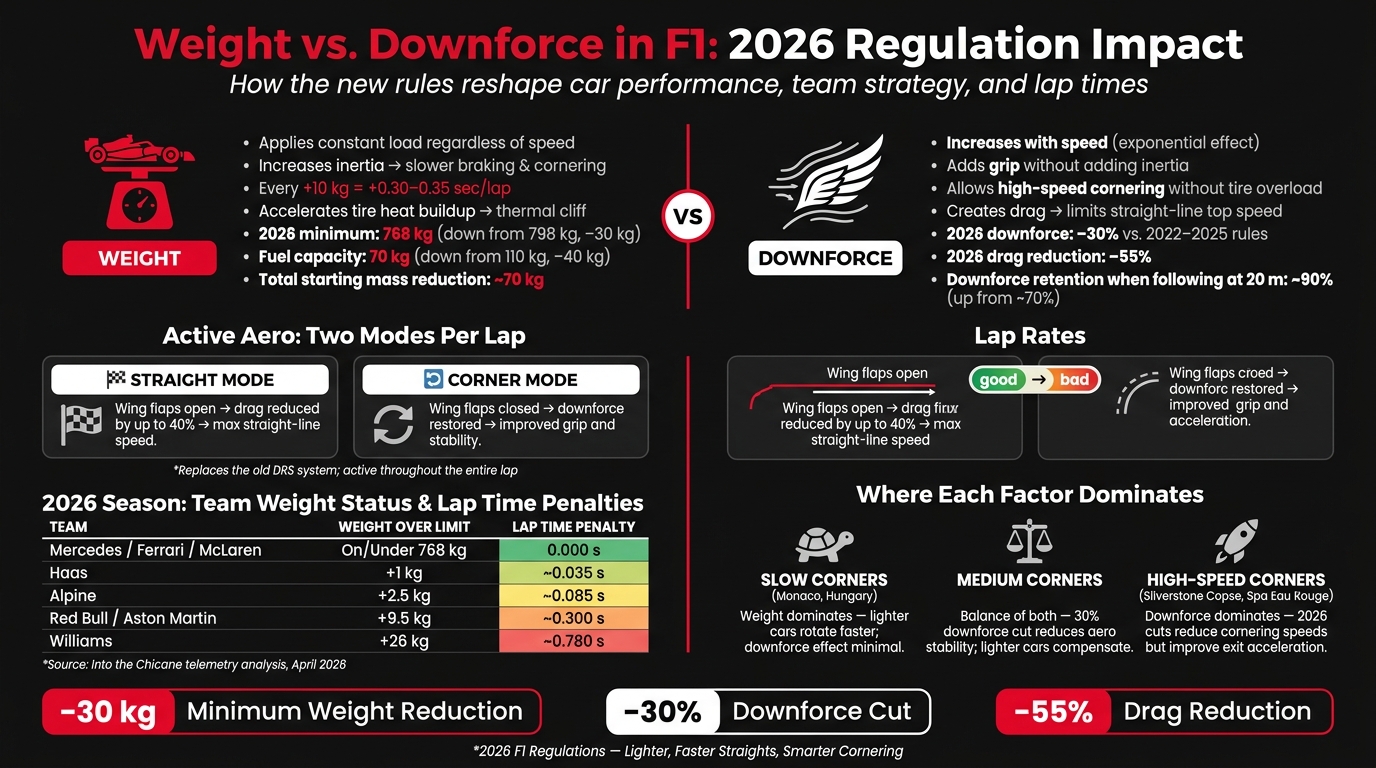
F1 Weight vs Downforce: 2026 Regulation Changes & Team Penalties
Mechanical Load vs. Aerodynamic Load
Weight and downforce both press the tires harder into the track, but they do so in entirely different ways - and this distinction plays a huge role in how a car performs.
Weight applies a constant physical load. While it ensures consistent pressure on the tires, it also increases inertia, making quick direction changes harder. This added mass slows down braking, makes turning sluggish, and heats up tires faster.
Downforce, on the other hand, increases with speed, providing more grip at higher velocities without adding inertia. Because its effect grows exponentially with speed, it becomes far more effective as the car goes faster. At low speeds, its impact is minimal, but at high speeds, it dominates, offering grip without the burden of additional mass.
The 2026 regulations highlight this tradeoff even more. The minimum weight has dropped from 798 kg to 768 kg, while downforce has been reduced by about 30%. Teams now face the challenge of managing cars that are lighter and more agile but lack the aerodynamic stability they once had in high-speed corners. These differences manifest differently depending on the type of corner, as we’ll explore next.
Performance in Slow, Medium, and High-Speed Corners
The interplay between weight and downforce becomes most apparent when looking at how cars handle different types of corners.
In slow-speed corners - like those at Monaco or the final chicane in Hungary - weight is the bigger challenge. The inertia from extra mass makes it harder to rotate the car and hit precise lines. A lighter car, such as those under the 2026 regulations, responds more quickly to steering inputs, making it better suited for these technical, low-speed sections. Downforce matters less here since speeds are too low to generate significant aerodynamic load.
Medium-speed corners present a balance between the two factors. Lighter cars benefit from reduced inertia, allowing for quicker direction changes. However, the 30% cut in downforce under the 2026 rules has reduced the aerodynamic stability drivers previously relied on to maintain speed through these transitions.
High-speed corners are where downforce reigns supreme. Corners like Silverstone's Copse or Spa's Eau Rouge have historically relied on aerodynamic load to maintain incredible speeds. With the 2026 regulations reducing downforce, those speeds have dropped. Nikolas Tombazis, FIA Single-Seater Director, explained the tradeoff:
"The 2026 cars will be slower through corners, but they will be quicker out of those corners."
This shift prioritizes straight-line acceleration and agility over high-speed cornering grip.
Fuel Use and Tire Wear
Weight doesn't just affect handling - it also impacts tire wear and fuel consumption over the course of a race.
With the 2026 changes lowering both fuel allowance and minimum chassis weight, cars now begin races significantly lighter. This reduces kinetic energy during braking and eases thermal stress on brakes and tires, especially in the early laps when fuel loads are highest.
When it comes to tire wear, extra weight tends to generate internal heat faster, pushing tires toward their thermal cliff sooner. A clear example of this came in April 2026, when Williams Racing’s chassis was 26 kg over the minimum limit. Their Medium compound tires hit the thermal cliff by Lap 12, costing them around 0.78 seconds per lap. Similarly, Red Bull’s RB22, which was 9.5 kg overweight, caused Max Verstappen to lose about 0.3 seconds per lap in minimum corner speed alone.
Downforce, while it does increase tire load at high speeds, doesn’t cause the same sustained heat buildup as weight. Because aerodynamic load decreases naturally in slower sections, it gives tires brief recovery periods - something weight simply doesn’t allow.
| Factor | Effect on Tire Wear | Effect on Fuel Use |
|---|---|---|
| Extra weight | Increases heat buildup; faster degradation | Higher fuel burn due to greater rolling resistance |
| Higher downforce | Adds load at speed; manageable if within tire window | Minimal direct impact on fuel; drag is the bigger factor |
| Lower weight (2026) | Reduces thermal stress; broader performance window | Lower consumption, especially in early stints |
| Lower downforce (2026) | Less load at speed; tires may slide more in fast corners | Reduced drag cuts fuel demand on straights |
Engineering and Setup Tradeoffs in F1 Teams
Building Light Cars With Strong Aerodynamic Performance
In Formula 1, every kilogram matters. Shedding weight can shave off about 0.03 to 0.035 seconds per lap, so teams are under immense pressure to slim their cars down. By 2026, F1 teams are aiming for a 768 kg minimum weight, even with a 34 kg heavier power unit due to a larger battery pack.
Take McLaren, for example. They reduced their car’s wheelbase by 15 cm, staying under the FIA’s 340 cm limit, by redesigning their gearbox and spacer assembly. This change required a complete overhaul of their cooling and sidepod aerodynamics. The result? McLaren hit the 768 kg target, giving them a stable platform and flexibility with ballast placement to fine-tune balance during race weekends. On the other hand, Aston Martin ended up nearly 9.5 kg over the limit, largely because of the complex cooling needs of their power unit. This extra weight disrupted the car's balance and affected traction.
"The mission is no longer about finding downforce - it's about a radical 'diet' to save their season." - Nilkanth RK Soni, Technical Analyst
These weight-saving efforts are just the start. They set the stage for more precise, track-specific adjustments.
Setup Changes Based on Circuit Layout
Once teams hit their weight targets, the focus shifts to tailoring setups for different circuits. One of the most exciting tools in this process is active aerodynamics. Unlike the old Drag Reduction System (DRS), these movable front and rear wings allow teams to switch between Corner Mode (high downforce) and Straight Mode (low drag) throughout an entire lap - not just in designated zones.
At high-speed tracks like Monza or Baku, Straight Mode can cut drag by up to 40%, delivering a huge advantage in straight-line speed. Meanwhile, at technical circuits like Monaco or Singapore, Corner Mode helps recover some of the overall 15–30% downforce loss seen in the current generation of cars. Teams also tweak ballast to shift weight between the front and rear axles, which impacts aerodynamic balance and tire wear. This approach is especially noticeable at slower tracks like Hungary compared to faster ones like Spa.
"Active aerodynamics - movable front and rear wings - will help to balance drag and downforce across straights and corners." - James Allison, Technical Director, Mercedes-AMG PETRONAS F1 Team
FIA Rules and Safety Requirements

The FIA’s 2026 regulations don’t just focus on weight - they also introduce stricter safety standards, creating fresh engineering challenges. For instance, roll hoop load requirements have increased from 16G to 20G, with test loads rising from 141 kN to 167 kN. Building stronger structures naturally adds weight, so lightweight design innovations are crucial to offset this.
One significant change is the removal of the MGU-H from the power unit, which helped make the 30 kg weight reduction possible. However, teams don’t get to pocket all those savings. The heavier battery, redesigned hybrid system, and tougher crash structures eat into that weight margin before aerodynamic considerations even come into play.
The FIA has also reduced car dimensions. Wheelbases are capped at 3,400 mm, and car widths are limited to 1,900 mm. While smaller cars require less material and are inherently lighter, they also offer less surface area for aerodynamic components. This creates a constant tradeoff between weight savings and aerodynamic performance. Nikolas Tombazis, FIA Single-Seater Director, summed it up well:
"The 2026 regulations tackle every aspect of F1 car design in order to create a new era of more competitive, safer and more sustainable racing."
Teams that can balance these constraints - hitting the weight limit while maximizing aerodynamic efficiency - will have the best shot at leading the pack.
Conclusion: Finding the Right Balance
Key Takeaways
In Formula 1, striking the right balance between weight and downforce is a delicate art. Extra weight slows acceleration and hampers cornering, while insufficient downforce compromises stability. The challenge lies in knowing which factor to prioritize - and when.
Even small weight increases can have a noticeable impact on lap times. On the other hand, achieving the right aerodynamic setup enables cars to maintain higher speeds through corners without excessive tire wear. The 2026 regulations highlight this dual challenge, introducing a 30 kg weight reduction to 768 kg, alongside a 30% cut in downforce and a 55% reduction in drag. These changes represent a major shift in how F1 cars are designed and optimized.
By 2026, it quickly became clear which teams had mastered this balancing act. Teams that struggled to stay under the weight limit faced significant lap time losses - penalties that couldn't be offset by aerodynamic adjustments alone.
"Having the best engine doesn't matter at all if your car is too heavy to carry speed through the corners." - Nilkanth RK Soni, Technical Analyst
Ultimately, the interplay between weight and downforce remains the cornerstone of F1 performance. The lessons learned from these challenges will shape future engineering strategies as teams adapt to evolving regulations.
What Could Change in the Future
Looking ahead, teams are exploring new ways to optimize performance. Instead of focusing solely on adding downforce through intricate aerodynamic designs, the emphasis is shifting toward weight reduction. Innovations include using thinner carbon fiber, removing paint to save grams, and reimagining internal cooling systems.
Active aerodynamics are also advancing. The 2026 introduction of moveable wing systems, which allow mid-lap adjustments between high-downforce and low-drag modes, has opened up new possibilities. As this technology evolves, the tradeoff between straight-line speed and cornering grip could become far easier to manage.
The cars that dominate won't necessarily be the ones with the most downforce. Instead, success will come to those that minimize weight and maximize aerodynamic efficiency with precision.
"Lighter cars don't make F1 easier. They make it more honest - and that's where the real racing usually lives." - RaceMate Blog
FAQs
Why does extra weight overheat tires faster than downforce?
Extra weight causes tires to overheat more quickly by increasing the load they bear. This added load forces the tire structure to work harder, dissipating more energy in the process. Unlike downforce, which enhances grip without adding mass, extra weight makes it harder for tires to respond to directional changes. This means drivers need to brake more aggressively, which generates excessive heat inside the tire's carcass. Over time, this heat buildup leads to thermal degradation, ultimately reducing the tire's performance during a race.
When is downforce more important than weight on track?
Downforce plays a critical role in high-speed corners by providing the grip necessary for stability and maintaining speed through turns. Unlike weight, which affects acceleration, braking, and tire wear, downforce specifically boosts lateral grip during cornering. On tracks with fast turns, increasing downforce is essential. However, engineers face the challenge of balancing it with the performance trade-offs associated with vehicle weight to maintain both traction and straight-line efficiency.
How do 2026 active aero modes change race strategy?
The 2026 active aerodynamics system introduces a dual-mode setup that replaces the traditional DRS. Drivers can now activate this system on any straight, offering two distinct modes: Corner Mode and Straight Mode.
- Corner Mode: Boosts downforce, enhancing grip and stability through turns.
- Straight Mode: Minimizes drag, improving energy efficiency - especially important given the increased reliance on electrical power.
Overtaking is no longer tied to DRS zones. Instead, drivers use a separate energy boost, allowing them to strategically manage energy deployment throughout the lap. This adds a layer of tactical decision-making to race strategy.