5 F1 fire incidents that changed extraction
Five F1 fire crashes that reshaped driver extraction, highlighting access, rapid suppression, and coordinated medical evacuation.
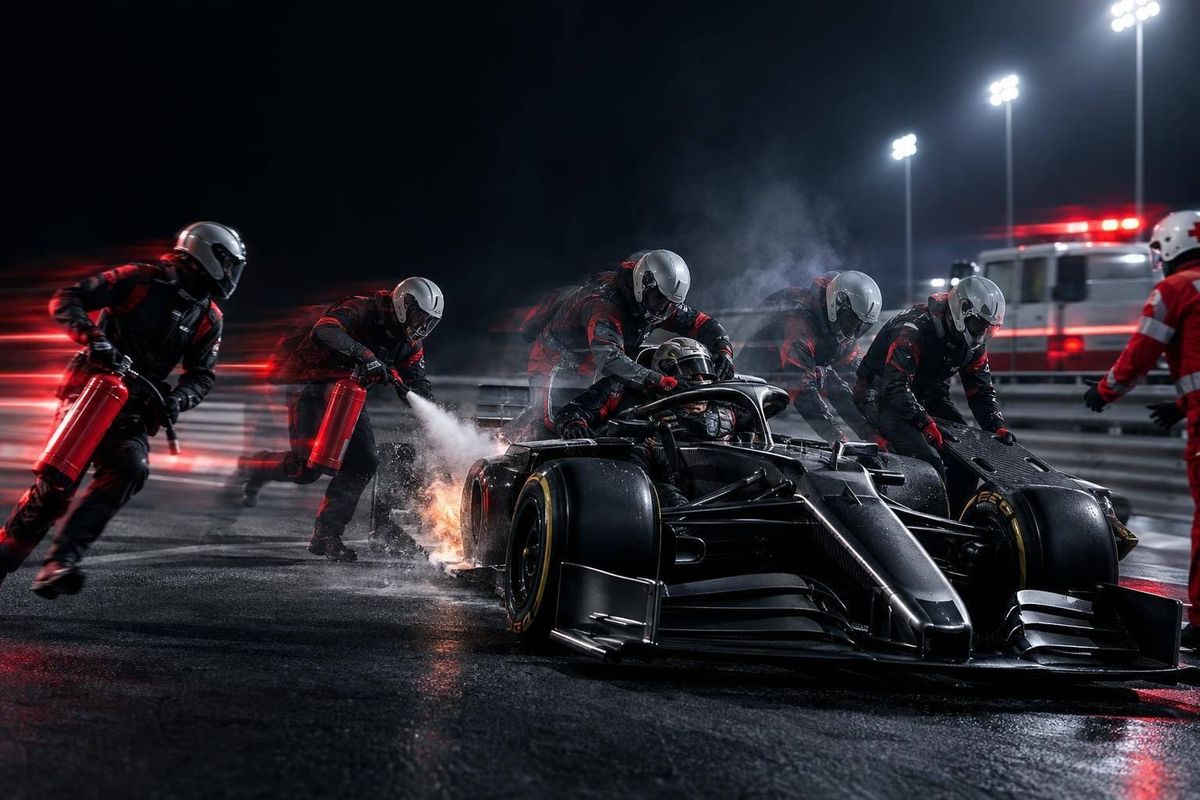
In an F1 fire, the safest way out depends on the flames, cockpit access, and the driver’s condition. Immediate danger can make fast removal safer than waiting for a controlled rescue. Grosjean escaped in about 28 seconds in Bahrain - but not every driver could get out alone.
These five cases show what helps or blocks a rescue. They cover both documented safety changes and lessons for modern response - not five proven changes to extraction rules.
Quick Comparison
| Incident | Main rescue problem | Lesson |
|---|---|---|
| Romain Grosjean - 2020 | A barrier restricted his exit | An intact cockpit still needs a usable escape path. |
| Niki Lauda - 1976 | He needed fellow drivers to free him | Rescue crews need access to remote track sections. |
| Roger Williamson - 1973 | An overturned car trapped him | Crews need training, protective gear, and equipment to reach the driver. |
| Gerhard Berger - 1989 | He was unconscious in a burning cockpit | Fire suppression must open access for removal and medical care. |
| Lorenzo Bandini - 1967 | An overturned car and tight streets delayed rescue | Street circuits need plans for car removal and backup evacuation routes. |
The shared lesson: plan for blocked exits, match removal to the danger, and keep medical care moving after the driver is out.
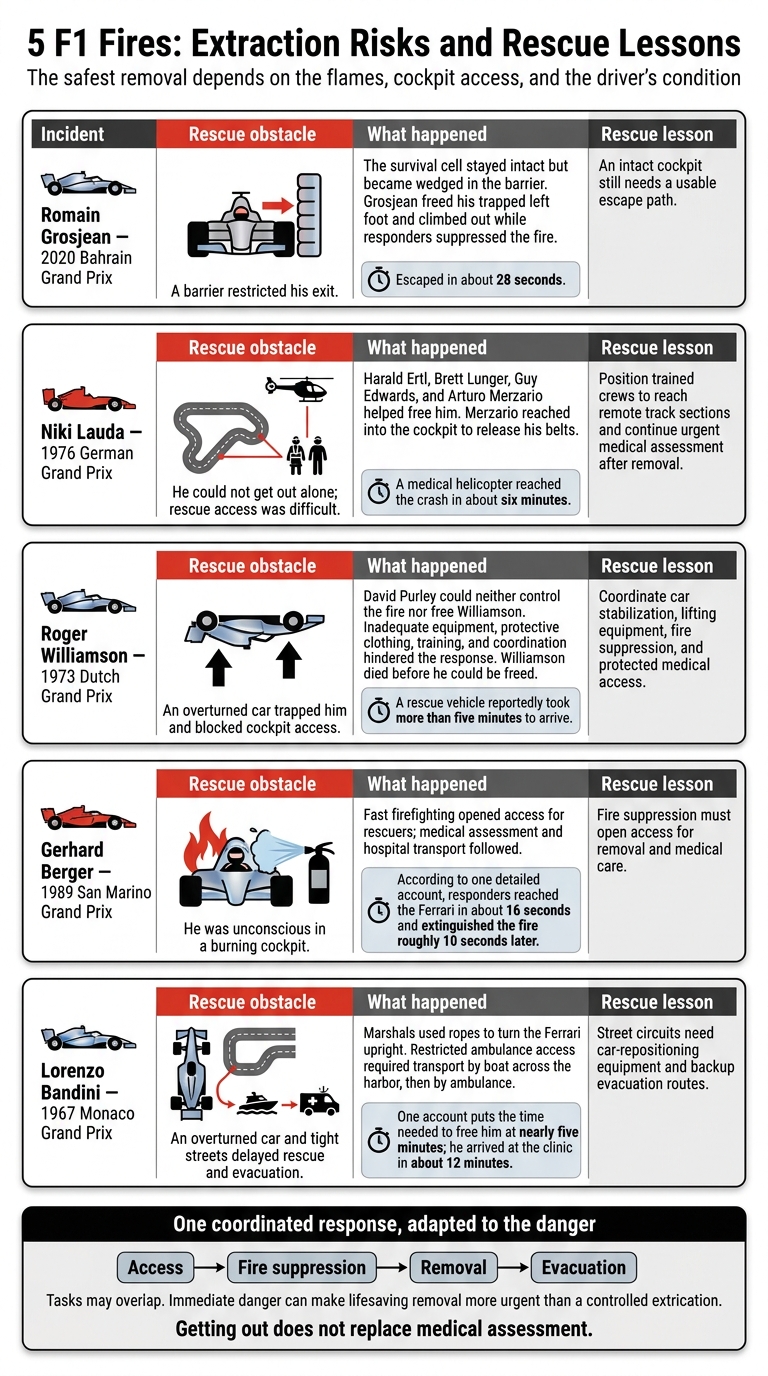
5 F1 Fires: Extraction Risks and Rescue Lessons
EXCLUSIVE! Romain Grosjean reveals how he escaped horrific fireball crash
sbb-itb-7c68254
Driver Self-Exit, Assisted Removal, and Controlled Extrication
Each incident below forced F1 to choose how to get the driver out: self-exit, assisted removal, or immediate extrication.
Self-exit means the driver gets out without being physically removed. But getting out alone doesn’t mean escaping injury. It shows only that the driver could move; a medical assessment is still needed.
Assisted removal helps a conscious driver who can’t move safely because of pain, weakness, or limited mobility. Controlled extrication is a planned, coordinated removal used when injury, unconsciousness, or entrapment makes independent movement unsafe. Rescuers protect the airway and limit head and neck movement. They may use a removable seat or vacuum mattress, with one team leader directing the removal.
An overturned car adds another challenge. Before moving the driver, rescuers must stabilize the chassis, check cockpit access, and choose the safest exit path.
Emergency extrication puts survival first. Fire, dense smoke, airway failure, or another worsening threat can make waiting more dangerous than moving. Equipment must not delay lifesaving removal. As a last resort, rescuers may use approved grab points on the driver’s gear while maintaining cervical-spine stabilization as far as possible.
In the five fires that follow, the choice of extraction method depended on fire intensity, cockpit access, and the driver’s condition.
1. Romain Grosjean - 2020 Bahrain Grand Prix
Bahrain is the clearest modern example of how a fire can become an extraction problem.
Fire Hazards
Grosjean’s Haas VF-20 struck the triple-rail barrier at 119 mph (192 km/h), reaching a peak of 67G. The survival cell stayed intact but separated from the rear powertrain and became wedged in the barrier. A torn inspection hatch allowed fuel to escape and ignite.
The halo pushed the middle rail upward, but the top rail stayed above the cockpit opening, leaving less room to escape. The rescue hinged on a basic question: Was there still enough space for Grosjean to get out?
Rescue Access
The wedged chassis restricted rescuers’ access, making a fast self-exit critical. Grosjean first had to free his trapped left foot. As marshals and medics suppressed the fire, he climbed out.
He escaped in about 28 seconds, suffering burns to both hands despite his fireproof gear.
Documented Changes
The FIA’s March 2021 review issued 22 recommendations covering several areas:
- Fuel systems: Fuel-bladder materials, connections, inspection-hatch design, and fuel-blend compatibility.
- Car structure: Survival-cell geometry, steering-column mountings, headrest retention, and mirror mountings.
- Rescue response: Extinguisher capacity, fire training, and trauma-hospital coordination.
The review focused on preventing wedging, reducing entrapment, and improving rescue readiness. Follow-through included tougher, puncture-resistant fuel-bladder materials in the 2022 regulations and about 20% greater glove heat-transmission protection in 2021. These measures addressed both keeping the exit accessible and giving drivers more time to use it.
Extraction Lessons
Grosjean’s case shows that extraction depends on the real escape path, not just survival-cell integrity. When access is obstructed, marshals must prioritize immediate escape support. The key variable was not the fire alone, but whether the exit stayed physically usable.
2. Niki Lauda - 1976 German Grand Prix
Grosjean’s escape shows how modern extraction can depend on a driver getting out unaided. Lauda’s crash shows what happens when that isn’t possible.
Fire Hazards
On August 1, 1976, Lauda’s Ferrari crashed on the second lap at the fast left-hand section before Bergwerk. It struck the barrier and came back onto the circuit in flames. His helmet shifted or came off, leaving his face exposed to the fire. He suffered burns to his face, hands, and wrists, multiple fractures, and smoke inhalation. He remained conscious, but his burns and smoke inhalation were severe.
Rescue Access
Harald Ertl, Brett Lunger, Guy Edwards, and Arturo Merzario pulled Lauda free because he could not get out alone. Merzario reached into the cockpit to release his belts.
A medical helicopter reached the crash in about six minutes, and Lauda was transported for burn treatment.
Documented Changes
The 1976 German Grand Prix was F1’s last race on the original 14.2-mile (22.8-kilometer) Nordschleife, but Lauda’s crash was not the only reason. Remote sectors, difficult emergency access, and limited fire and medical coverage for such a long circuit made meeting the safety standards of the time increasingly difficult. Access and medical reach determined how quickly crews could remove and treat a driver.
The accident added urgency to demands for better rescue access, fire suppression, and medical coverage. Helmet retention, protective clothing, and rescue equipment needed to work together. No single equipment failure explains Lauda’s injuries.
Extraction Lessons
Plan around the hardest place to reach. Position trained crews near remote sectors, rehearse belt release and removal of an unconscious driver, and test helicopter access and hospital routes. Lauda’s rescue also shows why fire response must include urgent airway assessment: getting a driver clear of the flames does not end the medical emergency.
The next cases show how extraction becomes even harder when access is slower, the cockpit is harder to reach, or the driver cannot stay conscious.
3. Roger Williamson - 1973 Dutch Grand Prix
An Overturned Car Blocked Access
Lauda’s crash showed the cost of slow access. Williamson’s showed how an overturned car could block access altogether.
On July 29, 1973, Roger Williamson’s March overturned and caught fire at Zandvoort after a suspected tire failure. He was trapped beneath the car, so responders had to turn it upright before they could reach him.
Purley Could Not Free Him Alone
David Purley stopped his own March and crossed the track to help. He tried to turn Williamson’s car upright and fought the flames with a marshal’s extinguisher, but he could neither control the fire nor free Williamson. Purley later received the George Medal for his rescue attempt.
Training, Equipment, and Command
Reports describe marshals in non-protective clothing who were unsure of their roles. The available extinguisher could not control the fire, and a rescue vehicle reportedly took more than five minutes to arrive.
The failure was procedural: training, flame-resistant gear, accessible extinguishers, assigned roles, and escalation authority all failed together, leaving Purley unable to secure access to Williamson.
Recovery and Medical Access
Williamson died before he could be freed, showing that an overturned-car response needs stabilization, lifting gear, fire suppression, and protected medical access as one coordinated operation.
The next fire presents a different extraction problem: a driver exposed to flames but not pinned beneath the car.
4. Gerhard Berger - 1989 San Marino Grand Prix
An Unconscious Driver in a Burning Cockpit
On April 23, 1989, Gerhard Berger’s Ferrari 640 hit Tamburello’s concrete wall at approximately 180 mph (290 km/h) after a reported front-wing failure. The fuel system ruptured, and the car burst into flames. Berger was knocked unconscious and couldn’t escape on his own.
Fast Firefighting Opened Access
Marshals had to control the flames before rescuers could reach Berger. According to one detailed account, Bruno Miniati, Paolo Verdi, and Gabriele Violi reached the Ferrari in about 16 seconds and extinguished the fire roughly 10 seconds later.
Berger’s fire-resistant clothing helped delay serious heat injuries, though he still suffered second-degree burns to his hands.
Survival Space Was Only One Layer
The carbon-fiber monocoque kept the cockpit intact enough for Berger to survive the impact. But the ruptured fuel system remained the weak link.
That bought time for medics, but extraction was only half the response.
Medical Care Continued After Removal
Medical personnel, including Dr. Sid Watkins, reached the wreck soon afterward. Berger was then airlifted to a hospital.
Berger’s rescue shows that fire suppression, medical assessment, and transport must work as one chain. That same chain of fire control, access, and medical transfer now defines modern extraction standards.
5. Lorenzo Bandini - 1967 Monaco Grand Prix
Street-Circuit Access Delayed Rescue
On May 7, 1967, Lorenzo Bandini crashed on lap 82 while chasing race leader Denny Hulme. His Ferrari hit the harbor chicane barriers, overturned, and caught fire among the straw bales. Bandini was trapped underneath.
With little room to approach, marshals used ropes to turn the Ferrari upright before they could reach him. One account puts the time needed to free him at nearly five minutes.
Rescuers needed protected access and equipment to reposition the car before extraction could begin. That delay mattered because Monaco’s street layout also slowed evacuation.
Harbor Access Complicated Evacuation
Limited ambulance access forced rescuers to take another route. Bandini traveled by boat across the harbor, then by ambulance to Princess Grace Polyclinic, arriving in about 12 minutes. He had third-degree burns over more than 70% of his body and a chest wound. He died on May 10, three days after the crash, at age 31.
That access problem is exactly what modern extraction planning is designed to prevent.
Barrier Changes and Rescue Planning
Historical accounts link the accident to Monaco’s decision to replace straw bales with extended guardrail the following year. That distinction matters: this was a reported track-safety response, not a documented change to extraction rules.
Bandini’s case shows why street circuits need protected access, stabilization gear, and a backup evacuation route when an ambulance cannot reach the scene. Those constraints still shape modern fire-response and evacuation planning.
Modern F1 Extraction and Race-Weekend Safety
The five incidents above show why modern F1 treats extraction as a timed, coordinated process.
Cockpit Protection and Driver Exit Tests
Mandatory since 2018, the titanium halo protects the cockpit opening during rollovers and barrier strikes. But cockpit protection doesn’t guarantee a clear exit, as Grosjean’s wedged cockpit shows.
In full racing gear, drivers must exit within seven seconds and refit the steering wheel within five. This test checks compliance - not how long it takes to escape a damaged or burning car.
Fire-Resistant Clothing: Tests and Limits
FIA standard 8856-2018 sets the current baseline for fire-resistant clothing. The clothing slows heat transfer, but it cannot replace fast rescue.
Fire Suppression and Driver Removal
When the exit path remains open and fire poses an immediate threat, speed takes priority over controlled movement. FIA rescue guidance puts lifesaving removal first in immediate danger. Responders may use the suit’s built-in pull loops when needed.
Once fire is controlled, trained responders can use a short-board and a BOA cervical stabilization device if they suspect a spinal injury.
Marshal Training, Medical Care, and Evacuation
Once the driver is out, responders move straight to medical assessment and transport. These five fires show the same response chain under pressure: access → fire suppression → removal → evacuation.
Training must prepare crews for blocked exits, overturned cars, and unconscious drivers. Race-weekend planning must also cover ready-to-use equipment, clear command, awkward car positions, and a backup evacuation route.
5 Incidents Compared: Extraction Risks and Lessons
These five cases trace the shift from improvised fire rescue to coordinated trackside response. Each highlights a lesson in the sequence access → suppression → removal → evacuation - and why driver removal must fit the risks at the scene.
| Incident and year | Primary extraction threat | What helped or hindered extraction | Safety lesson | Modern takeaway |
|---|---|---|---|---|
| Romain Grosjean, 2020 | Fire during self-exit | Halo protection helped preserve an escape path despite the barrier obstruction. | Survival space must also provide a usable exit. | Keep the escape path accessible. |
| Niki Lauda, 1976 | Rescue access | Fellow drivers reached him and released his belts. | Trained rescue crews need to be on scene. | Position responders where they can reach difficult sectors. |
| Roger Williamson, 1973 | Access to an overturned car | Failures in equipment, training, and command delayed access. | Marshals needed better training, gear, and rescue equipment. | Coordinate car stabilization, fire suppression, and driver removal. |
| Gerhard Berger, 1989 | Fire blocking removal | Fast firefighting let rescuers reach the unconscious driver. | The incident drove tighter fuel-containment standards. | Control flames quickly so rescuers can reach the cockpit. |
| Lorenzo Bandini, 1967 | Evacuation delay | Limited street-circuit access complicated removal and transport. | Street circuits need organized rescue plans. | Prepare backup evacuation routes. |
Conclusion: Match Driver Removal to the Risk
These five fires show how F1 driver extraction now relies on layers of protection: cockpit safety, fire response, rescue access, and medical care.
The removal method must match the hazard at the scene. When the car is stable and the fire is contained, crews can use controlled extrication. When fire threatens life, immediate removal takes priority.
Care must then follow in sequence: trackside assessment, hospital observation if needed, and medical clearance to race again. A driver’s ability to move does not replace medical judgment.
FAQs
How are F1 rescues practiced before races?
Before races, marshals train to respond to fires immediately and get drivers out safely. Medical and race-weekend safety teams plan ahead so equipment and access routes are ready for the first minutes of an incident.
These preparations stem from safety reforms after major fire crashes exposed gaps in fire marshal coverage and emergency access. Those crashes led to better emergency response and medical care procedures.
Can the halo complicate emergency extraction?
Yes. The halo cockpit protection system makes drivers safer by shielding them from debris and objects entering the cockpit. But its structure also leaves medical teams and marshals less room to reach or remove an injured driver.
To address that trade-off, emergency extraction procedures, marshal training, and race weekend safety planning have changed to help rescue teams work around the halo when every second counts.
Which fires led to documented safety rule changes?
Niki Lauda’s 1976 crash at the Nürburgring is the most influential example. The fire exposed gaps in fire marshal coverage and delays in emergency response. It helped drive the development of modern fire-resistant race suits and gave drivers the power to boycott circuits that didn’t meet safety standards. While other accidents led to broader reforms, Lauda’s crash remains a defining moment for fire safety and emergency response in Formula 1.