10 ways F1 teams cut travel fatigue and illness
F1 teams treat travel as performance—using sleep plans, flight timing, hydration, hotel setups and rotation to cut jet lag and illness.
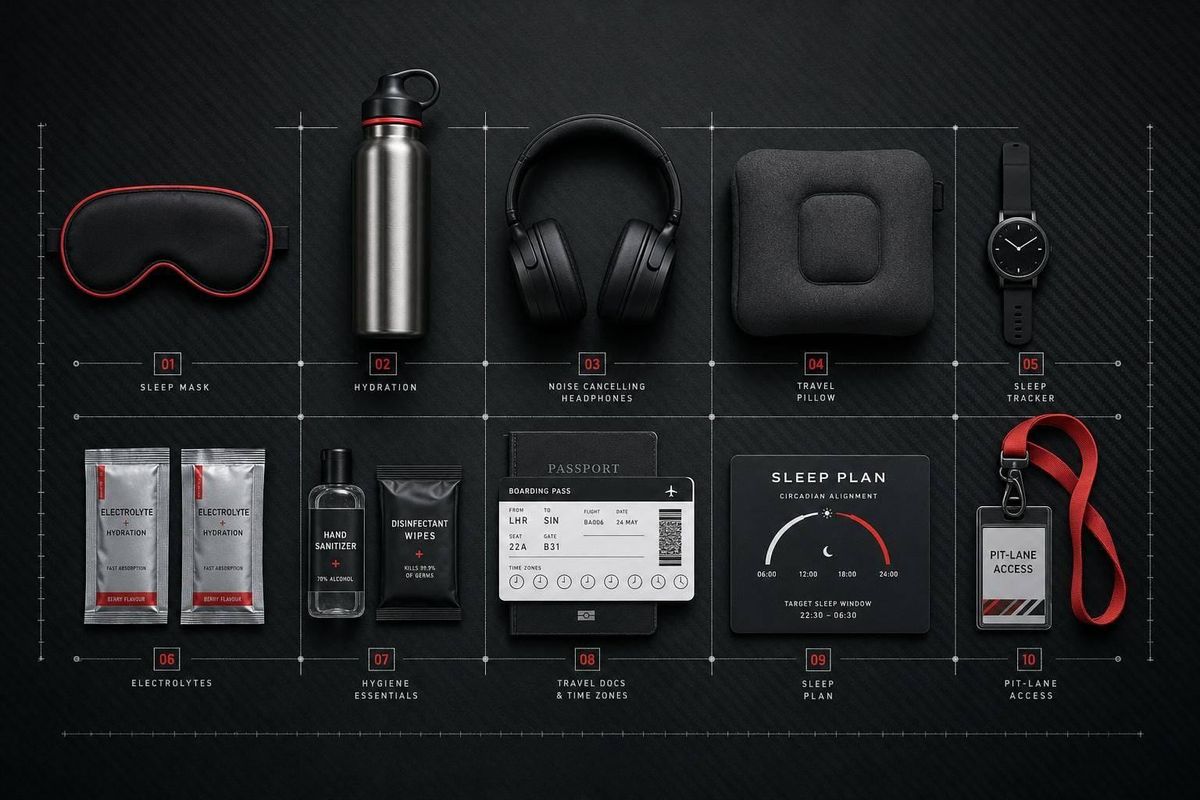
A 24-race F1 season can wear people down fast, so teams treat travel like part of performance. I’d sum it up like this: they plan sleep before takeoff, control fluids and meals in the air, protect recovery after landing, and rotate staff when they can.
Here’s the full picture in simple terms:
- Sleep comes first: teams shift bedtimes before travel and time flights around recovery.
- Flights are picked with purpose: arrival time matters because staff often need to be ready in 48 to 72 hours.
- Hydration and food are controlled: dry cabin air, caffeine, alcohol, and meal timing all affect focus and jet lag.
- Hotels become recovery spaces: room temperature, darkness, and spacing can help sleep and cut illness spread.
- Health kits travel too: teams use items like melatonin, electrolytes, compression gear, and, in some cases, antibiotics.
- Movement matters: mechanics and crew do mobility work to cut stiffness, strain, and injury risk after long flights.
- Not every role gets the same plan: drivers, engineers, and mechanics each need different recovery support.
- Rotation has limits: with 70 to 150 staff at a race and a $135 million budget cap, teams can’t just send backup crews for everything.
- The risk is real: staff can spend 200+ days a year away from home, and even small drops in reaction time can hurt pit stops, setup work, or race calls.
- The first few days after landing matter most: that short window often decides how sharp the team is by race weekend.
How Elite Athletes Manage Jet Lag and Travel Fatigue to Optimize Performance with Tom Clark
sbb-itb-7c68254
Quick Comparison
| Method | Main job | Best for | Main limit |
|---|---|---|---|
| Sleep plans | Shift body clock | Long-haul trips | Hard in triple-headers |
| Flight timing | Match travel to recovery | Tight turnarounds | Airline and schedule limits |
| Hydration control | Keep focus steady | Hot races, long flights | Needs staff discipline |
| Meal timing | Help reset body clock | New time zones | Hard to keep exact food plans worldwide |
| Hotel setup | Improve sleep | Back-to-backs, night races | Special gear can be hard to move |
| Illness kits | Cut sickness risk | Higher-risk flyaways | Some tools need careful use |
| Compression and movement | Cut stiffness and strain | Mechanics and pit crew | Takes time in packed schedules |
| Staff rotation | Lower season-long fatigue | Support roles | Key roles are hard to swap |
| Role-based jet-lag plans | Match support to job demands | Drivers, engineers, mechanics | Hard across large crews |
| Recovery windows | Get people ready fast | First 72 hours after landing | Less time for other work |
My takeaway: F1 teams don’t rely on one trick. They stack small habits - sleep, flight timing, fluids, food, hotel setup, movement, and staffing - to keep mistakes and sickness from costing time.
Why travel management is a competitive factor in F1
An F1 team brings 70 to 150 staff to each race - mechanics, engineers, hospitality and catering crews, and chefs - and every one of them deals with the same travel grind as the driver.
For mechanics, that strain is brutal. They handle tires that weigh about 48 lbs. (22 kg) each, deal with wheel gun recoil, and work 14- to 16-hour days in the garage. That’s hard enough on its own. Add jet lag and dry cabin air, and the job gets even tougher. A study during the 2013 Singapore Grand Prix tracked 16 F1 team members and found that reaction times slowed while stress levels climbed between practice and qualifying.
The pressure isn’t just physical. Engineers have to think fast all weekend, reading live data and making split-second strategy calls. When they’re bouncing between time zones and still expected to perform at full tilt, the load stacks up across the whole traveling team. Williams Racing chief mechanic Ollie Middleton put it like this:
"I've naturally shifted slightly to Vegas time, but it's always in the back of our minds that we're going straight to Qatar."
That’s the core problem. When people are tired and out of sync, reactions slow down, judgment slips, and small mistakes can turn into costly ones.
Illness can make things worse. Long-haul flights, along with different food and water standards, can increase the risk of stomach infections and other illnesses that take key staff out of the weekend. And this isn’t a one-off issue. With 24 races across five continents, and staff spending more than 200 days a year away from home, the strain adds up fast.
That’s why teams treat travel planning like part of performance. They use structured routines around sleep, flights, food, and recovery to cut down risk. In practice, planning starts well before anyone leaves, with sleep schedules and arrival timing mapped out in advance.
1. Sleep plans for every trip
The first control point is sleep. In F1, teams plan sleep before almost anything else. Even before flights are booked, staff map out sleep schedules based on the time zone, each person’s role, and the direction of travel.
At Aston Martin, team doctor Rahul Chotai creates individual charts for more than 100 traveling team members before each race. These charts cover the days before departure, the flight itself, and the hours after landing. The guidance changes depending on whether the team is flying east or west. Teams need to be fully operational within 2 to 3 days of landing, and each hour of time-zone change takes about a full day to absorb.
"I prepare a chart outlining what team members need to do for the days leading up to the flight and what they should do during the flight and when they land, depending on if we travel east or west." - Rahul Chotai, Team Doctor, Aston Martin
Some teams also use room-level sleep tools. Mercedes-AMG Petronas has used temperature-controlled mattress covers during race weekends to help with overnight recovery.
Night races add another layer. For events like Singapore, some teams stay on European time instead of moving to local time. That trade-off is deliberate: they accept some daytime fatigue so the switch into the next back-to-back race is easier. In other words, the sleep plan isn’t built only for the race in front of them. It’s built for the one that comes next too.
2. Flight timing to protect recovery
Sleep plans only work when the flight fits the plan. In F1, teams don’t pick departure times just because they’re easy or convenient. They pick them based on when staff need to be ready after landing. That turns flight choice into part of recovery, not just a travel detail.
The basic idea is simple: arrive at a time that lets the recovery plan start right away. Dr. Luke Bennett, Team Physician at Mercedes-AMG Petronas F1 Team, says it clearly:
"You want to select the flight appropriately, depending on what time of day they want to arrive and what they need to do on arrival. Teams may even factor in seat position to manage light exposure."
That means flight timing has to line up with the pre-shifted sleep schedule. Teams board only when the arrival window works for recovery, and once they’re on the plane, staff switch straight into arrival-time routines. The flight isn’t separate from the plan. It is part of the plan.
One of the biggest calls is whether to leave right after the race or stay overnight. Flying out straight after the race gives crews more time to adjust before the next event. But there’s a catch: it comes at the end of a 14- to 16-hour race day. Staying overnight protects that first recovery window, but it also cuts down the time available to adjust before track work starts.
That trade-off gets even tougher during back-to-back flyaways. In those cases, teams have to weigh immediate travel against overnight recovery based on how soon the next venue demands full performance.
3. Hydration and cabin fluid control
Once the flight schedule is locked in, the next checkpoint is fluid intake. Cabin air is dry, and that makes hydration more than a comfort issue. Even mild dehydration can hurt focus, reaction time, and concentration when people land.
Aston Martin links hydration with nutrition support on flyaways to help immunity and recovery. Teams don’t just tell staff to “drink more water” and leave it at that. They mix water with electrolytes, use caffeine with care, and limit alcohol on the plane so sleep windows don’t get thrown off and people don’t arrive feeling even more wiped out.
To keep this under control, teams set fluid targets for three points in the trip:
- before departure
- during the flight
- right after landing
That turns generic travel advice into race-week discipline.
McLaren’s 2026 Austrian Grand Prix program shows how detailed this can be. The team ran a hydration program in partnership with Liquid I.V., with staff monitoring mechanics and engineers and using electrolytes, caffeine, or quick sugar hits to keep focus sharp for sub-two-second pit stops.
4. Meal timing and food control
Hydration is only one piece of the puzzle. What teams eat, and when they eat it, matters too. It helps reset body clocks and cuts the odds of stomach problems.
This starts before anyone even gets on the plane. Teams begin moving meal times 2–3 days before departure to push the body toward the destination schedule. The key is that it doesn’t stop there. The shift begins before takeoff and keeps going after landing.
With dedicated chefs and catering crews on the road, teams can keep menus steady and lower food-risk exposure. That kind of control matters when the calendar sends people all over the world.
At some flyaways, unsafe water is a serious issue. In higher-risk locations, Aston Martin gives staff preventive antibiotics as soon as they arrive:
"We will provide everyone with antibiotics to take as soon as they land, so if anyone in the team were to accidentally ingest contaminated water, they are protected. Since the introduction of these measures, we have had next to no cases." - Rahul Chotai, Team Doctor, Aston Martin F1 Team
Singapore is the clearest example of how far teams will go with timing. Because the race runs at night, teams often stay on European time the whole weekend. In practice, that can mean staff go to bed at around 5:00 AM local time and eat breakfast as late as 2:00 PM. It sounds upside down, and on the ground it probably feels that way too. But the point is simple: keep the crew lined up with race time. After arrival, that same level of control shifts from meals to rooms and shared spaces.
5. Room spacing and hotel setup
Once meal timing is sorted, teams move to the room itself. That matters more than people might think. A hotel room isn’t just a place to sleep. It’s part of recovery, and the way rooms are set up can affect performance, not just comfort.
One big focus is stopping illness from moving through the hotel. Teams want key staff close enough to coordinate without friction, but not crammed onto the same floor. That matters even more on back-to-back race weekends, when there’s barely any time to recover or reset.
The two room factors teams can control best are temperature and light. Mercedes-AMG Petronas F1 uses temperature-controlled mattress covers for drivers and key staff. A sensor layer tracks heart rate and respiration, then adjusts bed temperature through the night to support REM and deep sleep. On the Singapore-to-Japan swing, the target was a 30% sleep-quality gain.
As Dr. Luke Bennett, Team Physician, Mercedes-AMG Petronas F1, put it:
"The physiology of temperature around sleep is really becoming recognised as probably as important as things like light and dark manipulation."
Teams also look for dark, light-blocking rooms, especially when staff are intentionally staying on a different time zone, like European time during the Singapore night race. Put simply, temperature and light help keep the body clock on the team’s schedule instead of local time. That same control-first approach carries over to the in-flight illness kits.
6. In-flight illness prevention kits
Once sleep and flight timing are locked in, the plane becomes the next place teams try to stay in control. In the air, they use a small travel health kit that lines up with the trip schedule.
These kits often include basic supplements for flyaways, melatonin, and light-management tools like sunglasses or blue-light devices. For places with more health risk, teams may also hand out antibiotics to take right after landing. As Aston Martin Aramco F1 Team doctor Rahul Chotai said:
"We will provide everyone with antibiotics to take as soon as they land, so if anyone in the team were to accidentally ingest contaminated water, they are protected. Since the introduction of these measures, we have had next to no cases."
Teams also match the kit to the local arrival time. If the flight lands at night, the focus shifts to darkness tools. If it lands during the day, the goal is light exposure. Mercedes team principal Toto Wolff summed it up this way:
"The very moment you board the plane, you must adjust to the time zone of your arrival. That might mean wearing sunglasses and shades when it's night, or exposing yourself to bright light."
The idea sounds simple, but timing is everything. The kit helps only if staff use each item at the right moment. After that, the focus moves to movement and circulation once they land.
7. Compression gear, movement, and circulation
Physiotherapists and fitness coaches travel with the team to set mobility, stretching, and compression routines that help cut long-haul flight strain. They then adjust those routines for the flight itself and for the first few hours after landing. Teams also use compression socks or sleeves to help blood flow during long-haul travel.
Once the flight starts, the job changes. It’s less about planning and more about keeping circulation going.
The timing of movement also matters. It sits inside the team’s jet-lag plan, not as a separate recovery step.
This work changes by role. A wheel gunner needs forearm and shoulder work to handle gun recoil. A tire mover needs lower-back and hip strength to deal with 48.5-lb (22-kg) tires. It’s pretty simple: keep key staff fit enough to get to work as soon as they arrive.
Miss a warm-up, and a mechanic can be sidelined for the weekend. Across a full season, teams manage that physical strain with rotation.
8. Staff rotation across the season
After teams sort out freight movement and garage flow, the next job is deciding who actually travels. And in Formula 1, that matters a lot.
The 2025 F1 calendar runs across 24 races on five continents, and team staff can spend more than 200 days a year away from home. That kind of schedule doesn't just wear people down. It can chip away at sharp decision-making, smooth pit work, and race-weekend prep.
Some roles are harder to rotate than others. Race engineers and performance analysts usually go to every event, while support staff and some mechanics can switch in and out more easily. So rotation isn't just a staffing choice. It's part of performance management. Teams have to protect pit-stop timing, engineer continuity, and the flow of the whole weekend.
Aston Martin's Rahul Chotai says replacing one person can break a drilled unit and cost time in the pit lane.
Money puts a hard limit on all of this. The $135 million budget cap, with salaries included, restricts how many extra people teams can send to races. More rotation can mean less money for car development. It also adds work behind the scenes for HR, finance, and legal teams.
That’s why teams try to pick their moments. They look for spots in the calendar where engineers and performance staff can get one or two days off, and the FIA's 14-day summer factory shutdown gives the whole paddock a rare chance to reset. Paddock curfews also cut back working hours, while phased travel plans for setup and teardown crews let early arrivals recover before the race weekend starts.
When teams can't rotate much, they lean on those other tools instead:
- factory shutdowns
- paddock curfews
- staggered travel for different crew groups
The next layer is role-specific jet-lag planning, because not every traveler can recover on the same schedule.
9. Jet-lag planning by role
Not everyone on an F1 team handles time-zone travel in the same way. Drivers and race engineers have to stay mentally sharp. Mechanics and freight crews need to bounce back physically. That difference shapes the whole trip, from the flight itself to the first hour after landing.
The divide comes down to mental load versus physical load. For drivers and engineers, teams center plans on sleep timing and light exposure so reaction time stays sharp. That matters because drivers may sit through roughly seven hours of engineering meetings over a single race weekend. If mental output drops, the weekend gets harder fast.
Mechanics and freight crews deal with a different kind of strain. Their workdays can run 14 to 16 hours, so their plans lean more on physical recovery, mobility work, and injury prevention. It’s less about fine-tuning alertness in a meeting room and more about making sure the body can keep going without breaking down.
There’s also a staffing issue in the background. Some support staff and certain mechanics can rotate across the season to cut cumulative fatigue. Race engineers and performance analysts usually can’t. Their knowledge is too specialized to swap out easily, so they’re expected to be at every event.
Once the plane lands, the focus moves from role-based travel planning to the first recovery window.
10. Recovery windows after arrival
Role-based planning only helps if teams handle the first 72 hours after landing the right way. In most cases, they have about 48 to 72 hours to get people ready to work, and that’s still less than the body’s usual adjustment period.
The timing is tight, and it changes by role. Engineering staff usually get in on Wednesday, which gives them one night of sleep before Thursday access. Drivers often arrive Thursday around midday, so they have less time in the packed paddock before they need to perform.
There’s also a fixed rule in play. The FIA’s 29-hour track-access rule creates a firm rest window before Free Practice 1. That gives car crew a required buffer for sleep and off-site prep, not just more work time at the circuit. Those timing limits set the starting point for the methods compared below.
Things get tougher during triple-headers or back-to-back flyaway races. In those stretches, the recovery window can shrink fast or vanish altogether.
As Aston Martin Aramco F1 team doctor Dr. Rahul Chotai noted:
"Long-haul flights cause substantial stress to the body, which has an impact on immunity and cognition. We have therefore introduced nutritional supplementation for flyaway races to help boost innate immunity and to promote recovery."
That’s why teams begin supplementation as soon as people arrive. The first few hours on the ground aren’t downtime. They’re already part of recovery.
Comparing the 10 methods at a glance
These methods work best in different moments. Each one tackles a different piece of the same issue: keeping staff sharp from departure to the garage. The table below shows where each method tends to help most, and where it runs into limits.
| Method | Main Benefit | Best Use Case | Primary Limitation |
|---|---|---|---|
| Sleep plans | Up to 30% improvement in recovery quality | Long-haul flyaway races with major time zone shifts | Hard to maintain during back-to-back triple-headers |
| Flight timing | Improves light exposure and arrival readiness | Continent-to-continent transitions | Limited by charter schedules and race logistics |
| Hydration and cabin fluid control | Helps preserve alertness before thirst kicks in | Hot, humid climates like Singapore and Qatar | Requires constant individual discipline |
| Meal timing and food control | Helps reset the internal body clock | First 48 hours in a new time zone | Sourcing specific nutrition globally is logistically difficult |
| Room spacing and hotel setup | Supports recovery via temperature control | High-pressure race weekends | Specialized equipment, such as mattress covers, is hard to transport |
| In-flight illness prevention kits | Lowers illness risk from infection | Races in regions with poor water quality | Risk of side effects or over-reliance on antibiotics |
| Compression gear, movement, and circulation | Lowers musculoskeletal injury risk | Mechanics prepping for high-intensity pit stops | Requires dedicated time in an already packed garage schedule |
| Staff rotation | Helps reduce long-term burnout and attrition | Support staff across a 24-race season | Specialized knowledge makes key engineering roles hard to rotate |
| Jet-lag planning by role | Matches recovery plans to specific job demands | Drivers and high-stakes decision-makers | Hard to scale across 150-plus staff |
| Recovery windows | Helps cut mental errors during tight turnarounds | Post-race Sunday nights and Monday arrivals | Cuts into available hours for car repairs and updates |
Some patterns stand out pretty fast. Environmental methods, like room setup and temperature control, can work very well, but they depend on gear that doesn’t always travel easily. Organizational methods, especially staff rotation, can ease burnout over a long season, yet they also create knowledge gaps that teams need to handle with care.
In practice, teams don’t rely on just one fix. They layer these tools across the race week, starting before departure and carrying through arrival and recovery. The next step is figuring out when to use each one, from travel day to the first session.
How the methods fit into a race-week timeline
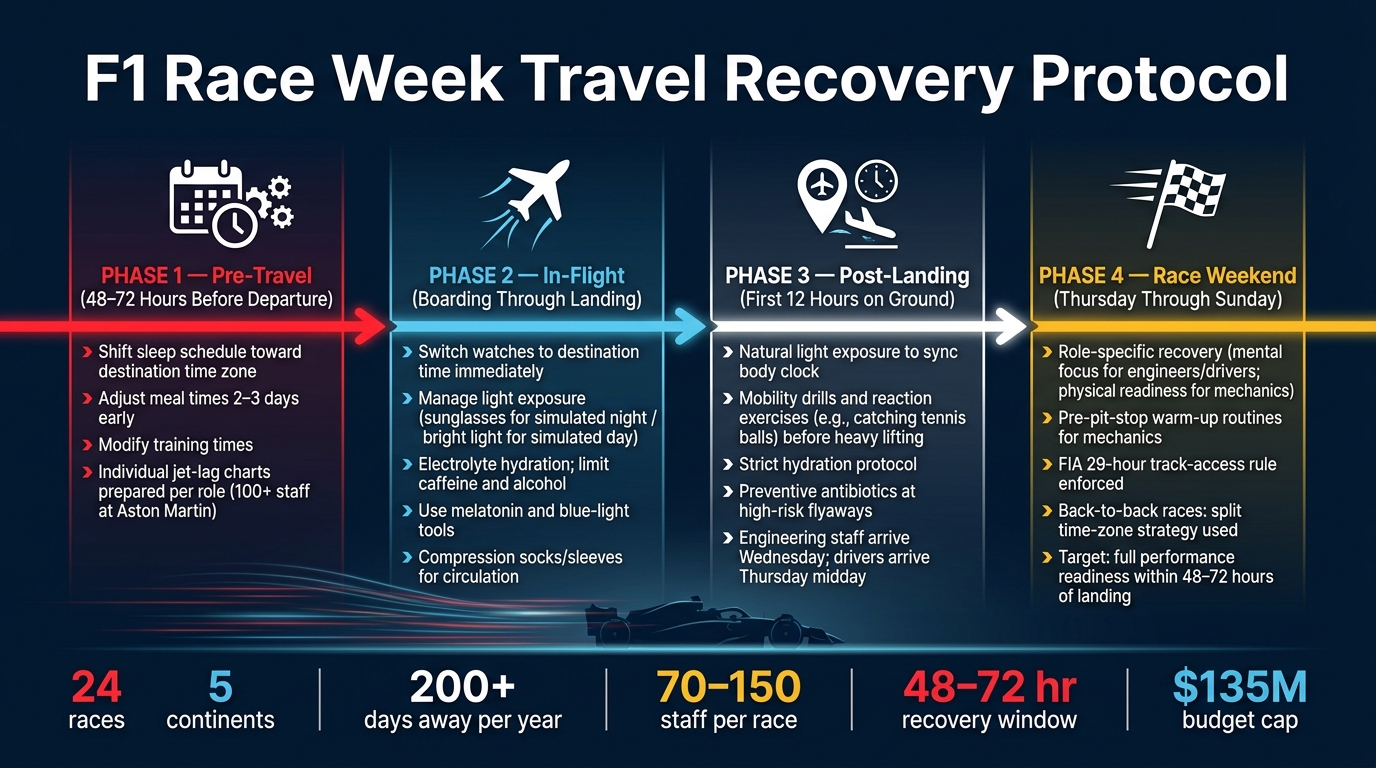
F1 Race Week Travel Recovery Protocol: From Departure to Race Day
Teams don’t use these methods at random. They apply them in a set order: pre-travel prep, in-flight control, arrival recovery, and weekend maintenance. Put together, that becomes a race-week protocol. And once you lay it out on a timeline, the logic is much easier to see.
Before departure (48–72 hours out): Teams begin shifting to the new time zone 48–72 hours before departure. Rahul Chotai, Team Doctor, Aston Martin F1 Team, puts it plainly:
"You need to start preparing several days before you travel: adjusting your sleep schedule, your meal times, and your training times."
During the flight: Once that schedule is in place, the flight itself becomes part of the plan. On board, the aircraft switches to destination time. Staff change their watches right away and adjust light exposure to match. That can mean sunglasses to mimic nighttime, or bright light to stay alert when it’s meant to be daytime at the destination.
First 12 hours after landing: Those first hours on the ground matter. To cut injury risk before the on-site workload ramps up, teams use mobility work and reaction drills, such as catching tennis balls, before any heavy lifting starts. Natural light exposure and strict hydration also help the body clock start syncing with local time.
Across the race weekend: After arrival, the focus moves from travel management to job-specific performance. Mechanics are handled like physical athletes, with warm-up routines before pit-stop work to help prevent cold injuries. During back-to-back race weekends, some teams don’t fully commit to either time zone. Instead, they split the difference, partly adjusting to local time while also keeping the next stop in mind, so they don’t hit a slump at the following race.
| Phase | Timing | Primary Focus |
|---|---|---|
| Pre-travel | 48–72 hours before departure | Sleep shifting, meal alignment, training adjustments |
| In-flight | Boarding through landing | Destination-time adoption, light management, hydration |
| Post-landing | First 12 hours on the ground | Light exposure, mobility drills, arrival-day workload |
| Race weekend | Across the weekend | Role-specific recovery, cognitive and physical readiness |
Conclusion
Put it all together, and these 10 methods make one thing clear: travel management in F1 isn't just support work. It's performance management.
Teams reduce travel fatigue by piling up small controls that work together: sleep timing, flight timing, hydration, food discipline, hotel recovery, and staff rotation. The gains come from the full stack, not from one magic fix.
Under the budget cap, teams can't afford to lose ground on human performance. Poor sleep, dehydration, and missed recovery windows lead to slower reactions, more mistakes, and less reliable work in the pit lane and on the engineering side. Across a 24-race, five-continent calendar, the teams that protect sleep, recovery, and staff availability are also protecting lap time.
FAQs
Why is travel management so important in F1?
In Formula 1, travel management matters because a relentless 24-race season pushes team staff to their physical and mental limits. Long-haul flights and constant time-zone shifts throw off circadian rhythms, which can lower alertness, hurt decision-making, and increase the chance of mistakes during high-pressure work.
That’s why travel, sleep, and recovery planning matters so much. Done well, it helps protect staff health, keeps precision high, and supports performance in a sport where even a small error can change a race result.
Which staff roles are hardest to rotate?
Roles that rely on deep, specialized know-how - or directly affect how the car performs - are the toughest to rotate.
That includes jobs like race engineers and performance analysts. In most cases, they need to be at every race to keep continuity from one weekend to the next. Teams can swap mechanics and other support staff more easily, but core technical roles usually stay on the full travel schedule. Over a long season, that can wear people down and add to fatigue.
What matters most in the first 72 hours after landing?
In the first 72 hours after landing, the main goal is simple: cut down the physical toll of travel so team members are ready for race weekend.
That means teams lock in the basics early. They pay close attention to safe water, hydration, nutrition, and immune support, while performance and medical staff make sure recovery plans are followed.
At the same time, each person has to manage their body clock. Planned light exposure and set sleep schedules help shift them onto local race time as soon as possible.