Ground Effect Evolution: F1 Timeline
A concise timeline of F1 ground-effect development from Lotus tunnels to 2026 rules, covering porpoising, floor changes, and ride-height tradeoffs.
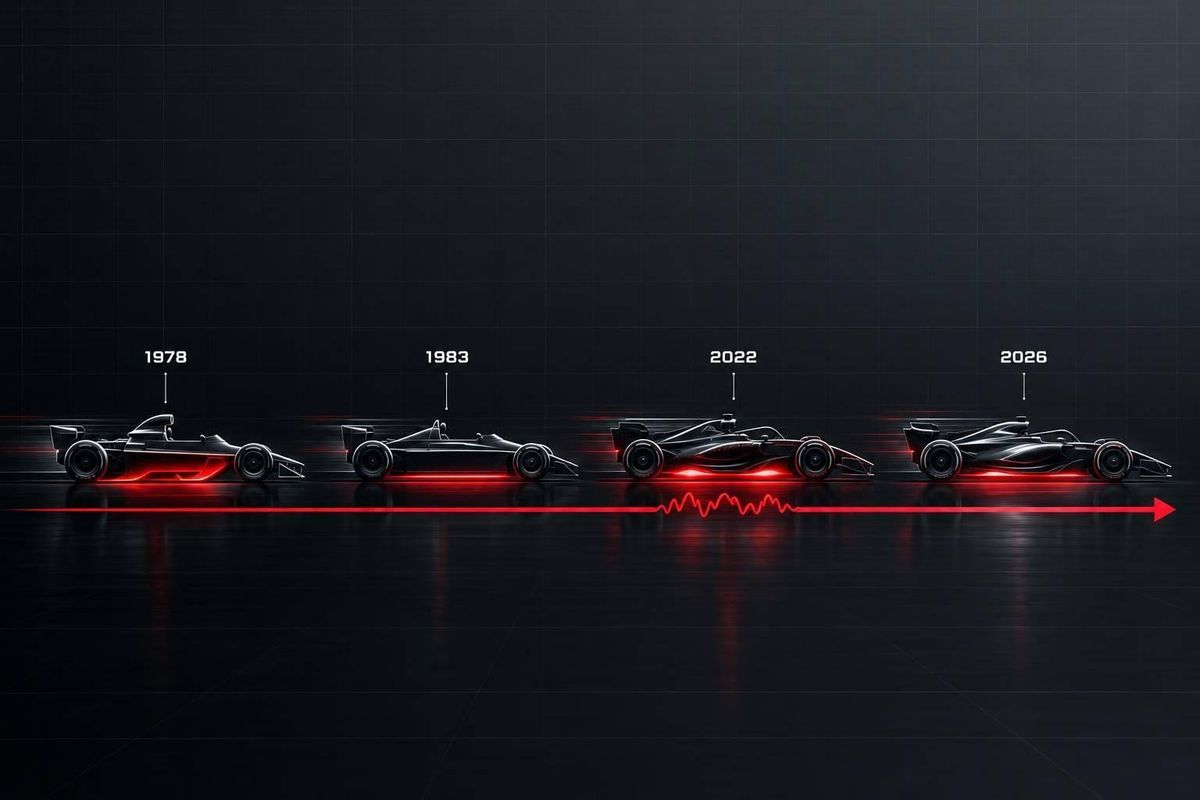
F1’s ground-effect story comes down to one tradeoff: more downforce means little if the floor stops working over bumps. I trace that balance from Lotus’s 1970s tunnel floors through flat-floor rules, diffuser development, and the return of large tunnels in 2022.
Here’s what connects each era:
- 1977–1982: Tunnels and skirts increased grip, but changes in ride height could cause sudden downforce loss.
- 1983–2021: Floor restrictions shifted development toward diffusers, airflow control, and plank-wear limits.
- 2022–2026: Tunnel floors returned, porpoising prompted rule changes, and revised floors joined active wings in 2026.
My takeaway: <u>lower isn’t always better</u>. The 2023 floor-edge increase of 0.59 inches (15 mm) shows why controlling airflow matters as much as producing peak downforce.
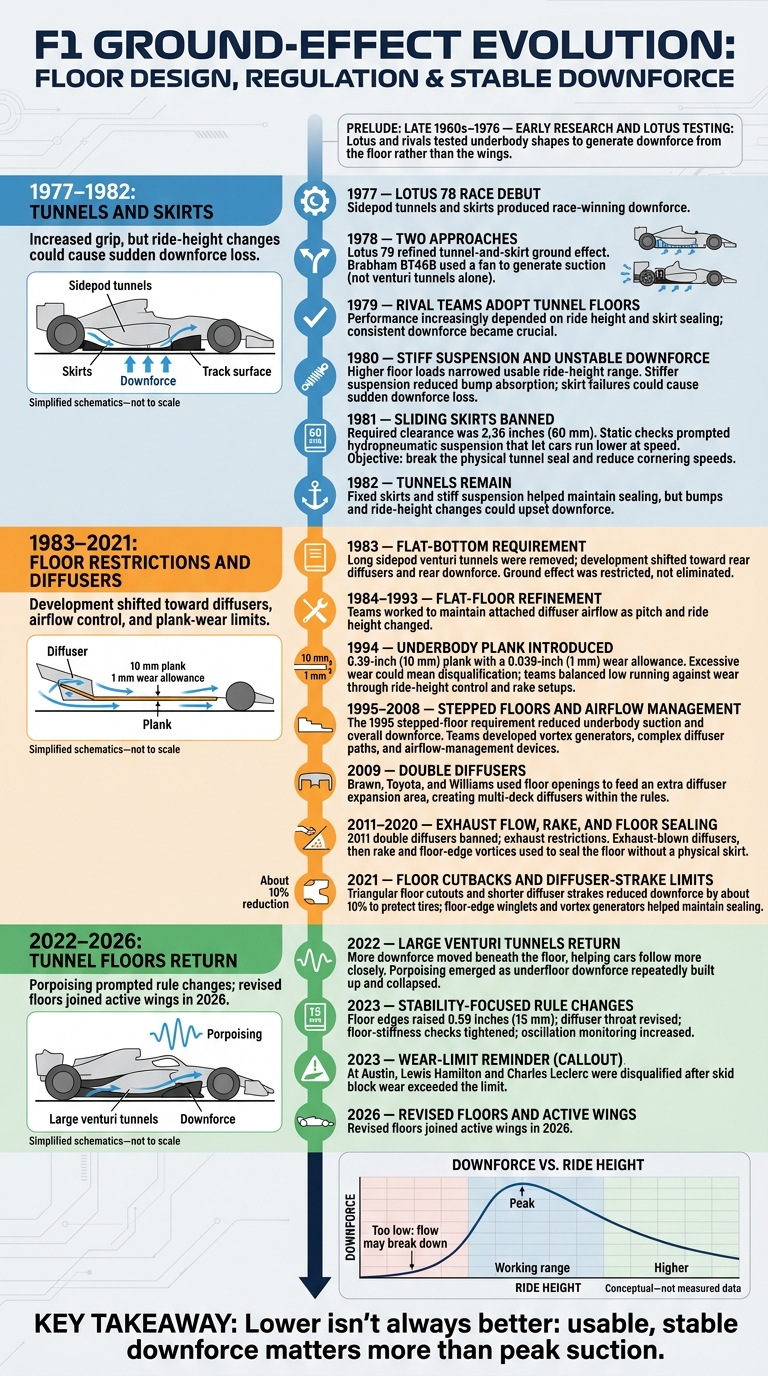
F1 Ground Effect Timeline: Lotus to 2026
Late 1960s–1980: From Research to Tunnel Floors
Late 1960s–1976: Early Research and Lotus Testing
Lotus and its rivals tested underbody shapes to generate downforce from the floor rather than the wings. This research laid the groundwork for Lotus’s first race-ready ground-effect cars.
1977: The Lotus 78 Makes Its Race Debut
The Lotus 78 used sidepod tunnels and skirts to produce race-winning downforce. Lotus had shown that the concept worked. In 1978, it pushed the design further.
1978: Lotus 79 Tunnels and Brabham BT46B Suction
The Lotus 79 refined the tunnel-and-skirt design. Brabham’s BT46B took a different route, using a fan to generate suction rather than relying on venturi tunnels alone.
1979: Rival Teams Adopt Tunnel Floors
As rival teams adopted ground-effect floors, performance depended more on ride height and how well the skirts sealed against the track. The challenge shifted from making more downforce to keeping it consistent.
1980: Stiff Suspension and Unstable Downforce
Higher floor loads left teams with a smaller usable ride-height range. They stiffened the suspension to keep the cars at the right height, but that made them less able to absorb bumps. Skirt failures could suddenly wipe out downforce and cause crashes. This instability put floor sealing in the regulators’ sights, leading to the 1981 sliding-skirt ban and minimum ride-height rule.
sbb-itb-7c68254
When Ground Effect Ruled Formula 1
1981–2021: Floor Rules and Diffuser Development
The FIA never removed ground effect. It kept tightening the rules around the underbody. Each change pushed teams to trade peak downforce for stability and drivability.
| Year | Rule change | Aerodynamic objective | Design response |
|---|---|---|---|
| 1981 | Sliding skirts banned; 2.36-inch (60 mm) clearance required | Break the physical tunnel seal and reduce cornering speeds | Hydropneumatic suspension passed static checks while letting cars run lower at speed |
| 1983 | Flat-bottom requirement | Remove long sidepod venturi tunnels | Teams focused on rear diffusers and rear downforce |
| 1994 | 0.39-inch (10 mm) underbody plank with a 0.039-inch (1 mm) wear allowance | Discourage excessively low running | Precise ride-height control and rake setups |
| 1995 | Stepped floor requirement | Reduce underbody suction and overall downforce | Vortex generators and complex diffuser paths |
| 2009 | Double-diffuser loophole | Increase rear downforce within new aero limits | Multi-deck diffusers fed through floor openings |
| 2011 | Double diffusers banned; exhaust restrictions | Reduce outwash and downforce | Exhaust-blown diffusers used gas to seal floor edges |
| 2021 | Floor cutbacks and diffuser-strake limits | Reduce downforce by about 10% to protect tires | Floor-edge winglets and vortex generators helped seal the floor |
1981: Sliding-Skirt Ban and 60 mm Clearance
Officials checked clearance while cars were stationary, not continuously on track. Teams used suspension systems that lowered the car at speed, recovering ground effect once it was moving.
1982: Tunnel Floors After the Skirt Restrictions
Teams still used tunnel floors. Fixed skirts and stiff suspension helped maintain the seal, but bumps and ride-height changes could upset downforce.
1983: Flat Floors Replace Sidepod Tunnels
With sidepod tunnels gone, teams relied more on rear diffusers and rear downforce. That made cars more sensitive to dirty air and harder to balance when following another car. Ground effect hadn't disappeared; development shifted toward diffuser shape and ride-height control.
1984–1993: Refining Flat Floors and Diffusers
Teams worked to keep airflow attached through the diffuser as pitch and ride height changed. The aim was more consistent underbody downforce.
1994: The Underbody Plank Sets Wear Limits
Plank wear became a performance limit. Losing more than 0.039 inch (1 mm) could mean disqualification, so teams had to weigh the gains from running low against the risk of excessive wear.
1995–2008: Stepped Floors and Airflow Management
Stepped floors made ground effect less efficient. Teams responded with more complex diffusers and vortex devices to manage airflow beneath the car.
2009: Double Diffusers Enter F1
Brawn, Toyota, and Williams used floor openings to feed an extra diffuser expansion area. This created a multi-deck diffuser that fit within the 2009 rules.
2011–2020: Exhaust Flow, Rake, and Floor Sealing
After the double-diffuser ban, teams turned to exhaust-blown diffusers. Later, they used rake and floor-edge vortices to help seal the floor without a physical skirt.
2021: Floor Cutbacks and Diffuser Limits
Triangular floor cutouts and shorter diffuser strakes reduced downforce by about 10% to protect tires. These changes preceded the return of tunnel-floor rules in 2022.
2022–2026: Tunnel Floors Return as Rules Change
2022: Tunnel Floors Return and Porpoising Emerges
After the 2021 floor cuts, F1 brought back large venturi tunnels in 2022. These moved more downforce beneath the floor and helped cars follow each other more closely. Ride height became a key setup variable, but porpoising also became a major stability problem. This repeated bouncing occurred as underfloor downforce built up and then collapsed.
2023: Higher Floor Edges and Stricter Checks
To tackle that instability, the FIA increased floor-edge height by 0.59 inches (15 mm), revised the diffuser throat, tightened floor-stiffness checks, and stepped up oscillation monitoring. These changes pushed teams toward stiffer floors under closer scrutiny.
Conclusion: Ground Effect’s Recurring Limits
Sealing the floor maintains underbody downforce - but only within a narrow ride-height window.
Why Stable Downforce Matters More Than Peak Load
Conceptual downforce vs. ride height:
Downforce
   ↑
   |        /‾‾‾\
   |       /     \____
   |      /           \____
   |_____/
   +--------------------------→ Ride height
    Too low   Working range   Higher
    Flow may
    break down
Braking, curbs, and changes in fuel load keep moving the car through that window. Peak downforce alone isn't enough: the floor needs to keep working as ride height changes.
In 2023, Lewis Hamilton and Charles Leclerc were disqualified in Austin after skid block wear exceeded the limit.
The same tradeoff shapes the modern ruleset, from the return of tunnel floors in 2022 to revised floors with active wings in 2026. From Lotus to 2026, F1’s target remains usable downforce, not just peak suction.
FAQs
How do modern floors seal airflow without skirts?
Modern Formula 1 cars use controlled vortices beneath the floor to form an aerodynamic seal. This keeps the low-pressure area needed for downforce in place without mechanical skirts.
Teams fine-tune the floor’s shape and underfloor tunnels to control how air speeds up and expands. The beam wing helps by creating a low-pressure zone that draws airflow out of the tunnels.
How is porpoising different from bottoming out?
Bottoming out happens when a car’s floor hits the track, often because its ride height is too low or it runs over bumps.
Porpoising is an aerodynamic instability. Ground-effect suction pulls the car down until the airflow stalls. The car then rebounds, and the cycle repeats.
Both relate to setting ride height for downforce. The difference: bottoming out involves physical contact with the track, while porpoising involves aerodynamic bouncing.
How do active wings affect ground effect in 2026?
In 2026, active wings don’t contribute to ground effect performance because FIA regulations require aerodynamic components to stay fixed and immobile. Systems such as mini-DRS were banned due to safety concerns and regulatory loopholes.
With multi-stage drag reduction and load-induced deflection prohibited, engineers focus on fixed rear wing designs and how the floor and diffuser work together.