Tire Energy Prediction Models in F1
How F1 teams use sensor data and physics+telemetry models to track tire energy, guide stint pacing, and inform pit calls.
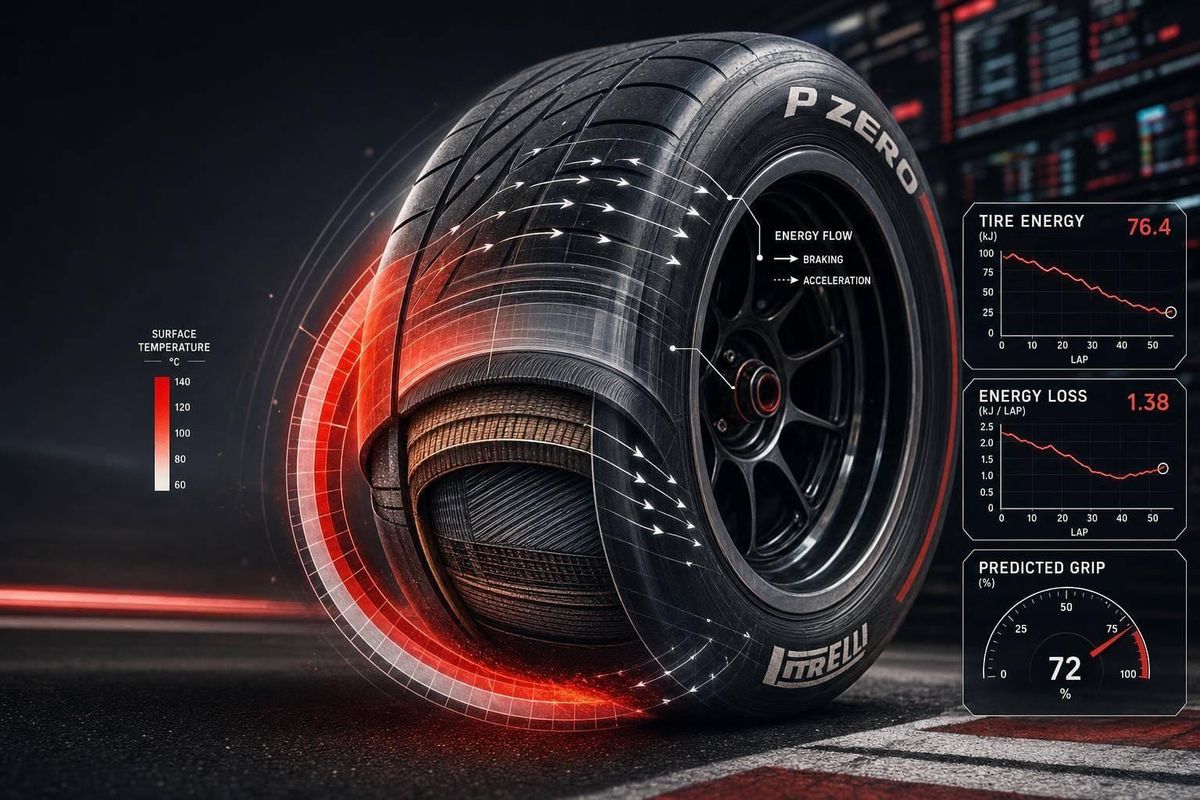
In F1, tire energy is the early warning sign teams watch before pace drops. I’d boil it down like this: teams use car data, tire load, slip, fuel weight, grip, and track heat to estimate how hard each tire is being worked, then use that read to guide stint length, push laps, and pit timing.
Here’s the short version:
-
Tire energy is not the same as temperature or wear
- Temperature is what sensors show
- Wear is the physical damage on the tire
- Tire energy is the load building up before those effects show up
-
Teams update the picture lap by lap
- F1 cars can produce about 1,500 data points per second
- That data comes from 300+ sensors
- I see that as the base for live tire-life estimates
-
The main inputs are simple to list
- Vertical load
- Slip angle
- Slip ratio
- Speed
- Steering
- Camber and toe
- Track grip and surface texture
- Fuel mass
- Track temperature
-
Two model types do most of the work
- Physics-based models: start from tire behavior under load and heat
- Telemetry-driven models: learn from past and live race data
- Most teams use both together
-
These models help with race calls
- When to push
- When to save tires
- Whether to pit early or stay out
- How to react after a safety car, traffic, or dirty air
-
They still have limits
- They tend to work best inside the conditions they have already seen
- Sudden shifts in weather, grip, or race pace can make forecasts drift
- Newer systems try to use more live context so the estimate stays closer to what the car is doing
If you want the plain-English takeaway, it’s this: tire energy models don’t tell teams the future, but they do help them spot tire trouble before it shows up on the stopwatch. Below, I sum up how the inputs, model types, race use, and limits fit together.
How Teams Calculate Tire Energy from Vehicle Dynamics and Track Load
This is where the raw data starts to turn into a tire energy estimate. An F1 car produces about 1,500 data points per second from more than 300 sensors, and a big chunk of that stream feeds the tire energy model. Teams take those readings and turn them into the inputs that describe tire load and heat build-up.
Core Inputs: Load, Slip, Speed, Camber, and Surface Grip
The model starts with vertical load, slip angle, slip ratio, speed, steering input, camber, toe, and surface grip.
Each one affects the tire in its own way. Slip angle - the gap between where the wheel points and where the car is actually going - drives a lot of heat build-up because the tire scrubs across the track in corners. Camber and toe shape where that heat ends up across the tread. Too much negative camber, for example, can overheat the inner shoulder while the outer edge stays too cool.
Surface texture matters too. Teams measure track texture because rougher asphalt changes how fast the tire takes in energy and builds heat. From there, engineers fold that track texture into the rest of the picture, along with circuit layout and fuel mass.
How Track Layout and Fuel Mass Change the Energy Picture
The same compound can act very differently from one circuit to another, and even from one fuel load to the next. High-speed sweepers put the front tires under long periods of lateral load. Traction zones and acceleration, on the other hand, send more energy into the rears. That shifts how fast the model expects each tire to build energy and start losing grip.
Fuel mass is another major factor. A full tank at the start of a race adds vertical load to all four tires, which increases energy input compared with the same car running lighter later in a stint. Track temperature matters as well, since a hotter surface pushes up the tire’s starting thermal state before the driver leans on it.
Rubber build-up changes things again. As more rubber goes down over a race weekend, grip rises. That changes how much slip the tire needs to make the same cornering force. So teams don’t just set the model once and leave it alone - they recalibrate it as grip shifts.
These inputs feed the two main model families: physics-based and telemetry-driven.
sbb-itb-7c68254
The Main Tire Energy Prediction Models Teams Use
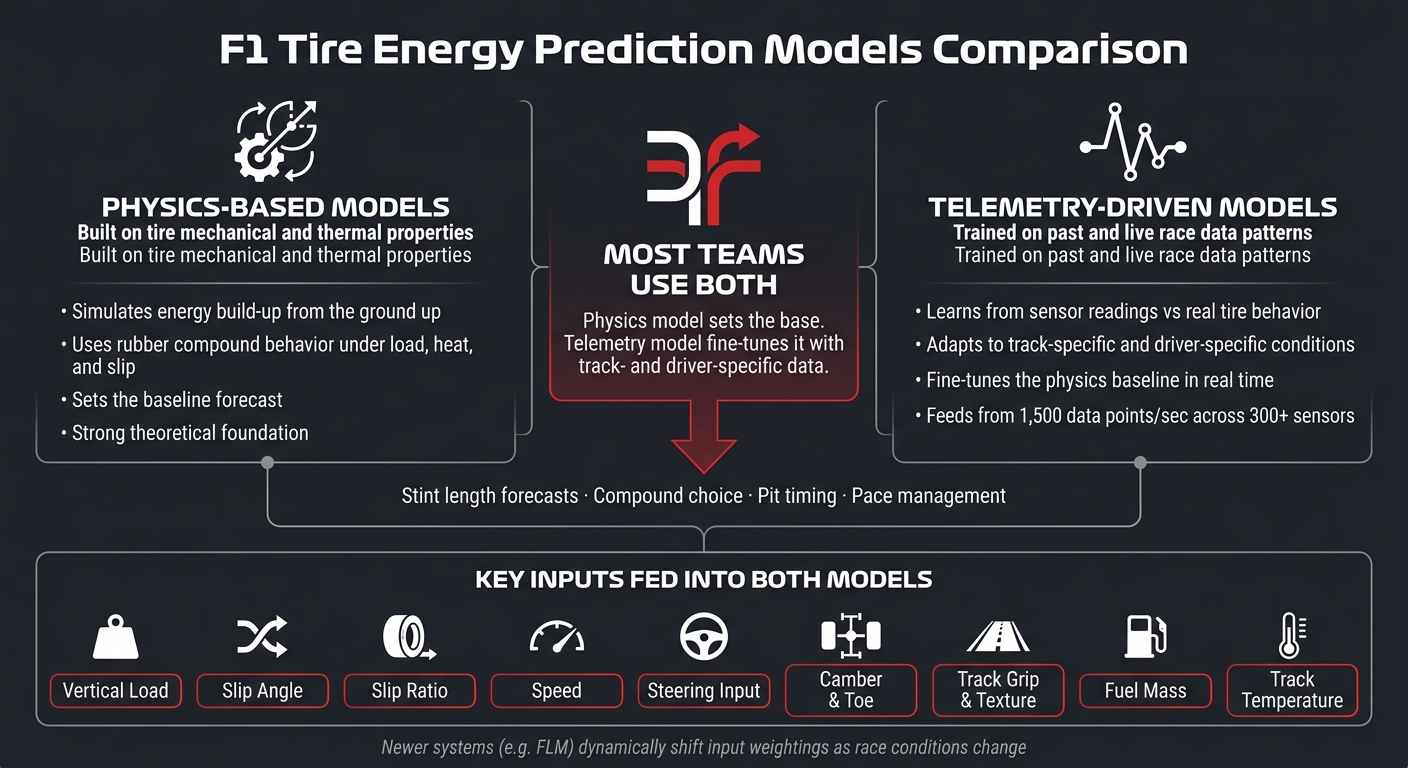
F1 Tire Energy Models: Physics-Based vs Telemetry-Driven Explained
Those inputs feed two types of models: one built on tire physics, the other on race data.
Physics-based models start with the tire itself. They use the tire’s mechanical and thermal properties - how the rubber compound reacts to load, heat, and slip - to simulate how energy builds up from the ground up.
Telemetry-driven models take a different path. They look at past race data to find patterns between sensor readings and what the tire did on track, then use those patterns to read live conditions.
Most teams use both. The physics-based model sets the base. The telemetry-driven model fine-tunes it with track-specific and driver-specific data. Put together, they give engineers a forecast that’s rooted in theory and checked against what happens in the car. The next step is turning those forecasts into calls on stint length, compound choice, and when to conserve.
How Tire Energy Models Shape Live Race Strategy
Even the best tire-energy models can start to drift once the race changes shape.
A safety car bunches up the field. A driver gets stuck in dirty air. Track temperature moves. Pace swings from tire saving to a flat-out push. In moments like that, the model is no longer working in a neat lab-style setting. It's working in the mess of a live race.
That’s the key point: accuracy matters, but limits matter just as much.
A model might look sharp before the start and still become less reliable a few laps later. Teams know this, so they don’t treat tire-energy models like magic. They use them as decision tools, then sanity-check them against what’s happening on track.
In practice, that can shape calls on:
- when to push
- when to manage the stint
- whether to pit early or stay out
- how much risk to take if conditions start to shift
So live strategy isn’t just about having a good model. It’s about knowing when the model still fits the race - and when the race has moved on.
Model Limits, Future Development, and Key Takeaways
Why Even Strong Models Still Get Surprised
Once a race drifts outside expected conditions, the forecast has to change or it stops being useful. Even with deep telemetry, tire-energy models tend to hold up only inside the range they were trained on. When race conditions, weather, or car-state inputs move past that range, accuracy starts to slip.
That’s the main reason teams are working on models that handle changing conditions with less friction.
Where Tire Energy Modeling Is Headed
The next step is context-aware models that blend vehicle-physics data with live weather and car-state inputs, which helps them generalize beyond the training set. One example is Feature-wise Linear Modulation (FiLM), which lets a model shift input weightings as conditions change.
The goal isn’t to wipe out the gap between prediction and reality. It’s to make that gap smaller.
What Tire Energy Models Do Well and Where Uncertainty Remains
| What Models Do Well | Where Uncertainty Remains |
|---|---|
| Estimate tire-energy trends and how a stint is evolving | Extrapolating beyond the training dataset |
| Support race-day strategy decisions | Generalizing to unseen track temperature, traffic, or car-state conditions |
| Help engineers read shifting conditions lap by lap | Handling sudden changes in context |
On race day, this means engineers adjust pace targets and pit plans when the forecast no longer fits what’s happening on track. That’s where these models earn their keep: they help teams make better calls even when the picture is still a bit cloudy.
FAQs
How is tire energy different from tire temperature and wear?
Tire energy is the mechanical power fed into a tire. Teams use it to gauge how fast performance is likely to fade over a stint.
Tire temperature describes the tire’s heat state. That heat changes grip and is shaped by tire energy, track conditions, and the air around the car. Wear is the tire’s physical loss of rubber that comes from those effects working together.
Teams watch all three closely because they’re connected, but they don’t mean the same thing.
Why do teams combine physics-based and telemetry-driven models?
Teams use both because each one covers what the other can miss.
Physics-based models give teams a starting point for airflow and mechanical behavior. Telemetry-driven models, on the other hand, can pick up complex patterns in live race data that don’t always show up in theory alone.
Put them together, and you get a more accurate digital twin. That helps teams make more reliable strategy calls by balancing expected performance with what’s happening on track, including tire degradation and weather.
What makes tire energy predictions go wrong during a race?
Tire energy predictions can go off track when a model doesn't fully reflect the messy, nonlinear nature of tire wear and degradation. A lot is happening at once: track asphalt, shifting weather, and driving styles that change lap by lap.
They can also miss factors that are hard to see coming, like safety cars, sudden mechanical issues, thermal behavior that wasn't modeled, or track temperatures that sit outside the data range used during training.