BeIN exit: piracy pressure on F1 rights
Piracy eroded F1 exclusivity in MENA, cutting rights value, shortening deals, and forcing feed control and stronger anti-piracy measures.
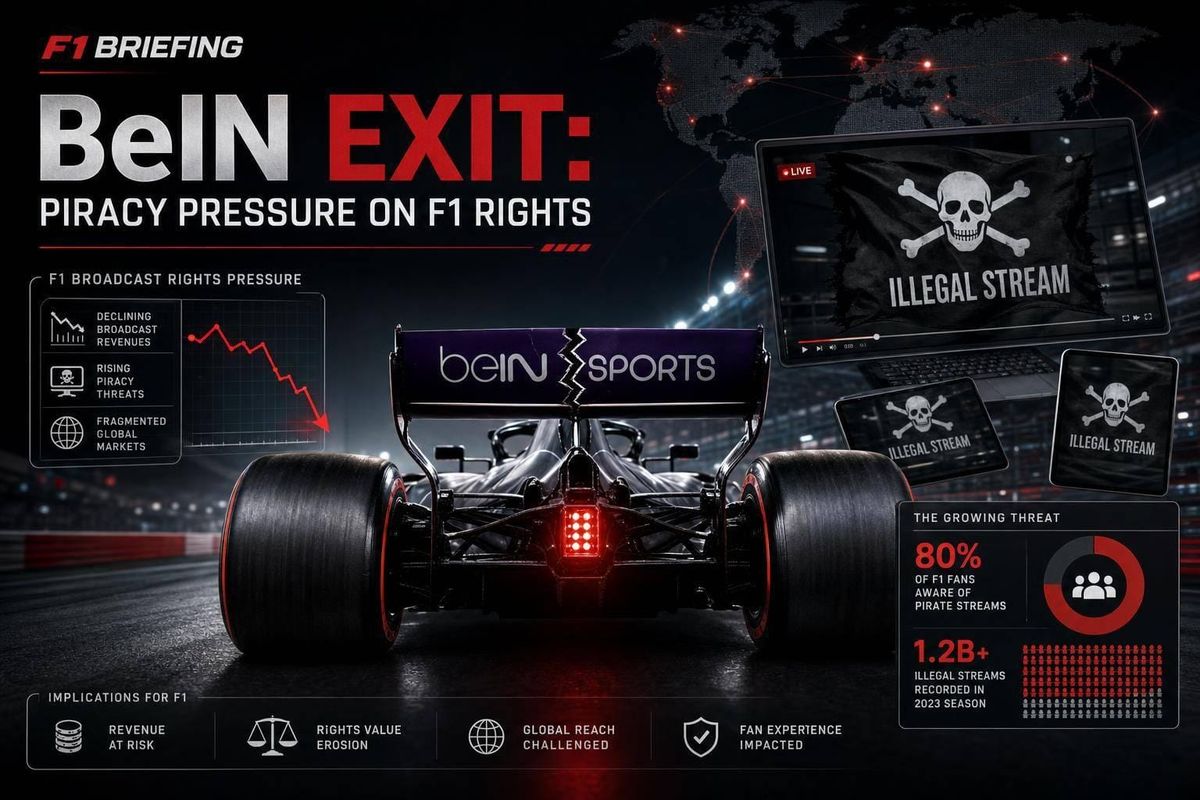
Piracy cut into the value of F1 rights in MENA by breaking exclusivity. My take is simple: when fans can watch a live race for free through illegal streams, a paid broadcaster has a harder time keeping subscribers, bidding high, or locking in long deals.
Here’s the article in plain English:
- BeIN’s old pitch weakened: it paid for exclusive F1 access, but illegal feeds made that access less exclusive in practice.
- Live sports get hit the hardest: an F1 race is worth the most while it is happening. If a live feed leaks, the money lost at that moment is gone.
- Rights prices changed: when exclusivity became harder to protect, bids fell and deal terms got tighter.
- Risk changed negotiations: in markets with weak enforcement, buyers tend to want shorter terms and more control.
- F1 changed its setup: in 2023, Formula One Management took over full broadcast-feed production, which gave it more control over the source signal.
- The market reset in 2024: F1 and beIN signed a new 10-year exclusive deal across 25 MENA territories and Turkey through 2033.
- The big lesson: rights are not priced on audience alone. They are also priced on how well the feed can be protected.
Quick Comparison
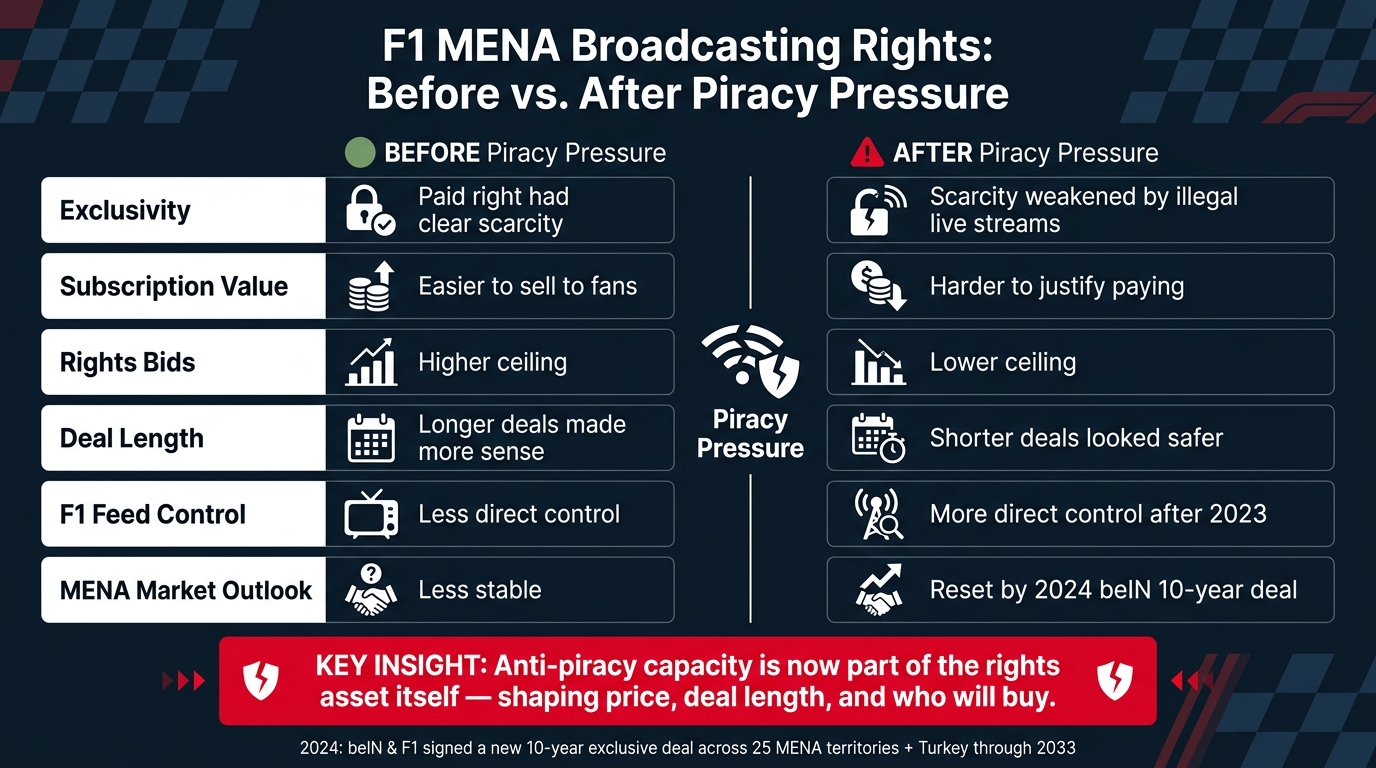
F1 MENA Rights: Before vs. After Piracy Pressure
| Topic | Before piracy pressure hit | After piracy pressure hit |
|---|---|---|
| Exclusivity | Paid right had clear scarcity | Scarcity weakened by illegal live streams |
| Subscription value | Easier to sell to fans | Harder to justify paying |
| Rights bids | Higher ceiling | Lower ceiling |
| Deal length | Longer deals made more sense | Shorter deals looked safer |
| F1 control over feed | Less direct control | More direct control after 2023 |
| MENA market outlook | Less stable | Reset by 2024 beIN deal |
What I take from this case is clear: anti-piracy strength is now part of the rights package itself. In MENA, that can shape price, term length, and who is willing to buy.
sbb-itb-7c68254
How piracy broke the MENA rights model
The main hit wasn't only lost viewers. It was the loss of scarcity.
The pay-TV sports model rests on a simple idea: fans pay because they can't get the event anywhere else. In MENA, beoutQ wiped out that scarcity by redistributing BeIN's live Formula 1 feeds across the region without authorization. Once fans could watch for free, BeIN's exclusive Formula 1 package lost value fast. And once that happened, the case for paying to renew those rights got much weaker.
beoutQ and the collapse of pay-TV sports scarcity
The key asset was scarcity, not just audience size.
When beoutQ broke controlled access, the package lost its leverage because it no longer decided who could watch. That changed the economics right away. Subscription revenue dropped, and the rights stopped working like a protected paid product.
Why piracy hits live sports harder than other content
Live sports take the hit harder because their value is tied to a very small window: the event happening right now.
A Formula 1 race loses most of its commercial value after the checkered flag. So illegal streaming during the live broadcast creates damage that is immediate and permanent. You don't get that time back. That's why F1 rights are so exposed to cross-border illegal streaming in a way on-demand content isn't.
That loss of scarcity then fed straight into renewal pricing and deal terms.
How piracy changed F1 rights pricing and deal terms
Once exclusivity stops meaning much in practice, bids drop. It’s pretty simple: broadcasters can’t charge a premium for scarcity if fans can get the same live race through illegal streams.
Why unprotected exclusivity leads to lower bids
A broadcaster’s subscription pitch rests on one basic idea: you can’t watch this anywhere else.
That pitch starts to crack when illegal feeds are easy to find during live races in MENA. At that point, the broadcaster loses part of what makes a paid subscription worth the money. As Nicola Charalambidou of the University of Sydney notes, viewer willingness to pay depends on perceived value. If fans can watch a Grand Prix for free through an unauthorized stream, renewals get weaker, bid ceilings come down, and rights holders lose leverage.
How rising partner risk changes negotiation terms
Piracy doesn’t just cut the price. It also changes the shape of the deal.
When exclusivity looks shaky in MENA, broadcasters tend to ask for shorter terms and tighter control over distribution. F1 Management tightened control of the world feed in 2023 to cut distribution risk. You can see the difference more clearly in markets with less piracy, where exclusivity still backs long-term pricing. Sky Sports, for example, signed a £1 billion exclusive UK and Ireland deal in May 2026 through 2034.
In markets with heavy piracy, a smaller deal that can actually be enforced may hold more value than a bigger offer built on weak exclusivity.
That shift in bargaining power helps explain why F1 and BeIN later rebuilt the deal in 2024.
Why F1 and BeIN rebuilt their deal in 2024
In 2024, Formula 1 and beIN Media Group signed a new 10-year exclusive deal covering 25 MENA territories and Turkey through 2033. This wasn't just another rights renewal. It was a response to a market that had been shaken by piracy. The main story here isn't only the length of the deal. It's what that length says: confidence in exclusivity came back once enforcement looked more believable.
What a 10-year return says about resetting the market
The deal came after a stretch of instability, with MBC Action and Shahid/SSC holding interim rights from 2019 to 2023. That stopgap period showed the market was still trying to find its footing.
Adding Turkey to the package matters too. A bigger regional bundle gives the rights holder more commercial scale and cuts down on fragmentation. Put simply, it's easier to sell and manage a larger, more unified block than a patchwork of smaller ones.
Exclusivity restored, but with clear lessons attached
Formula One Management's 2023 takeover of full broadcast-feed production gave it tighter control over the source signal and lowered redistribution risk. That change carries weight beyond this one deal. In MENA, anti-piracy strength isn't just a back-end concern anymore. It's part of what buyers are paying for when they buy the rights package.
This reset also makes another divide pretty clear: F1 rights in MENA still come with piracy risk that lower-risk markets don't carry. That's why MENA can't be priced the same way as cleaner, better-enforced F1 markets.
What the BeIN case means for other F1 rights markets
MENA versus lower-risk regions: why the same rights price differently
The BeIN reset points to a bigger lesson in the F1 media business: rights are priced based on enforcement, not just audience size.
You can see that most clearly when MENA is stacked against lower-risk regions. In more secure markets, broadcasters can charge hard for exclusivity. In markets with heavy piracy, they cut that math down to size and prefer shorter deals.
It’s pretty simple. When exclusivity holds, broadcasters will pay for scarcity. When that exclusivity leaks, they pay less for the same feed. If a big chunk of the audience can watch through illegal streams, fewer fans sign up and pay for subscriptions. And when fewer people pay, bids drop.
That’s also why deal length changes by market. Where enforcement is stronger, long-term agreements can still make sense. Where enforcement is weak, broadcasters usually want shorter terms and less exposure.
Conclusion: anti-piracy capacity is now part of the rights asset
Piracy doesn’t just hurt revenue around the edges. It changes the rights asset itself.
When signal protection is weak, enforceable exclusivity starts to lose its commercial meaning. Bids fall. Renewal talks get tougher. The same package of rights can end up worth less, not because fans care less, but because protection around the product is weaker.
Going forward, F1 rights talks will need to weigh a partner’s anti-piracy capacity alongside audience size and revenue potential. In F1 rights, anti-piracy capacity is part of the asset.
FAQs
Why does piracy lower F1 rights prices?
Piracy pushes down F1 broadcasting rights prices because it adds more risk and chips away at the audience. If unauthorized streams are easy to find, exclusive paid packages lose some of their appeal. Broadcasters can’t count on the reach or subscription growth they expected to buy.
That puts pressure on rights holders to rethink both pricing and distribution. This hits especially hard in regions where streaming is still less developed and expensive broadcast deals are still a main source of revenue.
Why are live F1 races hit harder by piracy?
Live F1 races are especially open to piracy because their value depends on real-time viewing. If fans can’t watch the race as it happens, a big part of the appeal is gone. That puts broadcasters under a lot of pressure to protect their exclusive rights.
Live coverage is also a premium product. It’s built around centralized feeds and detailed race data, which makes the official broadcast feel like the main event. But when access is limited, or the subscription price feels too high, unauthorized streams can start to look like a fallback for fans who still want to watch the race live.
What changed in the 2024 F1-beIN deal?
The available search results do not mention a 2024 F1-beIN deal or any specific changes tied to it.
Instead, they point to Formula 1’s broader shift in digital media, the planned 2026 move to exclusive U.S. broadcasting on Apple TV, and earlier contract updates involving other broadcasters like Sky Sports and Channel 4.